About 67 results
 06:33
06:33Sofia as a Fintech and Onchain Hub | Ivan Goychev, Sofia Municipality | Future Finance Forum 2026
ETHSofiaOct 6, 2026
Ivan Goychev of Sofia Municipality recalls his start as a software engineer in fintech, from portfolio management software for private equity, with one project for Goldman Sachs, to an algorithmic trading start-up that traded on news sentiment. He cites FinAnalytica, LimeChain, Nexo and Robinhood founder Vlad Tenev as proof of Bulgarian talent on the global stage. He presents the city as a platform for builders, offering open data, real use cases, marketing and 1.3 million residents as potential clients, while leaving laws and regulation to the national government and the European Parliament. He floats tokenising city assets and paying citizens in real time for micro-jobs that improve their neighbourhoods, and invites companies to partner with the municipality. Official Opening at Future Finance Forum 2026, 25 September 2026, Sofia. Part of Blockchain Week Bulgaria 2026. Speaker ▸ Ivan Goychev, Deputy Mayor for Digitalisation and Information Systems Ivan Goychev, Deputy Mayor for Digitalisation of Sofia, has 25 years of leadership experience, including managing global teams at Amazon Web Services (AWS) and serving as CTO of FinTech, TravelTech and ConstructionTech startups. He also supports open-source initiatives like Podkrepi.bg. LinkedIn: https://linkedin.com/in/igoychev Chapters 00:00 From fintech engineer to deputy mayor 01:47 Bulgarian fintech and blockchain talent 03:12 The city as a platform: open data and 1.3 million clients 04:02 Tokenising city assets and micro-jobs 05:06 An invitation to partner with Sofia Municipality 06:20 Closing titles Blockchain Week Bulgaria: https://www.blockchainweek.bg ETHSofia: https://www.ethsofia.com Future Finance Forum: https://www.blockchainweek.bg/f3 Follow Blockchain Week Bulgaria X: https://x.com/BWBulgaria LinkedIn: https://www.linkedin.com/company/blockchain-week-bulgaria Follow ETHSofia X: https://x.com/EthSofiaBG LinkedIn: https://www.linkedin.com/company/ethsofia Telegram: https://t.me/+b-33LJUpAB5iODNk Nothing in this video is financial advice. About the organiser Blockchain Week Bulgaria, ETHSofia and the Future Finance Forum are organised by the Bithope Foundation, founded in 2014 by Vladislav Dramaliev. Inspired by Andreas Antonopoulos, it is Europe's first non-profit operating exclusively with bitcoin donations. Over more than ten years, it has supported 50+ charitable campaigns, and in January 2016 it co-founded the Sofia Crypto Meetup, now the region's longest-running monthly crypto event. https://bithope.org
 26:36
26:36Stablecoins for Euro Payments: Private Rails and the Road to Adoption | Future Finance Forum 2026
ETHSofiaOct 6, 2026
With Bozhena Bozhilova (Bulgarian Fintech Association, moderator), Andrey Sirakov (Commerzbank AG), Bernie Niebsch (BVNK) and Eduardo Morrison (Schuman Financial). Moderated by Bozhena Bozhilova, the panel asks where euro stablecoins are finding real business use. Eduardo Morrison says Schuman Financial grew through B2B flows for fintechs in Africa and Latin America, reaching 150 million euros of payment volume in August, and is testing atomic settlement against tokenised money market funds with banks in Spain. Andrey Sirakov describes corporate demand as pragmatic, expects banks to combine permissioned networks and tokenised deposits, which Commerzbank AG is exploring, with public stablecoins, and lists the custody, audit and wallet-level compliance controls a bank needs first, while Bernie Niebsch argues that SEPA Instant works well and that SWIFT is where the pain lies. Looking five years ahead, the speakers expect stablecoins to run invisibly in the background. Panel at Future Finance Forum 2026, 25 September 2026, Sofia. Part of Blockchain Week Bulgaria 2026. Speakers ▸ Bozhena Bozhilova, Director, Bulgarian Fintech Association (moderator) Bozhena Bozhilova is Director of the Bulgarian Fintech Association, where she has spent three years advancing Bulgaria's fintech ecosystem across 15 verticals, including crypto, payments, and lending. She led an EU-wide digital bond platform project for SMEs and drives regulatory engagement between industry, institutions, and regulators. ▸ Andrey Sirakov, Senior Business Analyst, Commerzbank AG Andrey Sirakov is a Senior Business Analyst at Commerzbank AG, where he contributes to the development of institutional‑grade crypto custody solutions and supports the secure integration of blockchain technology into established banking infrastructure. He brings more than a decade of hands‑on experience in Web3 technologies. LinkedIn: https://www.linkedin.com/in/andrey-sirakov ▸ Bernie Niebsch, Enterprise Product Specialist, BVNK Bernie has 20 years in IT, with 14 in payments product management. Now based in Sofia, he has lived in Germany, Canada, Australia, and the UK. His extensive payments background spans consumer/business products, operations, risk, mobile, and APIs. LinkedIn: https://linkedin.com/in/bernhard-niebsch ▸ Eduardo Morrison, Co-Founder and Chief Business Officer, Schuman Financial Eduardo Morrison is Co-Founder & Chief Business Officer at Schuman Financial, where he leads strategic partnerships and the ecosystem around EURØP. Active in digital assets since 2017, he was an early team member at IntoTheBlock and previously led institutional clients for Europe and Latin America at Binance. LinkedIn: https://www.linkedin.com/in/eduardomorrison Chapters 00:00 Introduction 00:52 Where the demand for euro stablecoins is 03:08 How corporate clients view stablecoins 06:07 SEPA, SWIFT and the pain points of switching rails 08:36 Private and public rails: the role of banks 11:44 Use case: paying contractors across borders 13:05 Use case: stablecoins and tokenised money market funds 14:47 Security and compliance standards for banks 17:34 Safeguarding reserves, minting and redemption 19:21 Security as culture 20:56 B2B payments five years from now 24:44 Q&A: Is SWIFT being weaponised? Blockchain Week Bulgaria: https://www.blockchainweek.bg ETHSofia: https://www.ethsofia.com Future Finance Forum: https://www.blockchainweek.bg/f3 Follow Blockchain Week Bulgaria X: https://x.com/BWBulgaria LinkedIn: https://www.linkedin.com/company/blockchain-week-bulgaria Follow ETHSofia X: https://x.com/EthSofiaBG LinkedIn: https://www.linkedin.com/company/ethsofia Telegram: https://t.me/+b-33LJUpAB5iODNk Nothing in this video is financial advice. About the organiser Blockchain Week Bulgaria, ETHSofia and the Future Finance Forum are organised by the Bithope Foundation, founded in 2014 by Vladislav Dramaliev. Inspired by Andreas Antonopoulos, it is Europe's first non-profit operating exclusively with bitcoin donations. Over more than ten years, it has supported 50+ charitable campaigns, and in January 2016 it co-founded the Sofia Crypto Meetup, now the region's longest-running monthly crypto event. https://bithope.org
 17:49
17:49Retail Banking, Built Onchain | Joao Alves at Pragma Lisbon 2026
ETHGlobalSep 9, 2026
Joao Alves, Co-Founder of Bleap, explains what it takes to build a retail bank onchain and why blockchain infrastructure can improve both product speed and global availability. He highlights permissionless deployment, global reach, direct settlement, and composability with existing DeFi building blocks. Compared with a traditional bank’s web of providers and proprietary APIs, an onchain product can combine wallets, swaps, yield, and payments more quickly, while still choosing carefully between custodial and unhosted architectures. Alves grounds the comparison in product decisions made while building Bleap. An unhosted wallet can reduce intermediary risk and connect to DeFi protocols directly, but the team still must solve account recovery, regulatory controls, card integration, fiat access, and support. Custodial systems can simplify some interactions while creating a different operational and trust model. He argues that builders should choose architecture based on the customer experience they want to deliver rather than treating custody as an ideological decision. Alves also examines the obstacles that determine whether these benefits reach everyday users. Fiat onramps, card top-up fees, fragmented liquidity, poor user experience, regulatory obligations, and thin markets for tokenized assets can erase the advantages of the underlying technology. He points to stablecoins and cross-border transfers as a strong near-term use case: payments that currently cost two to three percent and take a day can settle in seconds. The broader opportunity is to deliver familiar, low-friction banking products while letting users benefit from programmable assets and open financial infrastructure. He evaluates savings, payments, remittances, cards, and tokenized investments through a retail lens. Consumers will not accept paying two percent every time they add money, managing gas across several chains, or understanding bridges and chain mechanics. Stablecoins are valuable when the product hides those mechanics and delivers a clear improvement over existing services. Cross-border transfers between Portugal and Brazil illustrate the opportunity, while weekend pricing for tokenized stocks illustrates what still needs work. 00:00 Introduction to Retail Banking Onchain 00:28 Joao Alves and the Bleap Product 01:27 Global Expansion for Financial Apps 02:01 Noncustodial Deployment Advantages 02:23 Composability With DeFi Building Blocks 02:46 Open Finance Versus Vendor Contracts 03:16 Onchain Network Effects 04:03 Savings, Investing, and Payments Onchain 04:57 Custodial Versus Noncustodial Design 05:48 Regulatory Benefits of Unhosted Wallets 06:05 Efficient Settlement and Treasury Flows 06:28 Connecting Wallets to Swaps and Yield 06:42 Do Not Outsource Complexity to Users 07:05 Keys, Recovery, and Crypto Jargon 07:32 Hiding Chains, Gas, and Slippage 08:00 Account Abstraction and Paymasters 08:23 The Fiat Onramp Experience 08:41 Why Retail Users Reject Top-Up Fees 09:03 Bleap OTC and Stablecoin Conversion 09:23 Moving Beyond Tab-Based Wallet UX 10:10 Retail Banking Opportunities 10:33 DeFi Yield for Bank Deposits 11:17 Retail Demand for Better Savings Rates 12:03 Stablecoin Currency Coverage Gaps 12:41 The Instant Remittance Opportunity 13:09 Portugal and Brazil Transfer Costs 14:17 Tokenized Stocks and Global Markets 15:08 Licensing and Liquidity Barriers 15:50 Instant Merchant Payments 17:02 Blockchain Versus Card Networks 17:29 Closing Vision for Onchain Banking _ _ _ _ _ _ _ _ _ _ _ _ _ _ _ _ _ _ _ _ 🇵🇹 *Pragma Lisbon 2026* Pragma Lisbon 2026 was held on June 25th at the Carlos Lopes Pavillion in Lisbon, Portugal and was an in-person summit for builders and leaders in the web3 ecosystem. Watch the full Pragma Lisbon 2026 YouTube Playlist here: https://www.youtube.com/playlist?list=PLMxB4xW8JYdk ETHGlobal's Pragma series takes place in cities around the world, and is designed to be a different kind of event. Pragma is a one-stage conference with founders-only on stage, bringing together a small group of curated attendees and speakers to discuss the future of web3 and reflect on the past. _ _ _ _ _ _ _ _ _ _ _ _ _ _ _ _ _ _ _ _ ✅ Follow Joao Alves X: https://x.com/JoaoAlvesDotETH ✅ Follow Bleap X: https://x.com/BleapApp ✅ Follow ETHGlobal X: https://x.com/ETHGlobal Warpcast: https://warpcast.com/ethglobal Website: https://ethglobal.com YouTube: https://www.youtube.com/@UCfF9ZO8Ug4xk_AJd4aeT5HA _ _ _ _ _ _ _ _ _ _ _ _ _ _ _ _ _ _ _ _ Are you interested in Ethereum development and entrepreneurship? 👉 Sign up for the next ETHGlobal event: https://ethglobal.com/events 🎁 Get exclusive access and perks with ETHGlobal Plus! https://ethglobal.com/plus 📣 Want us to throw an event in your city? Tell us where! https://ethglobal.com/city
 18:12
18:12Modern money management with Privy I Andrew Warner, Meghna Mehta
ETHGlobalAug 9, 2026
In this workshop at ETHGlobal New York 2026, Meghna Mehta and Andrew Warner from Privy present updated interfaces for modern money management and movement, plus the hackathon bounties. Meghna, a product manager who came from mining and years at Coinbase, and Andrew, a forward deployed engineer and former Privy customer who started in finance at BlackRock, introduce Privy as secure, scalable wallet infrastructure that lets you spin up embedded wallets in applications or server-side payments infrastructure. Privy has over 2,000 applications and 120 million users and processes around $15 billion a month in stablecoin and native currency transfers. They highlight three recently launched products: deposit addresses, Privy Earn, and an agent CLI. Andrew details the agent CLI and its skill, which gives Claude and Codex agents complete access to Privy's SDKs and APIs to fund wallets, send transactions, and sign messages while the developer stays in the loop controlling funding and access. Agents authenticate into an embedded wallet through a short-lived, per-transaction ephemeral signing key that can be revoked anytime, with policies to prevent malicious behavior or draining. Meghna covers deposit addresses (launched two weeks earlier): persistent per-user EVM addresses that let anyone send any asset on any chain, automatically bridging and swapping to a single canonical token on a canonical chain with no KYC or verification flows and broad asset support. She then covers Privy Earn, a simplified interface to leading on-chain yield providers like Morpho, letting you deposit, withdraw, and track balances via a single API call, with spending out of the balance coming later. She frames Privy as building financial infrastructure where wallets are just a starting point. In a long Q&A, they share exciting builders (Deel's stablecoin accounts paying contractors in Argentina with yield via a Morpho vault, and Ramp's business accounts), discuss potentially integrating ENS for easier send destinations, custom Earn partnerships, and the technical side of their roughly 20-millisecond server-side signing latency (down from 100), achieved by moving from client-side key reconstitution to a secure AWS Nitro Enclave with websocket infrastructure, parallelized pre-checks, and global regional coverage. They also explain Shamir secret sharing (splitting keys into shards reconstituted in memory then destroyed) and a bring-your-own-cloud option for institutional customers, and note Privy supports over 40 EVM and SVM chains. 00:00 Introduction 00:11 Meet Meghna and Andrew 00:56 What Is Privy 01:15 Privy by the Numbers 01:37 The Three Newly Launched Products 01:57 Introducing Privy Earn 02:22 The Agent CLI 02:44 How Agent Wallets Work 03:23 Staying in the Loop With Policies 03:47 Ephemeral Per-Transaction Signing Keys 04:06 How the Skill File Empowers Agents 04:26 Deposit Addresses Explained 04:41 Persistent Per-User Addresses 05:02 Automated Bridging and Swapping 05:23 No KYC and Universal Asset Support 05:54 Embedded Yield With Privy Earn 06:17 A Simplified Interface to Yield Providers 06:37 Deposit, Withdraw, and Track Balances 06:54 Why Wallets Are Just the Starting Point 07:17 Q&A: The Most Exciting Projects 08:01 How Deel Powers Global Stablecoin Accounts 09:05 How Ramp Uses Privy for Businesses 09:32 Q&A: Integrating ENS 10:38 Q&A: Custom Earn Integrations 11:19 Q&A: What the 20ms Latency Means 12:00 Moving to Server-Side Signing 12:39 What the 20 Milliseconds Covers 13:23 How Websockets and Enclaves Cut Latency 14:03 Global Regional Coverage 14:23 Q&A: Shamir Secret Sharing 15:42 How Key Shards Are Reconstituted 16:06 Bring Your Own Cloud for Key Storage 16:28 Q&A: How Many Chains Are Supported 17:36 Closing _ _ _ _ _ _ _ _ _ _ _ _ _ _ _ _ _ _ _ _ *ETHGlobal New York 2026* This workshop is specifically for ETHGlobal New York 2026, a 3-day hackathon held June 12-14 at the Metropolitan Pavilion, bringing together the most skilled web3 developers, designers and product builders from all around the globe for a weekend-long adventure to advance the Ethereum ecosystem! Watch the full ETHGlobal New York 2026 playlist here: https://www.youtube.com/playlist?list=PLXzKMXK2aHh7MZ8T-ict6YshkFDw9WJCu _ _ _ _ _ _ _ _ _ _ _ _ _ _ _ _ _ _ _ _ ✅ *Follow ETHGlobal* X: https://x.com/ETHGlobal Website: https://ethglobal.com YouTube: https://www.youtube.com/c/ETHGlobal _ _ _ _ _ _ _ _ _ _ _ _ _ _ _ _ _ _ _ _ _Are you interested in Ethereum development and entrepreneurship?_ 👉 Sign up for the next ETHGlobal event: https://ethglobal.com/events 🎁 Get exclusive access and perks with ETHGlobal Plus! https://ethglobal.com/plus 📣 Want us to throw an event in your city? Tell us where! https://ethglobal.com/city _ _ _ _ _ _ _ _ _ _ _ _ _ _ _ _ _ _ _ _
 14:12
14:12Mark Tyneway
Fireside Chat with Optimism Co Founders Jing Wang and Mark Tyneway at ETHConf
ETHGlobalJul 9, 2026
In this fireside chat, Optimism co-founders Mark Tyneway and Jing Wang take the stage to address rumors of Optimism's demise, defend the L2 thesis, and preview what's shipping next. They open by joking about Jing's intense treasury management discipline (Mark slept in a tent on the roof of the office for two years) confirming Optimism has years of runway. On the broader L2 sentiment, they reject the narrative that L2s are interested in forking away to become L1s, with Jing explaining that despite frustration with shipping speed inside the EF, Optimism continues to choose Ethereum L1 as its DA because of the properties it offers. They both express strong support for the controversial CROPS roadmap (censorship resistance, capture resistance, open source, privacy, security), arguing the backlash was more about communication than content. Mark and Jing share lessons from Optimism's own struggles with decentralized development during the token pump era, which made every idea feel like a good one. They remerged all companies back into one entity and have shipped more in the last six months than the previous two and a half years combined. They argue Ethereum needs quantifiable success metrics to unify the community, and float the idea of building the largest anonymity set in crypto larger than Zcash. The conversation pivots to enterprise demand for L2s, with Jing explaining their sequencer policy work as the strongest form of compliance: institutions can stake tokens for top of block access, halt trading of equity tokens at the sequencer level across all DeFi protocols simultaneously, and avoid concerns about sanctioned validators processing their transactions. They preview the long awaited reduction of withdrawal windows from 7 days to 1 day, work with privacy partners on private contracts and transfers, and confirm Optimism is hiring with new feature announcements every two weeks. 00:00 Introduction 00:11 Addressing Rumors That Optimism Is Dead 00:40 Treasury Discipline and the Tent on the Roof 01:10 L2s Forking Away to Become L1s 01:37 Why Optimism Stays on Ethereum L1 02:10 Supporting the Controversial CROPS Roadmap 02:38 What CROPS Actually Stands For 03:11 Communication Was the Problem, Not the Content 03:42 Optimism's Own Struggles with Decentralized Development 04:08 Remerging Into One Company 04:27 Gelatinous Cheeks and Growing Up in Crypto 05:01 Why Zcash Gets Love for the Same Roadmap 05:30 Ethereum Needs Quantifiable Success Metrics 06:05 ETH as Money vs Bitcoin 06:35 Building the Largest Anonymity Set in Crypto 07:00 Institutions Still Prefer Ethereum for Trustlessness 07:23 L2 Pedantry vs Real UX Impact 07:55 Sequencer Policies as the Strongest Form of Compliance 08:39 Trading Halts Across All DeFi Protocols at Once 09:39 Why L1 Will Never Match L2 Customization 10:58 Why a Single Sequencer Is a Superpower 11:31 Avoiding Sanctioned Validators on Your Network 12:03 Smart Contract Logic as Sequencer Policy 12:29 Reducing the Withdrawal Window From 7 Days to 1 12:55 From Hoodies to Suits 13:17 Closing: Optimism Is Not Dead _ _ _ _ _ _ _ _ _ _ _ _ _ _ _ _ _ _ _ _ *ETHConf 2026* ETHConf is a 3 day event for founders, industry leaders, and builders who are excited about the possibilities of building on top of Ethereum. Connect with 2,000+ top innovators in crypto, finance, technology, and policy at our inaugural three-day event packed with showcases, demos, partnerships, and conversations shaping the future of the global economy. _ _ _ _ _ _ _ _ _ _ _ _ _ _ _ _ _ _ _ _ ✅ *Follow ETHConf* X: https://x.com/ethconf Website: https://ethconf.com _ _ _ _ _ _ _ _ _ _ _ _ _ _ _ _ _ _ _ _ 🎟️ Get your early bird tickets for ETHConf 2027: https://ethconf.com/2027#tickets 🎤 View the full ETHConf 2026 Speaker Schedule: https://ethconf.com/schedule _ _ _ _ _ _ _ _ _ _ _ _ _ _ _ _ _ _ _ _
 20:42
20:42Kartik Talwar
Fireside Chat with Nemil Dalal (Y Combinator) and Kartik Talwar (ETHGlobal) at ETHConf
ETHGlobalJul 9, 2026
In this fireside chat, Kartik Talwar sits down with Nemil Dalal, visiting partner at Y Combinator and former head of Coinbase's developer platform, to discuss the early days of USDC, the current state of crypto startups, and what YC is looking for from founders. Nemil walks through how he spent seven years at Coinbase leading USDC from launch in 2018, when many in crypto circles thought stablecoins were the wrong vision and Bitcoin should replace everything. He pushed against two early strategies that didn't fit Coinbase's positioning as a US based regulated company: chasing high yield Asian markets where Tether dominated, and selling to banks that only knew about Bitcoin and saw stablecoins as a beta dollar. The breakthrough insight was bootstrapping DeFi adoption through the USDC Bootstrap Fund, deploying capital into Uniswap, Aave (then EthLend), DyDx, and other early protocols. Nemil shares how YC funds about 100 crypto startups today and expects to 10x that in the next decade, since crypto is moving from a niche DGen product to something most Americans will use without realizing. He outlines what YC is excited about: stablecoins and the businesses built on top, tokenized assets including equities and debt, and AI plus crypto including X2X (which Nemil's team launched at Coinbase). He shares his controversial view that founders should launch fewer tokens, since most are incentive tokens that act like marketing schemes attracting mercenary users and worsening UX, while reserving tokens for L1s, L2s, and DeFi protocols where decentralization is genuinely core to the product. On regulation, he tells the story of Coshi spending three years suing the CFTC and winning, framing regulation as either go regulation forward and specialize per country, or follow the Binance playbook offshore first. He closes urging founders to combine crypto with AI thoughtfully and pointing to the rolling YC application deadline. 00:00 Introduction 00:08 Nemil's Background and Homecoming to Ethereum 01:08 Launching USDC at Coinbase in 2018 02:26 Why Stablecoins Were Controversial in Crypto Circles 02:41 Two Bad Early Strategies: Asia Yield and Banks 03:41 The Breakthrough: Bootstrapping DeFi 03:58 Maker DAO, Compound, and Early DeFi Signals 04:23 Launching the USDC Bootstrap Fund 05:10 Nemil's Role as Visiting Partner at Y Combinator 05:38 What YC Offers Founders 06:20 Funding 100+ Crypto Startups and 10x'ing the Pace 07:00 Why Bear Markets Are the Best Time to Build 07:32 Tourists vs Real Builders 07:50 Why ETH Global Hackathon Attendance Correlates Inversely with Price 08:46 What YC Is Looking to Fund in 2026 09:04 Stablecoins and Stablecoin Neo Banks 09:51 Tokenized Stocks, Debt, Equity, and Emerging Markets 10:12 X2X and the AI Plus Crypto Opportunity 10:50 Agentic Finance May Be Agnostic to Crypto vs Credit Cards 11:33 YC's Mindset: Make Something People Want 12:14 Where Is the Saturated Space in Crypto Startups 12:38 Common Patterns: Dev Tools, On Off Ramps, Wallets 13:08 Prediction Markets and Crypto as Core Stack 13:25 Should Founders Launch a Token 14:10 Incentive Tokens as a Marketing Scheme 14:48 Tokens Often Hurt User Experience 15:19 Where Tokens Genuinely Make Sense: L1s, L2s, DeFi 16:05 Solving Pain Points, Not Decentralizing for Its Own Sake 16:36 How Founders Should Think About Regulation 17:01 The Coshi Story: Suing the CFTC and Winning 17:39 Regulation Forward vs Binance Playbook 18:43 Onshore vs Offshore Based on Product Type 19:00 How to Apply to YC and Reach Nemil 19:35 The Magic of Crypto and AI Coming Together 20:33 Closing _ _ _ _ _ _ _ _ _ _ _ _ _ _ _ _ _ _ _ _ *ETHConf 2026* ETHConf is a 3 day event for founders, industry leaders, and builders who are excited about the possibilities of building on top of Ethereum. Connect with 2,000+ top innovators in crypto, finance, technology, and policy at our inaugural three-day event packed with showcases, demos, partnerships, and conversations shaping the future of the global economy. _ _ _ _ _ _ _ _ _ _ _ _ _ _ _ _ _ _ _ _ ✅ *Follow ETHConf* X: https://x.com/ethconf Website: https://ethconf.com _ _ _ _ _ _ _ _ _ _ _ _ _ _ _ _ _ _ _ _ 🎟️ Get your early bird tickets for ETHConf 2027: https://ethconf.com/2027#tickets 🎤 View the full ETHConf 2026 Speaker Schedule: https://ethconf.com/schedule _ _ _ _ _ _ _ _ _ _ _ _ _ _ _ _ _ _ _ _
 26:34
26:34Fireside Chat with Hayden Adams (Uniswap Labs) and Camila Russo (The Defiant) at ETHConf
ETHGlobalJul 9, 2026
In this fireside chat, Camila Russo from The Defiant sits down with Hayden Adams, founder of Uniswap, to discuss the current state of DeFi, the recent Unification proposal, regulation, RWAs, perps, and what's next for Uniswap V4. Hayden frames the current moment as a pivotal one where DeFi is being integrated into mainstream finance through Coinbase, Robinhood, Deel, and traditional fintechs, while simultaneously facing a wave of security exploits driven by smarter AI tooling like Claude finding vulnerabilities in poorly written contracts. He sleeps well at night because Uniswap V3 underwent nine consecutive audits with a $15 million bounty, processes over a trillion dollars per year, and has never been exploited. He argues AI tooling will ultimately harden DeFi contracts to a far greater extent, and the projects that survive will be the ones that removed off chain dependencies and single points of failure. Hayden discusses the Unification proposal approved in December that consolidated foundation work into Labs and gradually rolled out fee switches, including a recent all time high single day burn of 186,000 UNI (about $500K) with V4 fees still not yet activated. He acknowledges the UNI token price disconnect from the burn but attributes this to general crypto market correlation, expecting fundamental value to assert itself over time. On regulation, Hayden explains how the shift from the Gensler era of regulation by enforcement has already done much of the work by removing the chilling effect, and the BRCA software developer protections are the key piece he'd want enshrined in any market structure bill. He outlines how Uniswap fits into RWAs and tokenization through the internet analogy (existing assets going onchain plus crypto native assets), differentiates Uniswap's neutral spot infrastructure approach from Hyperliquid's exchange as a product approach, and previews V4 hooks being built internally to optimize for stablecoins (where Uniswap has overtaken Curve as the dominant venue), yield bearing assets, RWAs, and volatile assets, plus a focus on issuer side tools and developer API integrations. 00:00 Introduction 00:08 DeFi at a Pivotal Mainstream Adoption Moment 01:35 Why Exploits Are Surging: AI Tooling Finds Bugs 02:22 Test in Production Mentality Doesn't Work Anymore 02:46 How V3 Survived: Nine Audits and a $15M Bounty 03:31 Launching a New Version Like Launching a Rocket 03:53 DeFi Ultimately Enables Safer Applications 04:24 Off Twitter, Adoption Is the Best It's Ever Been 05:15 DeFi Will Come Out Stronger From This Stress Test 06:29 The Unification Proposal Six Months In 07:38 Gradual Fee Switch Rollout and Sensitivity Testing 08:18 All Time High Single Day Burn of 186,000 UNI 09:00 The UNI Token Price Disconnect From Burn 10:39 Fundamental Value Will Assert Itself Over Time 10:56 Regulation: From Gensler Era to New Posture 11:53 The Chilling Effect That Held Back Integration 13:14 BRCA and Software Developer _ _ _ _ _ _ _ _ _ _ _ _ _ _ _ _ _ _ _ _ *ETHConf 2026* ETHConf is a 3 day event for founders, industry leaders, and builders who are excited about the possibilities of building on top of Ethereum. Connect with 2,000+ top innovators in crypto, finance, technology, and policy at our inaugural three-day event packed with showcases, demos, partnerships, and conversations shaping the future of the global economy. _ _ _ _ _ _ _ _ _ _ _ _ _ _ _ _ _ _ _ _ ✅ *Follow ETHConf* X: https://x.com/ethconf Website: https://ethconf.com _ _ _ _ _ _ _ _ _ _ _ _ _ _ _ _ _ _ _ _ 🎟️ Get your early bird tickets for ETHConf 2027: https://ethconf.com/2027#tickets 🎤 View the full ETHConf 2026 Speaker Schedule: https://ethconf.com/schedule _ _ _ _ _ _ _ _ _ _ _ _ _ _ _ _ _ _ _ _
 19:58
19:58Stani Kulechov
Building Credit Markets at Internet Speed | Stani Kulechov (Aave) at ETHConf
ETHGlobalJul 9, 2026
In this talk, Stani Kulechov, founder and CEO of Aave, frames credit as the last great frontier of the internet revolution and explains why Ethereum is uniquely positioned to solve it. Drawing on his pre-Aave experience running a fintech startup focused on receivables, Stani argues that while the internet transformed information, commerce, and communications into global systems, credit remains stubbornly local due to coordination problems across lenders, borrowers, intermediaries, localized regulation, and siloed capital. This fragmentation creates capital inefficiencies, regional interest rate discrepancies, and lost opportunities, particularly relevant today as credit historically backed industrial revolutions and will fund the next wave of AI, data centers, and infrastructure. Stani positions Ethereum as the connecting tissue and operating system that replaces manual, layered cost structures with programmable, automated infrastructure offering full transparency and execution certainty. He shares Aave's traction: over 1 trillion in cumulative loans, 3.5 trillion in cumulative deposits, and a peak of 75 billion in net deposits, proving Ethereum can support institutional scale. He explains how Aave V4's modular architecture solves the central tension between capital efficiency and risk isolation, allowing shared liquidity across pools while maintaining risk controls per market. He highlights tokenization unlocking utility for real world assets through DeFi, the bootstrapping advantages of shared pools, and the Wabi e-commerce integration as proof that fintechs and asset issuers are already moving onchain. Stani closes by predicting that the lowest cost of capital will increasingly come from DeFi as a global liquidity aggregator. 00:00 Introduction 00:08 From Fintech Receivables to Building on Ethereum 01:07 How the Internet Transformed Everything Except Credit 02:22 The Coordination Problem in Credit Markets 03:22 Regional Interest Rate Discrepancies and Capital Inefficiencies 04:41 Ethereum as the Connecting Tissue for Finance 05:21 Credit as the Backbone of Industrial Revolutions 06:40 Replacing Manual Cost Structures with Programmable Infrastructure 08:15 Pricing Risk and Reward Across End to End Markets 09:15 Aave by the Numbers: 1 Trillion in Cumulative Loans 10:27 What Works for Crypto Assets Will Work for All Finance 10:54 The Pool Model and Network Effects 11:26 Capital Efficiency vs Risk Isolation Tradeoff 12:25 Aave V4: Shared Liquidity with Isolated Risk 13:24 Solving the Bootstrapping Problem for RWAs 14:34 Tokenization Plus DeFi Utility 15:40 Why DeFi Will Offer the Lowest Cost of Capital 16:44 Wabi E-commerce Integration Case Study 17:21 Modular Infrastructure for All Asset Types 17:45 Borrowing Against Securities and Stocks Onchain 18:16 Funding the Future: AI, Data Centers, Solar Energy 19:19 Closing Remarks _ _ _ _ _ _ _ _ _ _ _ _ _ _ _ _ _ _ _ _ *ETHConf 2026* ETHConf is a 3 day event for founders, industry leaders, and builders who are excited about the possibilities of building on top of Ethereum. Connect with 2,000+ top innovators in crypto, finance, technology, and policy at our inaugural three-day event packed with showcases, demos, partnerships, and conversations shaping the future of the global economy. _ _ _ _ _ _ _ _ _ _ _ _ _ _ _ _ _ _ _ _ ✅ *Follow ETHConf* X: https://x.com/ethconf Website: https://ethconf.com _ _ _ _ _ _ _ _ _ _ _ _ _ _ _ _ _ _ _ _ 🎟️ Get your early bird tickets for ETHConf 2027: https://ethconf.com/2027#tickets 🎤 View the full ETHConf 2026 Speaker Schedule: https://ethconf.com/schedule _ _ _ _ _ _ _ _ _ _ _ _ _ _ _ _ _ _ _ _
 15:44
15:44Yoseph Ayele
Beyond the Hype How Money Actually Moves in Africa | Yoseph Ayele (LAVA) at ETHConf
ETHGlobalJul 9, 2026
In this talk, Yoseph Ayele from LAVA presents a ground level view of how stablecoins actually function in African markets, challenging the assumption that the continent is too small, too risky, or too distant to matter for global stablecoin adoption. He frames Africa as an early signal for what's coming everywhere, with stablecoins already embedded into how money moves, how finance operates, and how value gets created. The fundamental insight is that while Western stablecoin builders are trying to take market share from traditional finance, African builders are filling gaps banks left entirely, which creates fundamentally different building pace and defensible moats. Yoseph walks through real use cases that go beyond the dominant remittance and software developer payment narratives. Trade finance is the deepest volume, where businesses importing and exporting everything from t-shirts to oil and gas need to move money fast. He notes that African banks lend to governments and large corporations representing only 10% of the economy, leaving the other 90% (SMEs and mid market players) without bank credit while still asking them to use the same banks to move money across borders. This traps cash flow and exposes businesses to FX risk on volatile currencies, while stablecoins offer instant settlement at a fraction of the cost. He covers unified treasury management replacing the fragmented multi currency float requirement, and FX market coordination where stablecoins aggregate liquidity onchain so someone with $1 and someone with $1 billion can participate in the same market. He breaks down three prices for the Nigerian Naira: the central bank's "wish price," banks' "do you qualify price" with premiums for license preservation, and the open market stablecoin price, with margins ranging from 2 to 25% in Nigeria and up to 120% in his native Ethiopia. He closes by previewing how onchain FX options markets for local currency stablecoins enable transparent risk pricing, arguing that emerging markets are building both TradFi rails and fully onchain permissionless marketplaces in parallel, with everything ultimately moving toward open onchain economic structures. 00:00 Introduction 00:11 Show of Hands: Stablecoin Cross Border Payments 00:40 Why Africa Matters Despite Being a Flyover Region 01:10 Africa as an Early Signal for Global Adoption 02:20 Western Builders Take Share, African Builders Fill Gaps 03:05 Use Case: Trade Finance Is the Deepest Volume 03:51 Banks Only Lend to 10% of the Economy 04:20 How Banks Trap Cash Flow With Float 04:37 Stablecoins as Instant Settlement at Lower Cost 05:30 Use Case: Unified Treasury Management 06:20 Use Case: FX Market Coordination 06:42 Aggregating Liquidity From $1 to $1 Billion 07:19 Why Shell and Chevron Already Use Stablecoin Rails 07:43 How Money Actually Flows: The Flow Diagram 08:58 Settlement Times: Minutes to 24 Hours 09:26 Crypto Thriving Despite Regulation, Not Because of It 09:46 The Three Naira Prices 10:10 The Wish Price From the Central Bank 10:35 The Do You Qualify Price From Regulated Banks 10:35 The Open Market Stablecoin Price 11:06 Margins From 2% to 120% in Ethiopia 11:28 Speed of Execution as the Real Variable 11:52 Good Governance Follows Good Markets 12:36 Price Discovery for Local Currency Oracles 13:02 Pricing FX Risk a Year Out 13:44 Onchain Options Markets for Local Currency 14:16 Why Transparent Pricing Unlocks Capital 14:38 Building TradFi Rails and Onchain Markets in Parallel 15:21 Closing: Toward Fully Onchain Permissionless Marketplaces _ _ _ _ _ _ _ _ _ _ _ _ _ _ _ _ _ _ _ _ *ETHConf 2026* ETHConf is a 3 day event for founders, industry leaders, and builders who are excited about the possibilities of building on top of Ethereum. Connect with 2,000+ top innovators in crypto, finance, technology, and policy at our inaugural three-day event packed with showcases, demos, partnerships, and conversations shaping the future of the global economy. _ _ _ _ _ _ _ _ _ _ _ _ _ _ _ _ _ _ _ _ ✅ *Follow ETHConf* X: https://x.com/ethconf Website: https://ethconf.com _ _ _ _ _ _ _ _ _ _ _ _ _ _ _ _ _ _ _ _ 🎟️ Get your early bird tickets for ETHConf 2027: https://ethconf.com/2027#tickets 🎤 View the full ETHConf 2026 Speaker Schedule: https://ethconf.com/schedule _ _ _ _ _ _ _ _ _ _ _ _ _ _ _ _ _ _ _ _
 12:39
12:39Nick Stoev
The Idle Trillion | Nick Stoev (Mellow) at ETHConf
ETHGlobalJul 9, 2026
In this talk, Nick Stoev from Mellow addresses what he calls the idle trillion: the gap between how much capital sits on chain and how little of it is actually working. Drawing on 10 years building in the space, he traces the industry's evolution from an isolated world with few on-ramps and off-ramps and almost no real world use cases, through DeFi summer as the kickstarter, to today's landscape of on-chain settlement, tokenized products, and real world assets. He cites over $300 billion in stablecoins on chain now with BCG projecting more than $18 trillion by 2033, then polls the audience on how much of that capital is truly working. The answer is only around 10%, and he argues two forces are changing that: shifting regulations that, while limiting some asset classes, enable banks and institutions to hold stablecoins on their balance sheets, and the rise of payments and settlement as the main driver since on-chain settlement is atomic, cross border, and 24/7. Nick frames the opportunity in two parts: settlement, which is already solved with custodians, stablecoin settlement, and bridging infrastructure live today, and management, which is still being built and involves not just technology but business processes, strategy construction, compliance, NAV reporting, and strategy isolation. As sophisticated asset managers arrive from TradFi and fintech, the industry needs more guardrails and tech stack pieces to route capital between assets (stablecoins, money market funds, commodities) and distribution channels (wallets, exchanges, brokers, issuers). He stresses that yield is a liability with very different risk characteristics for retail versus institutions, where APY is the last question asked after transparency, risk, and structure. He covers the same yield stack serving AI agents that need guardrails since models hallucinate, DeFi products being baked invisibly into fintechs like Deel and Stripe, and Mellow's vault stack that deploys strategies on chain in hours without smart contract development. He emphasizes on-chain enforced risk management removing the need to trust asset managers, and the faster pace of updating strategies as RWAs make the market more dynamic, closing that the coming year will bring far more capital on chain and deeper DeFi and TradFi convergence. 00:00 Introduction 00:12 The Idle Trillion and an Invisible Industry 00:51 How the Industry Has Changed in 10 Years 01:17 The Numbers: 300 Billion in Stablecoins 01:57 Audience Poll: How Much Capital Is Working 02:26 Why Only 10% of Capital Is Active 02:26 First Driver: Changing Regulations 02:53 Second Driver: Payments and Settlement 03:16 Why Settlement Is Naturally On-Chain 03:44 The CFO Question About Treasury Stablecoins 04:17 Two Parts: Settlement and Management 04:42 Why Management Is More Than Technology 05:16 How the Asset Manager Landscape Is Changing 05:47 Assets and Distribution Already Solved 06:16 The Missing Middle: Strategies and Routing 06:48 Why Yield Is a Liability, Not Just a Number 07:25 Why Institutions Ask About Risk First 07:55 The Yield Stack for AI Agents 08:20 Why Agents Need Guardrails 08:20 DeFi Products Baked Into Fintechs 09:08 Invisible Deposit Buttons for End Users 09:39 Mellow's Vault Stack 10:08 On-Chain Enforced Risk Management 10:37 Transparency and Trust Without Trusting Managers 10:59 Why Speed of Updates Matters 11:29 Reallocating Capital Almost Instantly 12:03 Summing Up: DeFi and TradFi Convergence 12:32 Closing _ _ _ _ _ _ _ _ _ _ _ _ _ _ _ _ _ _ _ _ *ETHConf 2026* ETHConf is a 3 day event for founders, industry leaders, and builders who are excited about the possibilities of building on top of Ethereum. Connect with 2,000+ top innovators in crypto, finance, technology, and policy at our inaugural three-day event packed with showcases, demos, partnerships, and conversations shaping the future of the global economy. _ _ _ _ _ _ _ _ _ _ _ _ _ _ _ _ _ _ _ _ ✅ *Follow ETHConf* X: https://x.com/ethconf Website: https://ethconf.com _ _ _ _ _ _ _ _ _ _ _ _ _ _ _ _ _ _ _ _ 🎟️ Get your early bird tickets for ETHConf 2027: https://ethconf.com/2027#tickets 🎤 View the full ETHConf 2026 Speaker Schedule: https://ethconf.com/schedule _ _ _ _ _ _ _ _ _ _ _ _ _ _ _ _ _ _ _ _
 22:12
22:12Powering Stripe's Stablecoin Stack I Henri Stern (Privy) and Jacob Willemsma (ETHGlobal) at ETHConf
ETHGlobalJul 9, 2026
In this fireside chat, Jacob Willemsma from ETHGlobal sits down with Henri Stern, founder of Privy, to discuss Privy's first year inside Stripe and how stablecoin infrastructure is being woven into mainstream finance. Henri explains that Privy builds embedded wallets, key management systems that developers drop directly into their products to give users simple access to crypto, stablecoins, and any digital asset without needing to think about what happens under the hood. Privy serves several thousand customers ranging from crypto native companies like Jupiter, Hyperliquid, and Uniswap to much more mainstream businesses like Deel, Ramp, and Klarna. Henri shares that his biggest fear joining Stripe was the stack being co-opted and verticalized into captive infrastructure, but conversations with Stripe leadership affirmed a shared commitment to an open stack where developers pick their chains, orchestration, and rails, and where Privy can still serve Stripe, Bridge, and Tempo competitors. He describes the pragmatic balance between decentralization purism and usable infrastructure, citing wallet connectors and day one key export as escape hatches that preserve self custody. He walks through lessons absorbed from Stripe (decade long ambition exemplified by Atlas now powering 25% of Delaware incorporations, kinetic short term execution, and a deep commitment to never deprecating interfaces), the Treasury product giving businesses stablecoin backed accounts now used across 50 countries, and recent launches like MoneyGram's MGUSD and Deel's hold, earn, spend contractor wallets. He closes on the remaining bottlenecks of financial tooling, regulatory clarity, and accounting integration, along with his belief that these rails ultimately lay the groundwork for genuine self sovereignty. 00:00 Introduction 00:28 The Fear and Excitement of Joining Stripe 00:45 What Privy Builds: Embedded Wallets 01:04 From Crypto Native to Mainstream Customers 01:27 Privy Needs Friends: Why Wallets Need Ecosystems 02:11 The Fear of the Stack Being Co-Opted 02:33 Conversations With Stripe on an Open Stack 02:57 Working With Stripe, Bridge, and Tempo Competitors 03:37 Pragmatism Over Decentralization Maximalism 04:00 Where Are the Lines on Open vs Closed 04:40 Privy Earn Built on Morpho and Aave 04:57 Embedded Wallets and Abstraction From the Metal 06:06 Wallet Connectors and Escape Hatches 07:21 What Privy Learned Inside Stripe 07:40 Decade Long Ambition and the Atlas Example 08:40 Balancing Long Term Vision With Short Term Shipping 09:36 Never Deprecating Interfaces 09:50 Stripe Sessions and the Treasury Announcement 10:51 Why Crypto Rails Make Better Products 11:07 The Two Prongs of the Stablecoin Strategy 11:42 From Holding to Actually Using Stablecoins 12:30 Treasury Live in 50 Countries 13:00 Abstracting Crypto Without Losing the Magic 13:53 Smart Contract Risk and Disclosure 14:38 MoneyGram MGUSD and Deel Contractor Wallets 15:35 The Stablecoin Sandwich and Responsibility to Disclose 16:05 Ship the Value, Not the Infrastructure 16:48 Is Tooling Still the Bottleneck 17:30 Regulatory Clarity and Money 20/20 17:53 Accounting, Taxes, and Marrying the Rails 18:41 Meta Creator Payouts in Emerging Markets 19:33 The Perception Gap: Crypto Stuck in 2014 20:23 Three KPIs Henri Is Watching 21:21 New Experiences That Peek the Rails 21:39 The Ten Year Horizon of Self Sovereignty 22:04 Closing _ _ _ _ _ _ _ _ _ _ _ _ _ _ _ _ _ _ _ _ *ETHConf 2026* ETHConf is a 3 day event for founders, industry leaders, and builders who are excited about the possibilities of building on top of Ethereum. Connect with 2,000+ top innovators in crypto, finance, technology, and policy at our inaugural three-day event packed with showcases, demos, partnerships, and conversations shaping the future of the global economy. _ _ _ _ _ _ _ _ _ _ _ _ _ _ _ _ _ _ _ _ ✅ *Follow ETHConf* X: https://x.com/ethconf Website: https://ethconf.com _ _ _ _ _ _ _ _ _ _ _ _ _ _ _ _ _ _ _ _ 🎟️ Get your early bird tickets for ETHConf 2027: https://ethconf.com/2027#tickets 🎤 View the full ETHConf 2026 Speaker Schedule: https://ethconf.com/schedule _ _ _ _ _ _ _ _ _ _ _ _ _ _ _ _ _ _ _ _
 15:51
15:51What Fintech Missed in the Real Economy | Shadman Sakib (Flex) at ETHConf
ETHGlobalJul 9, 2026
In this talk, Shadman Sakib, founder of Flex Global, argues that fintech and banking have missed the real economy by building almost exclusively for customers who already have world class financial infrastructure. Through interactive audience polling, he illustrates that while most attendees use Robinhood and major banks, 99% of the world operates with a patchwork of obscure local banks, stablecoin wallets, FX platforms, manual checks, and separate debit cards just to complete a single transaction. Drawing on nine years at JP Morgan and City plus three years at Mercury, he explains that fintech was built in San Francisco for AI agents, NASDAQ listed companies, and large multi-million dollar deposit holders, while ignoring local manufacturers, middle market businesses, and exporters in places like Colombia hedging against currencies that fluctuate 20 to 30%. He notes even crypto foundations struggled to bank anywhere from 2020 to 2025, relying on patchwork setups across the Cayman Islands, BVI, Singapore, and Switzerland. Shadman contends that while stablecoins solved money movement, they don't solve operations for most companies, and 90% of stablecoin adoption happens overseas precisely where the complex use cases live. He details what's actually missing: invoices and ISO memos attached to payments, FX conversion to local currencies, local bank delivery, 30-day payment terms, and credit, which the US takes for granted but barely exists elsewhere. He critiques neo banks spinning up without true banking DNA or real compliance teams, chasing Solana treasuries and crypto companies with hundreds of millions rather than serving the businesses that drive the global economy. Using a Singapore tire manufacturer on HSBC as an example, he outlines the real needs: multicurrency accounts, multi-entity management, trade finance to borrow against receivables, local off-ramps, real credit, and compliance that understands industries rather than labeling crypto high risk. He explains Flex Global treats stablecoins not as a product to sell but as an augmentation of years of banking rails and credit expertise from servicing over 20,000 middle market customers, offering local currency accounts in 100 plus countries with invoicing, treasury, FX, and native credit. He closes urging the industry to stop building for people already on chain and instead serve those for whom simply holding US dollars is a luxury. 00:00 Introduction 00:12 Interactive Audience Poll 00:38 The One Transaction Nightmare 01:18 How Fintech Missed the Real Economy 01:47 Why the US Has World Class Infrastructure 02:12 How Things Break Outside the US 02:34 The Luxury of Using the US Dollar 03:02 Why Even Crypto Foundations Couldn't Bank 03:32 Who Fintech Has Been Building For 03:54 Building for Large Deposit Holders 04:18 The Neo Bank Cluster Chasing Crypto Treasuries 04:39 Why Regular Businesses Dwarf Crypto 05:02 Serving Crypto After SVB at Mercury 05:24 Why No Compliance Is a Death Sentence 05:45 How Banks Made Money on FX and Fees 06:10 Why the Fastest Money Movement Is Not Moving It 06:43 Why We Keep Building for the Same Customers 07:00 Why 90% of Stablecoin Adoption Is Overseas 07:35 What Is Missing From Stablecoin Payments 07:54 Why Credit Doesn't Exist Outside the US 08:42 Why Real Businesses Have Amplified Needs 09:09 Local Currency and Everyday Bills 09:45 The Singapore Manufacturer on HSBC 10:04 Trade Finance and Borrowing Against Receivables 10:22 Why Real Compliance Must Understand Industries 10:42 Why Neo Banks Lack Banking DNA 11:18 Why the Full Stack Is Hard to Build 11:44 Understanding Invoicing and User Permissioning 12:04 Why Business Payments Need Approval Layers 12:30 Serving the Customers Everyone Ignores 12:55 What Flex Global Is Building 13:25 Stablecoins as Augmentation, Not a Product 13:50 Serving the Customers Actually Moving Money 14:17 Local Accounts, Credit, and Native Rails 14:46 Talking to Design Partners 15:09 Building for People Who See This as Luxury 15:32 Closing _ _ _ _ _ _ _ _ _ _ _ _ _ _ _ _ _ _ _ _ *ETHConf 2026* ETHConf is a 3 day event for founders, industry leaders, and builders who are excited about the possibilities of building on top of Ethereum. Connect with 2,000+ top innovators in crypto, finance, technology, and policy at our inaugural three-day event packed with showcases, demos, partnerships, and conversations shaping the future of the global economy. _ _ _ _ _ _ _ _ _ _ _ _ _ _ _ _ _ _ _ _ ✅ *Follow ETHConf* X: https://x.com/ethconf Website: https://ethconf.com _ _ _ _ _ _ _ _ _ _ _ _ _ _ _ _ _ _ _ _ 🎟️ Get your early bird tickets for ETHConf 2027: https://ethconf.com/2027#tickets 🎤 View the full ETHConf 2026 Speaker Schedule: https://ethconf.com/schedule _ _ _ _ _ _ _ _ _ _ _ _ _ _ _ _ _ _ _ _
 19:23
19:23Kartik Talwar
The Next Era of ENS Katherine Wu (ENS Labs) and Kartik Talwar (ETHGlobal) at ETHConf
ETHGlobalJul 9, 2026
In this fireside chat, Kartik Talwar from ETHGlobal sits down with Katherine Wu, CEO of ENS Labs, to discuss the next era of ENS. Katherine explains that ENS launched in 2017 before NFTs, DeFi, L2s, account abstraction, and stablecoins existed, and that its smart contracts reflect a very different world. V2 is a ground-up rearchitecture of both the protocol and the front-end apps to meet users in a fast-changing, multi-chain industry. On the protocol side, V2 gives users maximal flexibility to design and set rules for their own namespaces in a world of stablecoins and L2s. On the app side, ENS is splitting its front end into two experiences: an Explorer for data nerds who want to see a name's full onchain history and footprint, and a simpler app for casual users who just want a profile. Katherine walks through the decision to abandon Namechain, ENS's planned own L2, which was not easy. The original motivation was sparing users the volatile, high mainnet gas fees of 2021 (she paid over $300 to register her name), but over the past year mainnet registration gas fell roughly 100x from around $5 to five cents, invalidating the core assumption. Since a name tied to identity needs the strongest security guarantees, and Ethereum L1 is the most secure chain with no downtime, they prioritized V2 on mainnet instead. She describes her role as CEO of an engineering-driven org, spanning finance, operations, and deep technical dives, and how working with the DAO forces user-first decisions (they put a first-ever price increase to a DAO vote and cannot unilaterally ship a protocol upgrade without token holder approval, a can't-be-evil design). She highlights ENS integration in PayPal and Venmo for sending stablecoins by username rather than a 0x address, arguing fintechs bringing users on chain cannot ship a 2017 UX. She previews V2 letting users pay for names with stablecoins or any ERC20 token, even starting the transaction on any L2 and settling on mainnet, and discusses years of good-faith relationship building with ICANN toward DNS compatibility (contrasting ENS with unrecognized alt-naming projects like .crypto that sit outside the internet root zone). She closes on the hardest part of building a trustless protocol with millions of users and owned assets: you cannot move fast and break the internet, and V2 is like ENS's version of the merge. 00:00 Introduction 00:11 The Next Era of ENS and Why V2 00:41 Why ENS Is Still Around Since 2017 01:07 How the Crypto World Has Changed 01:32 A World Before DeFi, L2s, and Stablecoins 02:04 The Big Features of V2 Over V1 02:33 Maximal Flexibility on the Protocol Side 02:56 Splitting the App Into Explorer and Normal 03:37 The Namechain Announcement 03:53 What Namechain Was and Its Goals 04:20 Maximizing Trustlessness 04:41 The $300 Gas Fee Problem of 2021 05:03 Why ENS Looked Into L2s 05:29 How Mainnet Gas Fell 100x 06:02 Why Security Guarantees Matter Most 06:21 Why Ethereum L1 Won 06:57 What the CEO of ENS Labs Actually Does 07:38 Why the Open Engineering Culture Matters 08:00 VC vs the Operating Side 08:22 How ENS Works With the DAO 08:53 Asking Users Before Raising Prices 09:29 Why Protocol Upgrades Need a Vote 09:53 The Can't-Be-Evil Design 10:13 ENS in PayPal and Venmo 10:57 Why Fintechs Integrated ENS for Stablecoins 11:51 The Security Case Against Raw Addresses 12:36 Why On-Chain Products Cannot Ship 2017 UX 12:59 Optimizing How You Pay for a Domain 13:15 Why ENS Was Not Built for ERC20 Payments 13:44 Buying an ENS Name With Any ERC20 Token 14:04 Starting the Transaction on Any L2 14:27 Compatibility With DNS and TLDs 14:59 Why ICANN Matters 15:37 Why Alt-Naming Projects Fall Outside the Root Zone 16:10 Years of Building Relationships With ICANN 16:58 The Hardest Part of Building Trustless Protocols 17:26 Why the Protocol Does Invisible Work 17:55 Why You Cannot Move Fast and Break the Internet 18:25 Designing for Every Edge Case 18:58 Why V2 Is ENS's Version of the Merge 19:16 Closing _ _ _ _ _ _ _ _ _ _ _ _ _ _ _ _ _ _ _ _ *ETHConf 2026* ETHConf is a 3 day event for founders, industry leaders, and builders who are excited about the possibilities of building on top of Ethereum. Connect with 2,000+ top innovators in crypto, finance, technology, and policy at our inaugural three-day event packed with showcases, demos, partnerships, and conversations shaping the future of the global economy. _ _ _ _ _ _ _ _ _ _ _ _ _ _ _ _ _ _ _ _ ✅ *Follow ETHConf* X: https://x.com/ethconf Website: https://ethconf.com _ _ _ _ _ _ _ _ _ _ _ _ _ _ _ _ _ _ _ _ 🎟️ Get your early bird tickets for ETHConf 2027: https://ethconf.com/2027#tickets 🎤 View the full ETHConf 2026 Speaker Schedule: https://ethconf.com/schedule _ _ _ _ _ _ _ _ _ _ _ _ _ _ _ _ _ _ _ _
 15:34
15:34gm The Man, We're Forking You I Adrienne Youngman
ETHGlobalMay 9, 2026
In this talk, Adrienne Youngman, head of marketing and comms at Gnosis, presents the practical implications of the Ethereum Economic Zone (EEZ) and frames it within Gnosis's broader mission of restoring digital ownership. She traces how Web3's original promise of self-custody and permissionless systems has been eroded by L2 fragmentation, custodial super apps, and permissioned infrastructure — and argues that EEZ can "unfork" Ethereum by enabling cross-chain calls within a single transaction, unified liquidity pools, and global collateral visibility. Adrienne gives concrete UX improvements: eliminating bridging friction, enabling CowSwap to route trades across all chains as one pool, letting Aave see collateral across multiple chains, and allowing Safe configurations to reflect everywhere from a single change. She highlights new capabilities like private identity verification across chains without data leaving private domains, and institutional use cases where private blockchains interact with the Ethereum ecosystem. She closes by showcasing Gnosis's product suite — Gnosis Pay for self-custodial fintech infrastructure, their consumer app with Visa card and IBAN integration, and the Circles protocol for fair-distribution peer-to-peer money based on trust graphs and social consensus. 00:00 Introduction 00:38 Gnosis: More Than Safe 01:23 Gnosis's Building Legacy: AMMs, Prediction Markets, Cow Protocol 02:21 Gnosis Pay, Consumer App, VPN, and EEZ 02:46 GM The Man, We're Forking You 03:06 Ownership and Power: Why It Matters 04:30 Ownership Through Cultural and Class Lenses 05:17 Losing Ownership in Digital Lives 06:37 Web3's Original Promise and How We Broke It 07:43 L2 Fragmentation and Custodial Drift 08:13 EEZ in Practice: No More Bridging 08:41 Unified Liquidity Pools Across Chains 09:08 Composable Finance: Stake, Borrow, Use in One Transaction 09:32 Global Collateral and Safe Configuration Sync 10:25 New Possibilities: Private Identity Across Chains 11:25 Institutional Use Cases with Private Blockchains 11:57 CTA: Join the EEZ Alliance 12:20 Gnosis Pay: Self-Custodial Fintech Infrastructure 13:19 Circles Protocol: Fair-Distribution Peer-to-Peer Money 14:51 Closing: Bank on Gnosis _ _ _ _ _ _ _ _ _ _ _ _ _ _ _ _ _ _ _ _ 🇫🇷 *Pragma Cannes 2026* Pragma Cannes 2026 was held on April 2nd at the JW Marriott Hotel in Cannes, France and was an in-person summit for builders and leaders in the web3 ecosystem. Watch the full Pragma Cannes 2026 YouTube Playlist here: https://www.youtube.com/playlist?list=PLXzKMXK2aHh5OnsJ95gz7HoI1tLUj3kZr ETHGlobal's Pragma series takes place in cities around the world, and is designed to be a different kind of event. Pragma is a one-stage conference with founders-only on stage, bringing together a small group of curated attendees and speakers to discuss the future of web3 and reflect on the past. _ _ _ _ _ _ _ _ _ _ _ _ _ _ _ _ _ _ _ _ ✅ Follow Gnosis X: https://x.com/gnosischain ✅ Follow Kartik Talwar X: https://x.com/TheRealKartik ✅ Follow ETHGlobal X: https://x.com/ETHGlobal Warpcast: https://warpcast.com/ethglobal Website: https://ethglobal.com YouTube: https://www.youtube.com/@UCfF9ZO8Ug4xk_AJd4aeT5HA _ _ _ _ _ _ _ _ _ _ _ _ _ _ _ _ _ _ _ _ Are you interested in Ethereum development and entrepreneurship? 👉 Sign up for the next ETHGlobal event: https://ethglobal.com/events 🎁 Get exclusive access and perks with ETHGlobal Plus! https://ethglobal.com/plus 📣 Want us to throw an event in your city? Tell us where! https://ethglobal.com/city
 21:17
21:17Stani Kulechov, Kartik Talwar
Fireside Chat with Stani on Future of DeFi I Stani Kulechov & Kartik Talwar
ETHGlobalMay 9, 2026
In this fireside chat, Kartik Talwar interviews Stani Kulechov, founder and CEO of Aave, about the vision behind Aave V4 and the future of DeFi as infrastructure for global credit. Stani explains that V4 introduces a modular hub-and-spoke architecture where liquidity is stored in central hubs that allocate credit lines to customizable spokes — enabling anyone to build new lending models (native Bitcoin collateral, debt trading, fixed lending) while tapping into Aave's existing liquidity pool rather than bootstrapping from scratch. Stani outlines three waves of new collateral entering DeFi: tokenized real-world assets, yield-bearing stablecoins, and data-backed credit facilities for consumers, businesses, and institutions. He discusses the Aave App's fintech-like mobile experience that fully abstracts away wallets, gas, and networks, and reflects on why Ethereum remains the strongest chain for DeFi due to tooling, security community, and liquidity network effects. Looking ahead, he frames the institutional transition as a decade-long journey of replacing financial backend infrastructure dating back to the 1970s, with DeFi serving as the efficient capital allocation layer for all future credit. 00:00 Introduction 00:10 Welcome and Aave V4 Context 00:40 Why V4 Took Two Years to Build 02:10 DeFi as a Backbone for All Future Credit 03:43 V4 Architecture: Hub-and-Spoke Model 04:48 Custom Spokes: Bitcoin Collateral, Debt Trading, Fixed Lending 05:59 Unified Liquidity Access for New DeFi Projects 07:31 New Collateral Types: RWAs, Yield Stablecoins, and Data 08:32 Risk Premiums and Collateral-Based Pricing 09:45 Institutional Requirements and Permissionless Infrastructure 11:11 BlackRock on Ethereum: A Turning Point 12:04 Aave App: Fintech-Like Mobile DeFi Experience 13:35 Building DeFi for Everyone 14:19 Staying Motivated Through Market Cycles 15:35 Why Now Is the Best Time to Build 16:57 Why DeFi Stays on Ethereum 18:36 Five-Year Prediction: A Decade-Long Institutional Transition 20:41 Closing _ _ _ _ _ _ _ _ _ _ _ _ _ _ _ _ _ _ _ _ 🇫🇷 *Pragma Cannes 2026* Pragma Cannes 2026 was held on April 2nd at the JW Marriott Hotel in Cannes, France and was an in-person summit for builders and leaders in the web3 ecosystem. Watch the full Pragma Cannes 2026 YouTube Playlist here: https://www.youtube.com/playlist?list=PLXzKMXK2aHh5OnsJ95gz7HoI1tLUj3kZr ETHGlobal's Pragma series takes place in cities around the world, and is designed to be a different kind of event. Pragma is a one-stage conference with founders-only on stage, bringing together a small group of curated attendees and speakers to discuss the future of web3 and reflect on the past. _ _ _ _ _ _ _ _ _ _ _ _ _ _ _ _ _ _ _ _ ✅ Follow Stani Kulechov X: https://x.com/StaniKulechov ✅ Follow Aave X: https://x.com/Aave ✅ Follow Kartik Talwar X: https://x.com/TheRealKartik ✅ Follow ETHGlobal X: https://x.com/ETHGlobal Warpcast: https://warpcast.com/ethglobal Website: https://ethglobal.com YouTube: https://www.youtube.com/@UCfF9ZO8Ug4xk_AJd4aeT5HA _ _ _ _ _ _ _ _ _ _ _ _ _ _ _ _ _ _ _ _ Are you interested in Ethereum development and entrepreneurship? 👉 Sign up for the next ETHGlobal event: https://ethglobal.com/events 🎁 Get exclusive access and perks with ETHGlobal Plus! https://ethglobal.com/plus 📣 Want us to throw an event in your city? Tell us where! https://ethglobal.com/city
 09:09
09:09Uniswap API Integrate Onchain Swaps in Minutes I Angela Ocando & Ivan Volovyk
ETHGlobalMay 9, 2026
In this workshop, Angela Ocando from Uniswap Labs and Ivan Volovyk, a Uniswap Foundation ambassador, introduce the Uniswap API as a way to integrate on-chain swaps into any application in minutes. Angela explains how the API aggregates all of Uniswap's trading infrastructure — including Uniswap v2, v3, v4, UniswapX, and over 25 market makers — so developers can focus on their product rather than building swap infrastructure. She highlights key stats including over $4 trillion in cumulative volume, 17 supported chains, 200ms routing latency, and 97% fill rates. Ivan then does a live demo in Cursor, showing how to create an API key at developers.uniswap.org, install the Uniswap AI skills into a project, and use a simple prompt to implement quoting and swapping functionality in minutes. He demonstrates a playful DnD-themed swap interface pulling real quotes from the Uniswap API. The session covers hackathon bounty details for best Uniswap API integration across trading apps, agent-based systems, automated strategies, and new financial primitives. 00:00 Introduction 01:02 What Is the Uniswap API 02:06 What the API Aggregates 02:30 Uniswap Protocol Stats 03:31 Common Use Cases 03:56 How Integration Works 04:20 Hackathon Bounty and Ideas 05:02 Resources: API Docs, Skills, and QR Codes 05:40 Live Demo: Creating an API Key 06:05 Installing Uniswap AI Skills in Cursor 06:39 Prompting Claude to Implement Swaps 07:17 Demo Results: Real Quotes and Transactions 08:16 Post-Hackathon Support and Closing 08:41 Q&A _ _ _ _ _ _ _ _ _ _ _ _ _ _ _ _ _ _ _ _ *ETHGlobal Cannes 2026* This workshop is specifically for ETHGlobal Cannes 2026, a 3-day hackathon held April 3-5 at the Palace of Festivals and Congresses of Cannes, bringing together the most skilled web3 developers, designers and product builders from all around the globe for a weekend-long adventure to advance the Ethereum ecosystem! Watch the full ETHGlobal Cannes 2026 playlist here: https://www.youtube.com/playlist?list=PLXzKMXK2aHh5YrcvSj6KSTztLMy58d7d4 _ _ _ _ _ _ _ _ _ _ _ _ _ _ _ _ _ _ _ _ ✅ *Follow ETHGlobal* X: https://x.com/ETHGlobal Website: https://ethglobal.com YouTube: https://www.youtube.com/c/ETHGlobal _ _ _ _ _ _ _ _ _ _ _ _ _ _ _ _ _ _ _ _ _Are you interested in Ethereum development and entrepreneurship?_ 👉 Sign up for the next ETHGlobal event: https://ethglobal.com/events 🎁 Get exclusive access and perks with ETHGlobal Plus! https://ethglobal.com/plus 📣 Want us to throw an event in your city? Tell us where! https://ethglobal.com/city _ _ _ _ _ _ _ _ _ _ _ _ _ _ _ _ _ _ _ _
 13:20
13:20Uniswap API Integrate Onchain Swaps in Minutes I Angela Ocando
ETHGlobalMay 9, 2026
In this workshop, Angela Ocando from Uniswap Labs introduces the Uniswap API for the Open Agents hackathon, framing it around the theme that crypto and fintech products need to swap, and now agents need to swap and pay too. The Uniswap API aggregates liquidity across Uniswap v2, v3, v4, UniswapX, and over 25 market makers, supporting 17+ chains with a 97% fill rate. Angela emphasizes the simplicity of integration: visit developers.uniswap.org, generate an API key, and start swapping in minutes with no fees from Uniswap. Angela does a live demo using Claude Code with the Uniswap AI skills plugin (specifically the Uniswap Trading plugin which includes swap integration, LP endpoints, and X2X pay-with-any-token support). She shows how to set up a base mainnet wallet, configure an .env file with Anthropic, Uniswap, and wallet keys, then prompt Claude in natural language to swap ETH for USDC. The hackathon offers a $5,000 prize pool for the best Uniswap API integration, with Angela strongly encouraging participants to include a feedback.md file in their submissions to help shape future API improvements — she notes that the LP endpoint was added based on feedback from a previous hackathon. She also covers testnet support requirements (minimum liquidity needed in Sepolia pools to avoid quote errors). 00:00 Introduction 00:11 Why Agents Need to Swap and Pay 01:09 What the Uniswap API Aggregates 01:36 Protocol Stats and 17+ Chain Support 02:01 Three-Step Integration Process 02:45 $5,000 Hackathon Bounty Overview 03:11 Importance of Submitting Feedback Files 03:57 Resources: Developer Platform Walkthrough 04:42 Uniswap AI Skills Plugin 05:27 API References and LP Endpoint 06:15 Setting Up Claude Code with Uniswap Plugin 07:25 Live Demo: Configuring Wallet and Keys 07:58 Prompting Claude to Swap ETH to USDC on Base 09:19 Walking Through the Swap Execution 10:04 Discord Support During the Hackathon 10:50 Q&A: Testnet Support Requirements 11:46 Q&A and Closing Remarks _ _ _ _ _ _ _ _ _ _ _ _ _ _ _ _ _ _ _ _ 🤖 *Open Agents 2026* This workshop is part of Open Agents 2026, an online hackathon held from April 24 to May 6. This async hackathon brings together the world’s most talented Web3 developers, designers, and product builders to advance the Ethereum ecosystem! Watch the full Open Agents 2026 playlist here: https://www.youtube.com/playlist?list=PLXzKMXK2aHh6vpKqgVU7bEKyYK0tWfYEQ _ _ _ _ _ _ _ _ _ _ _ _ _ _ _ _ _ _ _ _ ✅ *Follow Angela Ocando* X: https://x.com/ocandocrypto ✅ *Follow Uniswap Labs* X: https://x.com/Uniswap ✅ *Follow ETHGlobal* X: https://x.com/ETHGlobal Warpcast: https://warpcast.com/ethglobal Website: https://ethglobal.com YouTube: https://www.youtube.com/c/ETHGlobal _ _ _ _ _ _ _ _ _ _ _ _ _ _ _ _ _ _ _ _ _Are you interested in Ethereum development and entrepreneurship?_ 👉 Sign up for the next ETHGlobal event: https://ethglobal.com/events 🎁 Get exclusive access and perks with ETHGlobal Plus! https://ethglobal.com/plus 📣 Want us to throw an event in your city? Tell us where! https://ethglobal.com/city _ _ _ _ _ _ _ _ _ _ _ _ _ _ _ _ _ _ _ _
 09:14
09:14The Future of E commerce with Primer I Cynthia Wang
ETHGlobalNov 9, 2025
Cynthia Wang, co-founder of Primer Pay and Stanford student, discusses the future of e-commerce and payments, focusing on bridging Web2 and Web3 through seamless stablecoin transactions. Primer, developed by a team from three universities, enables users to pay with stablecoins on platforms like Amazon via a Chrome extension. The solution abstracts away complex crypto details, targeting mainstream adoption, especially in emerging markets where stablecoin demand is high. Primer converts stablecoins to gift cards for merchant compatibility, emphasizing user experience and integration with existing consumer habits. The team is exploring AI-driven product discovery and checkout, aiming to create a universal aggregation layer for receipts and payments across credit cards, stablecoins, and tokens. Cynthia highlights industry trends like AI agents, Google’s agent payment protocol, and institutional crypto adoption, positioning Primer at the intersection of e-commerce, crypto payments, and AI. The project continues to iterate, with plans for broader platform integration and a focus on user-centric design. 00:00 Introduction 00:38 Team Background & Motivation 01:02 Crypto UX & Decentralization Debate 01:44 Crypto Payments: US vs Emerging Markets 02:03 Bridging Web2 and Web3 02:33 E-commerce Challenges & Opportunities 03:23 Merchant Infrastructure & Trust Issues 03:50 Vision: Universal Aggregation Layer 04:08 Industry Trends & Inspiration 04:37 Building Primer: ETH Global New York 04:56 Demo: Stablecoin Payments on Amazon 05:36 Improving Gift Card Conversion & Expansion 06:15 Target Markets & Use Cases 06:36 User Flow & AI Integration Plans 07:15 Payments Focus & Institutional Adoption 07:33 AI Agents & Microtransactions 07:53 Future of E-commerce & UX 08:26 Community Engagement & Next Steps 08:46 Iteration, Waitlist, and Future Vision 09:04 Conclusion _ _ _ _ _ _ _ _ _ _ _ _ _ _ _ _ _ _ _ _ 🇮🇳 *Pragma New Delhi* Pragma New Delhi 2025 was held on September 25th at the JW Marriott Hotel in Aerocity New Delhi and was an in-person summit for builders and leaders in the web3 ecosystem. Watch the full Pragma New Delhi YouTube Playlist here: ETHGlobal's Pragma series takes place in cities around the world, and is designed to be a different kind of event. Pragma is a one-stage conference with founders-only on stage, bringing together a small group of curated attendees and speakers to discuss the future of web3 and reflect on the past. _ _ _ _ _ _ _ _ _ _ _ _ _ _ _ _ _ _ _ _ ✅ Follow Cynthia Wang X: https://x.com/cynthwangg ✅ Follow ETHGlobal X: https://x.com/ETHGlobal Warpcast: https://warpcast.com/ethglobal Website: https://ethglobal.com YouTube: https://www.youtube.com/@UCfF9ZO8Ug4xk_AJd4aeT5HA _ _ _ _ _ _ _ _ _ _ _ _ _ _ _ _ _ _ _ _ Are you interested in Ethereum development and entrepreneurship? 👉 Sign up for the next ETHGlobal event: https://ethglobal.com/events 🎁 Get exclusive access and perks with ETHGlobal Plus! https://ethglobal.com/plus 📣 Want us to throw an event in your city? Tell us where! https://ethglobal.com/city _ _ _ _ _ _ _ _ _ _ _ _ _ _ _ _ _ _ _ _
 22:20
22:20Anton Bukov I DeFi Needs Familiar Entry Points with 1inch I Pragma Bangkok 2024
ETHGlobalOct 9, 2025
How can DeFi evolve to serve billions of users without breaking the EVM gas limits? In this fireside chat, Anton Bukov, co-founder of 1inch, discusses how protocol design, O(1) complexity, and innovations like 1inch Fusion can create more scalable, non-custodial solutions. From hackathon origins to cross-chain atomic swaps, learn how architectural optimizations, precompiles, and smart-contract best practices can deliver familiar entry points for global DeFi adoption. Topics Covered: • The 1inch journey from hackathon project to DeFi aggregator • Achieving constant-time (O(1)) complexity for mass scalability • Why gas will never be “enough” and how to design around constraints • Credit card integrations for mainstream DeFi • L2 scaling solutions, cross-chain bridging, and atomic swaps • Building with self-custody in mind and the future of Fusion Plus • Stay tuned for Anton’s insights on pushing DeFi UX forward while preserving security and efficiency—plus a preview of what’s next for 1inch in the race to onboard the next wave of crypto users. 00:00 Introduction & Anton Bukov Welcome 00:54 1inch Origins as a Hackathon Project 02:14 Early DEX Aggregation & Growth 03:42 Introducing 1inch Fusion & Intent-Based Swaps 04:45 Credit Card Integration for DeFi 06:20 Designing Protocols for Gas Constraints 08:02 Billions of Wallets & O(1) Complexity 09:05 Architectural Frameworks for Efficiency 11:08 Examples of Constant-Time Algorithms 12:13 EVM Extensions & Precompiles for Layer 2 14:17 Cross-Chain Strategy & Atomic Swaps 19:27 Non-Custodial Fusion Plus & Future Plans 21:28 Closing Remarks & Thank You _ _ _ _ _ _ _ _ _ _ _ _ _ _ _ _ _ _ _ _ 🎤 *Pragma Bankgkok* Pragma Bangkok 2024 closed out a year of exceptional Pragma events held around the world, and offered the global Web3 community a chance to hear from founders and builders as they reflect on the past, and look to the future of Web3. Pragma Bangkok 2024 was held on November 14th at the Hyatt Regency Bangkok Sukhumvit in Bangkok, Thailand. Watch the full YouTube Playlist here: https://youtube.com/playlist?list=PLXzKMXK2aHh4JNkhnsv5F95OqxT_IjCEl&si=6Tv3CvB6vrQIIjBA ETHGlobal's Pragma series, which began in Tokyo in the spring of 2023, has been fostering a curated, global community of individuals who deeply care about web3. You can learn more about Pragma and upcoming events in the series here: https://ethglobal.com/pragma _ _ _ _ _ _ _ _ _ _ _ _ _ _ _ _ _ _ _ _ ✅ Follow Anton Bukov X: https://x.com/k06a ✅ Follow 1inch X: https://x.com/1inch Website: https://1inch.io YouTube: https://www.youtube.com/channel/UCk0nvK4bHpteQXZKv7lkq5w ✅ Follow Kartik Talwar X: https://x.com/therealkartik Warpcast: https://warpcast.com/kartik ✅ Follow ETHGlobal X: https://x.com/ETHGlobal Warpcast: https://warpcast.com/ethglobal Website: https://ethglobal.com YouTube: https://www.youtube.com/c/ETHGlobal _ _ _ _ _ _ _ _ _ _ _ _ _ _ _ _ _ _ _ _ Are you interested in Ethereum development and entrepreneurship? 👉 Sign up for the next ETHGlobal event: https://ethglobal.com/events 🎁 Get exclusive access and perks with ETHGlobal Plus! https://ethglobal.com/plus 📣 Want us to throw an event in your city? Tell us where! https://ethglobal.com/city _ _ _ _ _ _ _ _ _ _ _ _ _ _ _ _ _ _ _ _
 20:21
20:21Evgeny Yurtaev, Kartik Talwar
Fireside Chat with Kartik Talwar & Evgeny Yurtaev at Pragma Prague 2025
ETHGlobalOct 9, 2025
In this fireside chat at Pragma Prague 2025, Kartik Talwar sits down with Evgeny Yurtaev, co-founder of Zerion, to discuss the evolution of self-custodial wallets, the rise of specialized blockchain APIs, and the future of crypto infrastructure. Topics include Zerion’s transition from a wallet to a developer API, challenges in managing multi-chain data, the role of RPCs vs. APIs, and the impact of AI on crypto transactions. Evgeny also shares insights on wallet trends, embedded finance, and the lessons learned from launching Zero Network, Zerion’s experimental L2. 00:00 Introduction to Evgeny Yurtaev and Zerion 00:47 What Zerion does: Wallet and API evolution 01:56 Zerion API for developers and third-party use 02:27 Origins of Zerion API and first clients 03:32 How wallets like Rainbow use Zerion API 04:05 Challenges in building multi-chain data APIs 05:45 The cost of maintaining blockchain infrastructure 07:34 Future of RPCs vs. specialized APIs 09:12 Trends in wallet adoption and embedded finance 11:28 Will users have one wallet or many? 12:30 Simplifying Zerion’s wallet experience 14:21 Lessons from launching Zero Network L2 15:33 Advice for new blockchain builders 17:19 Missing pieces in crypto infrastructure 18:27 AI integration with Zerion API 19:27 AI agents and permissionless networks _ _ _ _ _ _ _ _ _ _ _ _ _ _ _ _ _ _ _ _ 🇨🇿 *Pragma Prague* Pragma Prague 2025 was held on May 29th at Holešovice Market in Prague, Czech Republic and was an in-person summit for builders and leaders in the web3 ecosystem. This event was in collaboration with ETH Prague. Watch the full Pragma Prague YouTube Playlist here: https://youtube.com/playlist?list=PLXzKMXK2aHh7vLS72NelQ2dOx2VgPNxJZ&si=uwzTuItQTdcQqkTE ETHGlobal's Pragma series takes place in cities around the world, and is designed to be a different kind of event. Pragma is a one-stage conference with founders-only on stage, bringing together a small group of curated attendees and speakers to discuss the future of web3 and reflect on the past. _ _ _ _ _ _ _ _ _ _ _ _ _ _ _ _ _ _ _ _ ✅ Follow Evgeny Yurtaev X: https://x.com/evgeth_ ✅ Follow Zerion X: https://x.com/zerion ✅ Follow Kartik Talwar X: https://x.com/TheRealKartik ✅ Follow ETHGlobal X: https://x.com/ETHGlobal Warpcast: https://warpcast.com/ethglobal Website: https://ethglobal.com YouTube: https://www.youtube.com/@UCfF9ZO8Ug4xk_AJd4aeT5HA _ _ _ _ _ _ _ _ _ _ _ _ _ _ _ _ _ _ _ _ Are you interested in Ethereum development and entrepreneurship? 👉 Sign up for the next ETHGlobal event: https://ethglobal.com/events 🎁 Get exclusive access and perks with ETHGlobal Plus! https://ethglobal.com/plus 📣 Want us to throw an event in your city? Tell us where! https://ethglobal.com/city _ _ _ _ _ _ _ _ _ _ _ _ _ _ _ _ _ _ _ _
 31:34
31:34Fern API - Pooja Shah
ETHGlobalOct 9, 2025
Learn how to integrate Fern’s global money movement infrastructure into your crypto and fintech applications. In this workshop, Fern founder Pooja Shah walks through the Fern API, its core concepts, and real-world workflows to help you seamlessly bridge fiat and crypto in your product. You’ll discover how to: -Provision multi-chain EVM wallets with gas sponsorship -Enable fiat on/off ramps, foreign exchange, and crypto swaps -Register and manage customers, payment accounts, quotes, and transactions -Use hosted forms for KYC/KYB and bank account registration -Automate payment flows between first-party and third-party accounts -Set developer fees to monetize transactions -Build on Fern’s Multiplex with liquidity providers, compliance, and routing Pooja also covers setup via the Fern dashboard, how to fund your billing wallet, best practices for on/off ramp workflows, and how to get support through Fern’s Discord and in-dashboard help system. Whether you’re creating DeFi apps, payment platforms, or global payout systems, Fern offers the building blocks to launch fast and scale with ease. 00:10 Introduction & workshop outline 00:59 What is Fern 01:27 Core building blocks of the Fern API 02:57 Supported funds flows 05:35 Fern Multiplex architecture 07:28 Supported fiat currencies 08:25 Getting started via the Fern dashboard 10:41 Core API concepts: Customers, accounts, quotes, transactions 14:29 Common on/off ramp workflow 15:10 KYC/KYB verification methods 17:39 Registering payment accounts & wallets 19:34 External bank accounts & hosted forms 21:19 Fern auto fiat accounts 22:50 First- and third-party account registration 23:10 Creating quotes: source & destination details 24:35 Developer fees & monetization 26:08 Crypto-only vs fiat transactions 26:30 Creating transactions from quotes 27:48 Transfer instructions & fund movement 28:41 KYC requirements for fiat transactions 29:05 How to get support & join Fern’s Discord 31:03 Closing remarks _ _ _ _ _ _ _ _ _ _ _ _ _ _ _ _ _ _ _ _ 🇺🇸 *ETHGlobal New York* This workshop is specifically for ETHGlobal New York, a 3-day hackathon held August 15-17, bringing together the most skilled web3 developers, designers and product builders from all around the globe for a weekend-long adventure to advance the Ethereum ecosystem! Watch the full ETHGlobal New York 2025 playlist here: https://www.youtube.com/playlist?list=PLXzKMXK2aHh4Xze0ZeSWCSGsw25clPpvZ _ _ _ _ _ _ _ _ _ _ _ _ _ _ _ _ _ _ _ _ ✅ *Follow Fern X: https://x.com/fernhq_ ✅ *Follow ETHGlobal* X: https://x.com/ETHGlobal Warpcast: https://warpcast.com/ethglobal Website: https://ethglobal.com YouTube: https://www.youtube.com/c/ETHGlobal _ _ _ _ _ _ _ _ _ _ _ _ _ _ _ _ _ _ _ _ _Are you interested in Ethereum development and entrepreneurship?_ 👉 Sign up for the next ETHGlobal event: https://ethglobal.com/events 🎁 Get exclusive access and perks with ETHGlobal Plus! https://ethglobal.com/plus 📣 Want us to throw an event in your city? Tell us where! https://ethglobal.com/city _ _ _ _ _ _ _ _ _ _ _ _ _ _ _ _ _ _ _ _
 22:48
22:48Ben Jones
Fireside Chat with Ben Jones and Robert Miller
ETHGlobalOct 9, 2025
In this fireside chat at Pragma New York, Ben Jones, Co-founder of Optimism, and Robert Miller, Steward at Flashbots, discuss the future of rollups, the OP Stack, and the Superchain—an open-source network of Ethereum-aligned Layer 2 chains. They highlight the importance of scaling Ethereum to meet global demand for block space, emphasizing open-source development as a competitive advantage over closed-source approaches. The conversation explores the evolving role of rollups as fintech companies launch their own chains, the composability and flexibility of the EVM, and the potential for both app-specific and shared chains (like OP Mainnet) in the ecosystem. They delve into MEV (Maximal Extractable Value), its impact on transaction ordering, and the challenge of capturing value for application developers. The discussion concludes with the need to channel MEV into positive user outcomes, leveraging crypto’s experimental nature to outcompete traditional finance by delivering better results for users. 00:00 Introduction 00:34 Event Hype and Opening Remarks 00:56 What is Optimism and the Superchain? 02:34 Open Source vs Closed Source in Crypto 04:38 The Role of the OP Stack and Rollups 06:11 Fintech Companies and Custom Chains 07:38 Composability and Value of Chains 09:01 Non-Obvious Use Cases for Chains 10:17 Differentiation and Competition Among Chains 11:54 Network Topology: App Chains vs Shared Chains 13:37 Governance and Neutrality in Chain Deployment 14:49 Introduction to MEV (Maximal Extractable Value) 15:57 MEV’s Impact and Application Developer Challenges 18:22 Monetizing MEV and Application Value Capture 19:34 MEV: Negative Externalities and Opportunities 20:53 Harnessing MEV for Better User Outcomes 21:35 MEV in TradFi vs Crypto 22:14 Auctions, User Outcomes, and Closing Remarks _ _ _ _ _ _ _ _ _ _ _ _ _ _ _ _ _ _ _ _ 🇺🇸 *Pragma New York* Pragma New York 2025 was held on August 14th at Vesper Events in Brooklyn, New York and was an in-person summit for builders and leaders in the web3 ecosystem. Watch the full Pragma New York YouTube Playlist here: https://www.youtube.com/playlist?list=PLXzKMXK2aHh5TRLdUXjnhUVfdbBtu6z2j ETHGlobal's Pragma series takes place in cities around the world, and is designed to be a different kind of event. Pragma is a one-stage conference with founders-only on stage, bringing together a small group of curated attendees and speakers to discuss the future of web3 and reflect on the past. _ _ _ _ _ _ _ _ _ _ _ _ _ _ _ _ _ _ _ _ ✅ Follow Ben Jones X: https://x.com/ben_chain ✅ Follow Optimism X: https://x.com/optimism ✅ Follow ETHGlobal X: https://x.com/ETHGlobal Warpcast: https://warpcast.com/ethglobal Website: https://ethglobal.com YouTube: https://www.youtube.com/@UCfF9ZO8Ug4xk_AJd4aeT5HA _ _ _ _ _ _ _ _ _ _ _ _ _ _ _ _ _ _ _ _ Are you interested in Ethereum development and entrepreneurship? 👉 Sign up for the next ETHGlobal event: https://ethglobal.com/events 🎁 Get exclusive access and perks with ETHGlobal Plus! https://ethglobal.com/plus 📣 Want us to throw an event in your city? Tell us where! https://ethglobal.com/city _ _ _ _ _ _ _ _ _ _ _ _ _ _ _ _ _ _ _ _
 07:38
07:38Kartik Talwar
Welcome and Introduction to Pragma New York 2025 Kartik Talwar
ETHGlobalOct 9, 2025
Kartik Talwar, Co-founder of ETHGlobal, opens Pragma New York 2025, a one-day, single-track Web3 conference designed to be accessible to all skill levels, not just engineers. The event features 15 curated sessions—eight fireside interviews and seven talks—with founders and executives from leading blockchain, fintech, and DeFi organizations. Key topics include the future of Ethereum, interoperability, fintech and stablecoins, AI integration in Web3, scaling solutions, privacy, institutional adoption, yield strategies, and onchain DeFi evolution. Pragma emphasizes pragmatic, non-technical discussions, global participation (410 attendees from 43 countries), and innovative event features like city packs, ETHGlobal Plus, and NFC wristbands for networking. Major partners include Archology, Chainlink, Circle, and PayPal USD. The agenda includes speakers from the Ethereum Foundation, Privy, Offchain Labs, Flow, Chainlink, Plume, Etherealize, Uniswap, Flashbots, Aztec, Bankless, and Optimism. 00:00 Introduction 00:36 What is Pragma? Event Philosophy 01:17 Event Format and Speaker Lineup 01:39 Focus on the Future & Accessibility 02:10 Sessions Overview 02:26 Schedule & Global Participation 02:44 Acknowledgment of Partners 03:00 City Packs and Event Perks 03:28 ETHGlobal Plus & Community Access 04:21 NFC Wristbands & Networking 05:06 Agenda Overview: Ethereum Foundation & Privy 05:25 Interoperability, Fintech, AI, and Scaling 05:44 Consumer Crypto, Privacy, and Institutional Adoption 06:31 Yield, Institutional Ethereum, and Onchain DeFi 07:03 Break & Afternoon Sessions 07:16 Privacy, Bullish Ethereum, and Scaling with Optimism 07:40 Closing & Where to Find More Info _ _ _ _ _ _ _ _ _ _ _ _ _ _ _ _ _ _ _ _ 🇺🇸 *Pragma New York* Pragma New York 2025 was held on August 14th at Vesper Events in Brooklyn, New York and was an in-person summit for builders and leaders in the web3 ecosystem. Watch the full Pragma New York YouTube Playlist here: https://www.youtube.com/playlist?list=PLXzKMXK2aHh5TRLdUXjnhUVfdbBtu6z2j ETHGlobal's Pragma series takes place in cities around the world, and is designed to be a different kind of event. Pragma is a one-stage conference with founders-only on stage, bringing together a small group of curated attendees and speakers to discuss the future of web3 and reflect on the past. _ _ _ _ _ _ _ _ _ _ _ _ _ _ _ _ _ _ _ _ ✅ Follow Kartik Talwar X: https://x.com/TheRealKartik ✅ Follow ETHGlobal X: https://x.com/ETHGlobal Warpcast: https://warpcast.com/ethglobal Website: https://ethglobal.com YouTube: https://www.youtube.com/@UCfF9ZO8Ug4xk_AJd4aeT5HA _ _ _ _ _ _ _ _ _ _ _ _ _ _ _ _ _ _ _ _ Are you interested in Ethereum development and entrepreneurship? 👉 Sign up for the next ETHGlobal event: https://ethglobal.com/events 🎁 Get exclusive access and perks with ETHGlobal Plus! https://ethglobal.com/plus 📣 Want us to throw an event in your city? Tell us where! https://ethglobal.com/city _ _ _ _ _ _ _ _ _ _ _ _ _ _ _ _ _ _ _ _
 21:21
21:21Itai Turbahn
How to Build a Global Fintech App with Stablecoins I Itai Turbahn
ETHGlobalOct 9, 2025
Itai Turbahn, Co-founder of Dynamic, discusses building global fintech apps using stablecoins. He highlights the rapid adoption of stablecoins in fintech, driven by real product-market fit and global demand for faster, more flexible money movement. Key use cases include payins (accepting crypto payments and settling in fiat), payouts (international vendor, contractor, and remittance payments), and holding/investing (users keeping funds in stablecoins to earn yield or spend via debit cards). Turbahn details the tech stack needed: compliance, on/off-ramps, card issuance, wallet infrastructure, and blockchain networks. He notes the current complexity in integrating these services, predicting industry consolidation into unified platforms. Dynamic’s solution abstracts away this complexity, enabling developers to launch global fintech products quickly. He forecasts all major fintechs will soon support stablecoins, and new global-first neobanks will emerge, leveraging crypto rails for scale. 00:00 Introduction 00:31 Audience Poll & Dynamic Overview 01:54 Stablecoin Market Trends 03:03 Fintech Adoption of Stablecoins 04:34 Evolution of Stablecoin Use Cases 05:37 Three Main Use Cases: Payins, Payouts, Hold/Invest 07:22 Deep Dive: Payins (Stripe, Shopify) 08:17 Deep Dive: Payouts (Vendor, Contractor, Remittance) 10:11 Deep Dive: Hold & Invest (Yield, Debit Cards) 11:50 The Required Tech Stack 13:36 Developer Challenges & Market Complexity 15:06 Industry Consolidation & Dynamic’s Solution 16:48 Dynamic Stablecoin Accounts & Developer Tools 17:27 Predictions for the Future of Fintech & Stablecoins 19:59 Stablecoin Report & Closing Remarks _ _ _ _ _ _ _ _ _ _ _ _ _ _ _ _ _ _ _ _ 🇺🇸 *Pragma New York* Pragma New York 2025 was held on August 14th at Vesper Events in Brooklyn, New York and was an in-person summit for builders and leaders in the web3 ecosystem. Watch the full Pragma New York YouTube Playlist here: https://www.youtube.com/playlist?list=PLXzKMXK2aHh5TRLdUXjnhUVfdbBtu6z2j ETHGlobal's Pragma series takes place in cities around the world, and is designed to be a different kind of event. Pragma is a one-stage conference with founders-only on stage, bringing together a small group of curated attendees and speakers to discuss the future of web3 and reflect on the past. _ _ _ _ _ _ _ _ _ _ _ _ _ _ _ _ _ _ _ _ ✅ Follow Itai Turbahn X: https://x.com/turbahn ✅ Follow Dynamic X: https://x.com/dynamic_xyz ✅ Follow ETHGlobal X: https://x.com/ETHGlobal Warpcast: https://warpcast.com/ethglobal Website: https://ethglobal.com YouTube: https://www.youtube.com/@UCfF9ZO8Ug4xk_AJd4aeT5HA _ _ _ _ _ _ _ _ _ _ _ _ _ _ _ _ _ _ _ _ Are you interested in Ethereum development and entrepreneurship? 👉 Sign up for the next ETHGlobal event: https://ethglobal.com/events 🎁 Get exclusive access and perks with ETHGlobal Plus! https://ethglobal.com/plus 📣 Want us to throw an event in your city? Tell us where! https://ethglobal.com/city _ _ _ _ _ _ _ _ _ _ _ _ _ _ _ _ _ _ _ _
 13:41
13:41Revolution of Gateway Payments | European Blockchain Convention 9
European Blockchain ConventionOct 9, 2024
In this keynote, Karolina Holusova, Chief Administration Officer of Codego Group, enthusiastically introduced the company's innovative solutions at the European Blockchain Convention. Codego, a fintech company, specializes in white-label solutions for financial institutions and banks across Europe and the Middle East. They offer a comprehensive suite of services, including core banking systems, banking-as-a-service, card issuing, cash lending, KYC services, and more. Karolina highlighted Codego's card issuing solutions, available through a full core banking platform or API integration, making it accessible for both startups and established businesses. The company's " Crypto to Bank" service simplifies crypto-to-fiat transactions in Euro, USD, and GBP. She also proudly introduced Codego's in-house developed KYC service, leveraging blockchain and AI for swift and secure identity verification. Additionally, Karolina unveiled Codego's latest offering, Banking as a Service (BaaS), providing individuals and companies the ability to open bank accounts or integrate white-label banking solutions seamlessly. Looking to the future, Codego aims to revolutionize user verification through biometric recognition, starting with face payment technology tested in Italian hotels and soon to be expanded globally, promising enhanced security and convenience. --------- Speaker: Karolina Holusova | Codego --------- The European Blockchain Convention is the most influential blockchain event in Europe. Follow us to find out more 👇 Linkedin: https://www.linkedin.com/company/european-blockchain-convention/ Twitter: https://twitter.com/EBlockchainCon Instagram: https://www.instagram.com/eblockchainconvention/
 34:07
34:07How Does Crypto Compare to Other Asset Classes? | European Blockchain Convention 9
European Blockchain ConventionOct 9, 2024
The panel covered topics such as the pitch for investing in crypto, the diversification of crypto assets, correlation with traditional markets, and the impact of macroeconomic shocks. Panelists emphasized the evolving nature of crypto as an asset class, with Kerel mentioning the variety of assets within crypto, including stable assets and high-risk assets. Tony discussed the correlation between traditional finance and crypto, while George highlighted the historical repetition of cycles in emerging markets. The discussion also touched on the concept of volatility, defined as the magnitude of price swings. Panelists acknowledged the inherent volatility in crypto but emphasized the diverse range of assets and the potential for stable income streams within the crypto space. The conversation concluded with an exploration of the role of crypto in combating inflation and providing an alternative to traditional financial systems. --------- Speakers: Andrew Rummer | Digital Frontier (moderator) Kerel Verwaerde | Cryptology Menno Martens | VanEck Tony Cheng | Foresight Ventures George Zarya | Bequant --------- The European Blockchain Convention is the most influential blockchain event in Europe. Follow us to find out more 👇 Linkedin: https://www.linkedin.com/company/european-blockchain-convention/ Twitter: https://twitter.com/EBlockchainCon Instagram: https://www.instagram.com/eblockchainconvention/
 07:18
07:18Providing Modularity at the Application Layer
ETHTokyoSep 20, 2024
Talk Session by Nero The video discusses Nero, a blockchain platform that aims to empower applications by providing modularity at the application layer. The speaker identifies the problem of one-dimensional fees and inefficient markets in current blockchain systems, which leads to a lack of utility for application tokens. Nero addresses fee volatility and the Goldilocks problem of finding the optimal fee level by allowing applications to customize their own paymaster, which can set gas tokens, markup fees, and sponsor gas costs. This system is designed to increase demand for an application's token, create new revenue streams, and attract users. Nero's key breakthroughs include parametric pricing, fee sharing with applications, consignment block space that reduces risk for developers, and the option for applications to select their own transaction bundlers. The platform also plans to offer abstract wallet management for users, improving account recovery and creating a more satisfying experience. Overall, Nero positions itself as a solution that gives economic power back to applications by allowing them to set their own rules within the ecosystem while attracting new users and fostering growth.
 03:45
03:45Embarking on a New Chapter
ETHTokyoSep 20, 2024
Talk Session by Neo-X Steven, the head of development for Neo Blockchain, introduces NeoX, an EVM compatible sidechain designed to attract more EVM developers to the Neo ecosystem. Launched in July, NeoX offers full EVM compatibility, allowing existing DApps to integrate seamlessly. The platform emphasizes its anti-MEV features to protect transactions from front-running through encrypted transactions that only consensus nodes can decrypt. Additionally, NeoX maintains the original two-token model with Neo and GAS tokens and retains the DBFT consensus algorithm for one block finality. A native bridge is available for token transfers between Neo N3 and NeoX. Steven also mentions an Elevates program aimed at encouraging more Ethereum developers to join their ecosystem and invites contributors to get involved.
 22:54
22:54Tokamak zk-EVM: A new type of zk-EVM
ETHTokyoSep 18, 2024
This talk will propose a new zk-EVM type that compromises between existing zk-rollups and optimistic rollups. The video features a speaker introducing a new development approach to GKE rollups, focusing on Layer 2 solutions for scaling improvements over Layer 1. The discussion will cover the concepts of GKP and SNARKs in defining rollups, as well as sharing the vision and future of GKP. The video appears to contain repeated content, possibly due to an error in the text provided.
 --:--
--:--Interplanetary Banking System
ETHTokyoSep 17, 2024
This talk will talk about lending in the future, if our current infra is sufficient for truly tokenized economy and what is missing to support humans as multi-planetary species. The video features a presentation on the concept of an Interplanetary Banking System (IPBS), exploring how lending could operate in the future, including the possibility of mortgages on Mars. The speaker discusses the evolution of banking from face-to-face interactions to blockchain technology, which removes geographical constraints and is enforced by code rather than law. The presentation covers how financial transactions have evolved with communication advancements, from hand-delivered letters to instant global transactions via the internet and blockchain. The speaker outlines a hypothetical scenario where someone buys property on Mars and secures a mortgage with specific terms, using a tokenized asset as collateral. They delve into various aspects of this futuristic lending system, such as interest rates that could vary based on external conditions like sandstorms, borrower-specific default conditions, and different liquidation processes. The presentation emphasizes flexibility in lending protocols, advocating for modular designs that can adapt to change and cater to different needs. The speaker suggests that instead of trying to predict future requirements, we should create systems that are responsive and can integrate new modules for functions like interest calculation, default management, and liquidation. In summary, the video is about envisioning an adaptable and decentralized financial system for an interplanetary future where anyone can engage in financial transactions without the constraints of traditional banking systems or physical borders
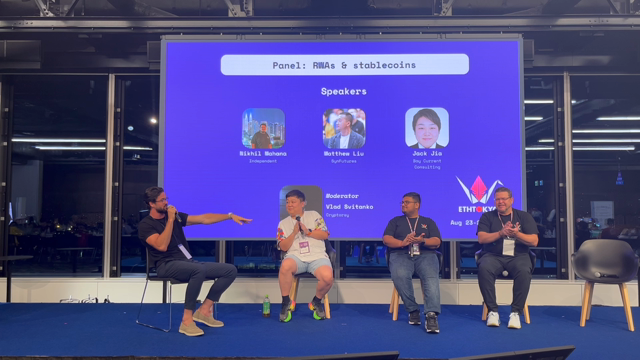 --:--
--:--Panel discussion: RWAs and Stablecoins
ETHTokyoSep 17, 2024
The FSA is actively working on stablecoin regulations. We anticipate that many stablecoins will be issued by Japanese banks this year. However, the most crucial aspect will be determining how these stablecoins will be utilized after they are issued. The video features a discussion on the current and future state of real-world assets (RWAs) and stablecoins in the cryptocurrency space. Vlad, the founder and CEO of a leading marketing studio based in Dubai, hosts the show, emphasizing the importance of RWAs as a driving force in the industry. The panel includes experts like Mathew Vanikert, who has experience with stablecoins and programmable money; Jack from a Japanese consulting firm leading web strategy; and Nikhil, a blockchain developer from India. The conversation explores various topics such as the common use cases for RWAs beyond real estate, like tokenizing movies or intellectual property. The panelists also discuss strategies for raising capital through utility tokens versus security tokens and emphasize the need for legitimacy and investor protection in these ventures. They touch upon challenges such as ensuring mass adoption, government regulation, industry readiness, and technological infrastructure. The panelists agree that while technology is prepared for widespread use of RWAs on blockchain, there are still significant barriers to overcome including regulatory issues and market readiness. The summary encapsulates an engaging discussion that covers the potential of RWAs and stablecoins in transforming traditional financial markets and assets through blockchain technology.
 26:55
26:55ETHBerlin04 Workshop: Richard Liu, Rob Knight - How to add ZKPs to your app (with Zupass)?
ETHBerlinSep 5, 2024
ETHBerlin04 May 24-26, 2024, CIC Innovation Campus Technical Workshop: Richard Liu, Rob Knight - How to add ZKPs to your app (with Zupass)? No prior circom or ZK experience needed for this workshop, where we'll run through a simple example of a sybil-resistant app that requests a "proof of ETHBerlin hacker visa". Hackers may receive a cryptographic surprise during this workshop. ETHBerlin04 - https://ethberlin.org A Department of Decentralization event - https://dod.ngo The provided text does not contain any meaningful content to summarize for a video description. It consists only of a series of dots, which may indicate placeholder text or an error in the input. Users would not be able to understand what the video is about based on this summary.
 36:33
36:33ETHBerlin04 Keynote: Nick Almond - Building for Big V Value
ETHBerlinSep 4, 2024
ETHBerlin04 May 24-26, 2024, CIC Innovation Campus Keynote: Nick Almond - Building for Big V Value ETHBerlin04 - https://ethberlin.org A Department of Decentralization event - https://dod.ngo The video features a speaker with a background in physics and decentralized governance who has been involved in the crypto industry for several years. He shares his perspective on the current state of cryptocurrency, emphasizing the need to focus on creating value (big V value) rather than just inflating metrics such as token prices and daily active users (small v value). He discusses concepts like Goodhart's Law, which suggests that once a measure becomes a target, it ceases to be a good measure, and how this principle applies to the crypto industry's fixation on numbers. The speaker criticizes the trend of short-termism and the creation of meme coins that lack substantive use cases. He also touches upon regulatory avoidance and the superficial appeal of decentralization, suggesting that these tendencies are steering the industry away from its potential to make meaningful contributions. The talk is intended as a call to action for change, urging developers and participants in the crypto space to prioritize genuine utility and societal benefit in their projects.
 21:20
21:20A Lightweight Architecture for Ethereum Archive Nodes
EthCCAug 9, 2024
The core idea is to maintain compacted, flattened, and fine-grained (i.e., transaction-level) historical states by flattening the minimum state changes of each transaction required for the world state. The video features a talk by Andy, the CEO of BlockSec and a professor at Zhejiang University, discussing their research on optimizing Ethereum archive nodes. The research is a collaborative effort between BlockSec, students, and other partners. Andy emphasizes the importance of building real systems with tangible impacts and outlines BlockSec's role in enhancing blockchain security through various products and solutions. Andy explains that blockchain optimization can be achieved at different layers, including consensus mechanisms, execution layers, and storage engines. Their work focuses on optimizing the storage engine to improve efficiency and reduce costs by modifying the state model within Ethereum's archive nodes. He provides an overview of Ethereum's storage layer, explaining that it operates as a state machine driven by transactions that change states. The state is an account-based model with each account having its own storage referenced by a storage root. All states are encoded in a Merkle Patricia Tree (MPT) for quick data authentication. Different types of Ethereum nodes exist with varying capabilities regarding historical data storage. Full nodes only maintain the latest world state for reorganization tolerance while archive nodes preserve all historical states but require significant disk space due to saving all intermediate MPTs at each block. Archive nodes are essential for detecting transaction attacks and smart contract vulnerabilities through historical transaction analysis. They also help
 19:41
19:41Benchmarking data for the settlement of crypto derivatives
EthCCAug 9, 2024
This keynote is an in-depth presentation on the benchmarking data used in the context of crypto derivatives settlement, both on and off chain, specifically diving into regulated use cases and benchmark data provided by independent index providers. The video discusses the significance of benchmarks in the settlement of crypto derivatives, highlighting their role as reference prices. The speaker explains that benchmarks can be sourced online or from trusted third parties and stresses the importance of using regulated benchmarks to prevent manipulation, drawing parallels to the Libor scandal. The current state of the crypto derivatives market is examined, noting its volume compared to spot markets and the growth in open interest for Bitcoin and ETH futures. Examples of exchanges using regulated benchmarks for settlement are provided, and the requirements for creating reliable crypto benchmarks are outlined, including regulatory compliance, data quality, robust methodology, and a stable platform. The talk aims to convey the maturing process of the crypto industry by adopting best practices from traditional finance.
 16:52
16:52Old Notes to New Coins: Collaborative Strategies for Small Issuers (Matthew Commons)
Stable SummitJul 16, 2024
Old Notes to New Coins: Collaborative Strategies for Small Issuers The video features Matthew Commons, president of the VerifiedUSD Foundation, speaking at an industry event. He discusses the history of stablecoins and private currencies, highlighting that while stablecoins are a recent development, private currencies have existed since ancient times. He introduces his organization's stablecoin, USDV, which is backed by real-world assets and utilizes technology for decentralized minting and tracking capital inflow. Commons then draws parallels between the current state of stablecoins and the free banking era in the United States (1837-1866), a time when private currencies flourished alongside significant economic growth. He emphasizes the importance of transparency and shared risk and reward in such systems, as demonstrated by historical practices like banknote reporters and interbank networks. The talk aims to provide insights on applying historical lessons to modern-day currency systems and fostering partnerships within the crypto community.
 12:39
12:39Creating a Unified Liquidity Layer Across Web3 || Jonathan Lim,
Stable SummitJul 12, 2024
Creating a Unified Liquidity Layer Across Web3 The video features Jonathan Lim, a product manager at Circle, discussing the current state and future of stablecoins. He begins by engaging the audience with a mood check and then proceeds to talk about his dislike for the term "stablecoins," suggesting that it implies a lack of dynamism, which he disagrees with. Lim highlights the market validation of stablecoins through traditional financial players entering the space. He shares statistics about the Cross-Chain Transfer Protocol (CCTP), including $10 billion transferred since launch, $250 million in weekly volume, 1 million unique transactions, and involvement from over 50 active developers. Lim emphasizes the importance of network effects and shows how adoption increased as more chains were added to CCTP. He discusses capital efficiency in terms of USDC circulation moving cross-chain and presents data on increasing interchain velocity. The impact on users is shown through the generation of 47K multi-chain wallets since CCTP's launch. He briefly touches on an incentive campaign spike in wallet creation due to airdrop farming but clarifies that it's not a primary use case for CCTP. Lim's vision is for CCTP to help users enjoy multi-chain benefits without drawbacks like fragmentation. He illustrates cross-chain volume with a chart showing thick lines between certain nodes, indicating high
 13:55
13:55Live Demo: Enabling fully on chain payments || Sebastian Burkhard
Stable SummitJul 12, 2024
Live Demo: Enabling fully on chain payments This video features a speaker with a decade of experience in building banking infrastructure, discussing the future of stablecoins in emerging markets by 2030. The speaker, who has a background in leading a successful payment processing company in Latin America, believes stablecoins will become the primary form of money in these regions. They outline three main use cases for stablecoins: as a store of value based on USD (e.g., USDC, USDT, DAI), as investment products linked to U.S. treasuries (e.g., USDM, Ondo), and for financial infrastructure tied to local currencies and payment instruments. A significant point made is the difficulty for individuals in emerging economies to access U.S. dollars and how stablecoins provide an easier and more accessible hedge against local inflation. The video also highlights the barriers faced by people from emerging markets when trying to invest in U.S. markets due to high minimum account requirements compared to their average wages. The speaker invites questions via email at the end of the presentation.
 59:20
59:20Yield bearing Stablecoins: Design Trends & Redefining Value Distribution
Stable SummitJul 11, 2024
panel The video features a panel discussion on yield-bearing stablecoins with a diverse group of panelists, each representing their own unique stablecoin. The host, Nate from Token Dynamics, introduces the topic and the panelists, who then each give an overview of their respective stablecoin projects and how they approach yield generation. Amin Soleimani discusses his project's float coins, which are not pegged to a specific value but aim to stabilize based on internal supply and demand dynamics. Nick Van Ack describes his company's one-to-one stablecoin model that shares income with businesses to drive utility and liquidity. Uriah Klagesmund shares insights from his PhD research on stablecoins and discusses Gyroscope's resilient design and efficient liquidity pool model. Matthew Commons talks about the Verified USD Foundation's use of tokenized US Treasury bills for backing their stablecoin and their Omnichain fungible token standard. Lastly, Pablo the Penguin explains QIDAO's multi-chain stablecoin that allows borrowing against various collaterals. The panel aims to explore where the yield comes from in each protocol, looking for commonalities and differences among them. They discuss concepts like farm-to-table yield, organic versus inorganic yield sources, and sustainable long-term revenue generation methods within the context of stablecoins.
 10:21
10:21Reconstructing the Monetary Stack || Joao Reginatto, CSO, M^0 Labs
Stable SummitJul 11, 2024
Keynote by M^0 Labs The video features a speaker discussing the concept of stablecoins and the potential to reconstruct the monetary stack. The speaker, who has experience working at Circle and leading the build-out of a stablecoin, critiques the term "stablecoin," suggesting it limits the broader implications and possibilities of the technology. They advocate for thinking beyond price stability to consider how major currencies like the dollar could operate on the internet, comparing early digital newspapers to the current rudimentary stage of digital currencies. The speaker then delves into their personal view of money as a layered concept, with belief systems at its base and applications on top, while highlighting a middle "middleware" layer that is often overlooked. They argue that this layer has room for innovation, particularly in issuance, governance, and settlement processes, which are currently based on outdated systems. The discussion turns to M0, an infrastructure aimed at creating an open federation for crypto dollar issuances. M0's approach involves on-chain protocols and off-chain technology that allow businesses to mint fungible stablecoins by pledging collateral like short-term US Treasuries. This system aims to directly connect money issuers with a base layer representing a claim on dollars without intermediaries. Finally, the speaker warns that many current efforts in stablecoin development may fail due to lack of
 18:59
18:59Immutable Data Provenance: Leveraging Swarm for Secure Tracing || Tex
SwarmJun 21, 2024
Building Data Provenance - A quick overview of how data provenance; We will go throug what data provenance is. Iterate through existing standards and go through abstract implementation. The video features an individual named Tex discussing the concept of data provenance, the importance of authentication, auditing, and compliance within systems that synergize with blockchain technology. The speaker addresses the creation of a registry that aids in the current form of data management and emphasizes the use of Diffie-Hellman key exchange for securing data transactions on the blockchain. The video also delves into concepts such as smart contracts and notarization techniques that validate and secure data, ensuring its integrity over time. Additionally, it touches upon practical applications like legal evidence, contracts, intellectual property, and medical records management. The overarching theme is the significance of establishing a timestamped, verifiable record of data on the blockchain to ensure its historical accuracy and prevent tampering.
 29:52
29:52Multichain support || Viktor Tron
SwarmJun 21, 2024
No description The video is a thank you message, although the content of the gratitude or context is not specified in the text provided. The summary does not offer details about what the video contains beyond an expression of thanks.
 32:49
32:49Gnosis 3.0 || Phillippe Schommers
SwarmJun 20, 2024
No description The video features a comprehensive talk about Gnosis, covering its ecosystem, history, and various projects. The speaker begins by discussing the origins of Gnosis as a prediction market on Ethereum and its evolution into a builder of Ethereum-centric infrastructure. They highlight Gnosis Chain, which aims for horizontal scaling of Ethereum with a focus on decentralization and credible neutrality. The talk then covers several Gnosis projects: 1. Gnosis Chain: A blockchain similar to Ethereum with a beacon chain, validators, and hard forks. It uses the native token XDAI for transactions and GNO for staking. 2. Safe (formerly known as Gnosis Safe): A smart account or multisig wallet that's self-custodial with over $100 billion in assets stored. 3. CowSwap: An aggregator finding the best prices across DEXes and protecting users from MEV. 4. Karpatsky: A DAO treasury and risk management company managing over $3 billion worth of assets. 5. OpenEthereum: Maintenance of the Ethereum client after Parity abandoned it to ensure client diversity. 6. Zodiac: An open standard for DAOs allowing for more interconnectedness. The speaker then outlines the vision for Gnosis 3.0, which includes around 30 teams working on
 28:49
28:49Defending malicious behavior in federated learning with blockchain
ZuBerlinJun 18, 2024
Clip The video features Jiahao Sun, the founder and CEO of Flock, discussing the company's mission and technology. Flock is a pun for federative learning blockchain, an idea stemming from a paper published in NeurIPS 2022 and further detailed in the journal "Transitioning AI." Jiahao's background includes working in traditional finance as head of AI at Eurobank Canada and as a researcher at Imperial College London. Flock aims to solve data silo issues in industries like finance and healthcare by combining federated learning with blockchain technology. Federated learning occurs on devices like smartphones, where data stays local while only model weight changes are sent to improve collective models. However, there's a risk of centralized control and data misuse, which Flock addresses using blockchain for transparency and security. The platform introduces an incentive mechanism where good behaviors are rewarded, and bad actors are penalized, ensuring honest participation. The system uses random selection for proposers who contribute to model training and voters who validate results. Malicious attempts are thwarted through this process, maintaining high accuracy even with a significant presence of bad actors. Jiahao also discusses experiments with the Kaggle Learning Club dataset that demonstrate the effectiveness of Flock's approach compared to traditional federated learning under malicious conditions.
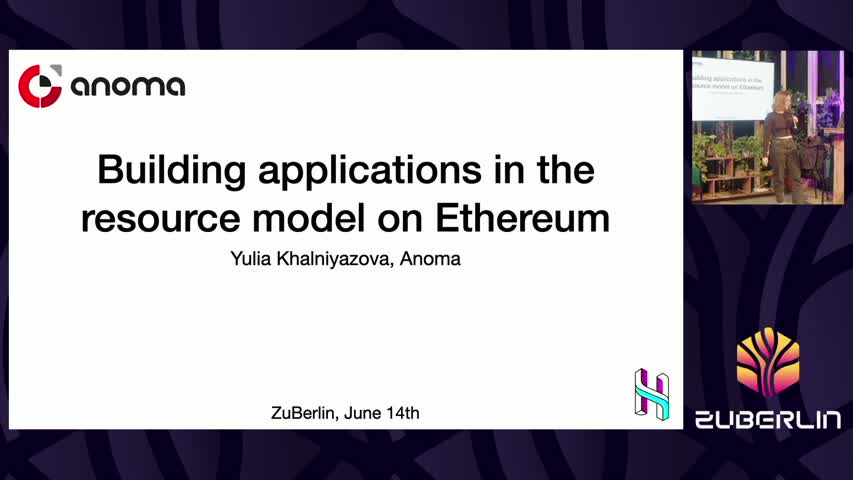 21:28
21:28Building applications in the resource model on Ethereum with Yulia
ZuBerlinJun 14, 2024
Clip The video is a presentation on building applications within the resource model on Ethereum, focusing on the concept of a resource machine and how it compares to Ethereum's EVM. The speaker discusses the abstract concept of resources as atomic state units, which are immutable and can only be created or consumed once. They introduce the idea of resource logics, which are rules determining when resources can be created or consumed, and explain that transactions in this model consist of creating and consuming resources while maintaining balance. The talk covers how users express preferences through intents (unbalanced transactions), which can be composed to create balanced transactions that update the system's state. The speaker also touches upon the benefits of this model, including better user experience through intent-level composability and programmable disclosure for privacy control. Applications in this model are defined by a set of logics specifying how to handle resources, with an interface that allows interaction through transaction functions. The presenter uses a counter as an example application to illustrate these concepts. Finally, they discuss how to use this resource machine model with Ethereum by deploying a smart contract that verifies transactions according to the resource machine rules. The audience is encouraged to engage with their forum for further discussion or follow their work on various platforms provided at the end of the talk.
 21:52
21:52[Debate] Steelman Challenge: we are all building the same damn thing! 6
ZuBerlinJun 13, 2024
Clip This video features a panel discussion with key players in the cryptocurrency supply chain, including builders and relay operators. They delve into the adoption of pre-confirmations (pre-cons) and their impact on block construction. The panelists discuss how pre-cons serve as an additional constraint in block building, affecting transaction ordering and potential reverts. They also explore the shifting power dynamics between builders and relays, with pre-cons potentially democratizing order flow. The conversation further touches on the challenges of pricing pre-confirmations, considering factors such as time constraints, block space availability, and the uncertainty of transaction arrival. The panelists theorize about optimal pricing functions for pre-cons and compare block building to ad auctions due to its complexity and interdependencies. From a searcher's perspective, they debate the utility of pre-confirmations for sex-dex arbitrage, considering the premiums associated with guaranteeing execution within a block. The discussion also highlights the evolving role of relays in ensuring transaction confirmation speed and reliability. Overall, the video provides insights into how pre-confirmations might change business operations for builders and relays while affecting strategies for searchers within the cryptocurrency supply chain.
 25:20
25:20[Debate] Steelman Challenge: we are all building the same damn thing! 1
ZuBerlinJun 13, 2024
Clip The video appears to be a technical discussion or presentation focused on the topic of MEV (Miner Extractable Value) in the context of cryptocurrency and blockchain technology. The speaker discusses how MEV impacts user outcomes, validator outcomes, and the security of blockchain systems. They emphasize the importance of aligning these outcomes and considering how different proposals affect the distribution of MEV. The speaker also touches on topics such as sandwiching (a type of front-running), privacy in transactions, and the potential for centralization. They argue that MEV cannot be eliminated but can be harnessed for beneficial purposes. The presentation includes a Q&A session with panelists who discuss various aspects of MEV, privacy, and economic incentives within blockchain ecosystems. The summary is that the video is likely to be highly technical, aimed at an audience familiar with cryptocurrency concepts, and focused on the nuanced implications of MEV in blockchain systems.
 21:47
21:47Talk | Overload the Execution Proposer instead (From MEV-Boost to ePBS to APS) (Barnabé)
ZuBerlinJun 13, 2024
Clip The video features a speaker discussing the intricacies of precomp builders and the separation of attester and proposer roles within a blockchain network. The talk delves into various design concepts like PBS (Proposer Builder Separation) and APS (Attester-Proposer Separation), explaining their importance in mitigating centralization risks, reducing MEV (Maximal Extractable Value) reward viability, and providing a clean protocol interface. The speaker elaborates on the conceptual differences between proposing and building rights, as well as between beacon proposing and execution proposing. They explore the current MEV Boost system where validators, acting as proposers, seek builders to determine block contents. The talk also covers EPBS (Enshrined Proposal Builder Separation), which involves fair exchange via protocol, allowing proposers to commit to builders within the network. Further discussion points include the potential for different market structures under EPBS, questions about bid cancellations, and the concept of burning MEV to capture value from builder-to-proposer transactions. The speaker also suggests an iterative roadmap towards APS, with steps including creating a logical role for execution proposers separate from beacon proposers, running slot auctions in advance to capture bid value more effectively, and considering alternative designs like execution tickets. The talk concludes by highlighting how
 34:28
34:28Discussion 2: Delegation / no delegate with Limechain
ZuBerlinJun 12, 2024
Clip This video discusses a new model for pre-confirmation in cryptocurrency transactions that reduces the required collateral from 1,000 ETH to just 1 ETH. The speaker explains the original rationale for the high collateral amount was to cover the worst-case scenario of maximum extractable value (MEV) in a single block. However, this approach is costly as it requires overpaying for security every time. To improve this, a distinction is made between inclusion pre-confirmations, which guarantee a base fee and are economically beneficial when there's no contention on state, and execution pre-confirmations, which are more complex and relate to trades like Uniswap transactions. The speaker proposes an insurance market model where users pay for coverage based on the actual risk of price movement during transaction confirmation time rather than a flat worst-case fee. This model allows solo validators with minimal collateral to provide pre-confirmations and introduces benefits such as increased access for solo stakers, better risk-reward balance, and stronger user assurance through insurance rather than sheer collateral amount. The video also addresses potential user experience aspects, how wallets could handle these changes, and how trust networks might impact gateway reputations. Additionally, it touches on issues like denial of service attacks on validators, decentralized encrypted mempools to protect user transactions from front
Understanding The Fundamentals And Regulatory Landscape Of Cryptocurrency In Nigeria
LBWTVJun 12, 2024
Understanding The Fundamentals And Regulatory Landscape Of Cryptocurrency In Nigeria The video discusses the fundamentals and regulatory landscape of cryptocurrency in Nigeria. It features a presentation by Ifeoma Ben, the secretary of the Saiban Ketika Committee and a founding partner of a law suite. The talk covers the definition and key features of cryptocurrency, such as decentralization, cryptography, and blockchain technology. It also touches on different types of cryptocurrencies like Bitcoin, Ethereum, altcoins, and stablecoins. Ifeoma highlights the growth of the cryptocurrency market in Nigeria due to factors like high inflation rates, a youthful population eager to adopt new technologies, remittances challenges with traditional banking systems, and economic instability. She points out that despite these drivers, there are challenges including regulatory uncertainty, accessibility issues due to limited internet access in rural areas, security concerns, and volatility. The presentation delves into opportunities presented by cryptocurrency for economic growth through innovation and job creation. Ifeoma then focuses on the regulatory landscape in Nigeria, discussing the roles of key regulatory bodies like the Central Bank of Nigeria (CBN) and the Securities and Exchange Commission (SEC), their directives, and how they've impacted the industry. She provides an overview of CBN's cautious approach towards cryptocurrencies due to concerns about their potential use in illegal activities like terrorism financing. However, she notes recent changes
 20:25
20:25Radius
ZuBerlinJun 11, 2024
Clip The video features the co-founder of Radius discussing their approach to using basic sequencing for the decentralization and unification of ROLIPS. The talk covers the importance of basic sequencing in ensuring safety, censorship resistance, and liveness during the pre-settlement step of ROLIPS transactions. The presentation explains how ROLIPS inherits decentralization from Ethereum during the settlement phase but lacks these properties in pre-settlement. The speaker proposes a solution involving incentive alignment between users and Ethereum proposers to ensure transaction safety before they are sent to Ethereum. The talk delves into the challenges of achieving decentralization without causing layer 1 centralization or relying on sequencer and proposer relationships. It introduces a delegation contract as a potential solution, which involves a complex interaction between sequencers, builders, and proposers to hedge operational risks through auctions and contracts. Furthermore, the presenter discusses risk management strategies for builders and profit opportunities for sequencers while maintaining censorship resistance through an encrypted mempool that ensures transactions are processed without bias. Lastly, a liveness solution called RAFT is mentioned to handle sequencer failures. The speaker concludes by inviting discussion on further ideas for achieving decentralization in ROLIPS, particularly focusing on safety with basic sequencing and addressing challenges related to liveness and avoiding layer 1 central
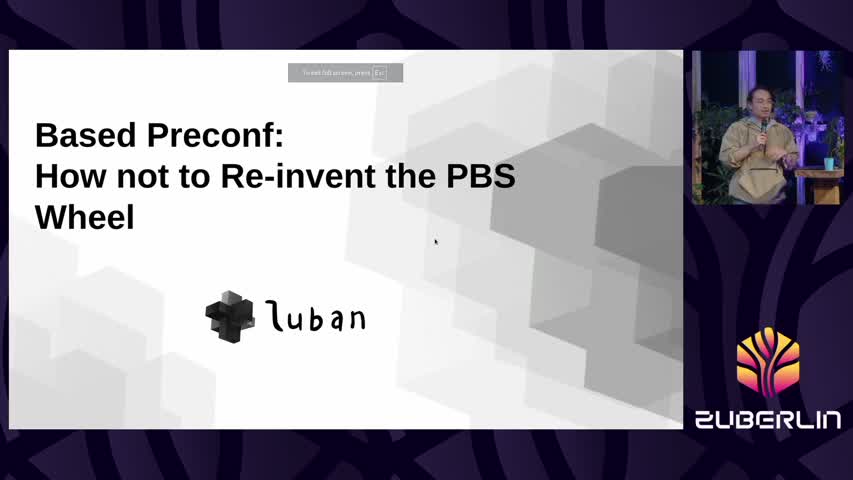 24:46
24:46Luban
ZuBerlinJun 11, 2024
Clip The video presents a discussion on how to reinvent the protocol buffer (PBS) space, specifically focusing on Layer 1 (L1) pre-confirmation protocols and their integration with wallets for gas fee hedging. The speaker represents a research and product company in the blockchain financial primitives sector. They introduce a mental model where rollups act as block space dealers, buying space from L1 and reselling to Layer 2 (L2) users. The talk outlines the current issues with high L2 transaction submission costs due to inefficient packing and non-deterministic block confirmation times. A solution proposed is based on pre-confirmation, aiming to reduce confirmation time significantly and lower transaction costs. The speaker delves into the concept of proposal commitment, which includes an optimistic mechanism, EVM state changes, state dependencies, and a challenge mechanism for penalizing non-compliance. They address the "cold start" problem of getting enough validators to opt into the pre-confirmation network and suggest using pre-conf delegation as an initial strategy. A go-to-market strategy is discussed, drawing lessons from MEV-Boost's adoption journey by minimizing risk for proposers and simplifying their opt-in process. The talk also touches on potential issues of centralization and censorship resistance that can arise from delegated pre-conf
 26:04
26:04Primev
ZuBerlinJun 11, 2024
Clip The video features a researcher from Primav discussing the concept of pre-confirmation in blockchain transactions, specifically within the context of Ethereum. Pre-confirmation is a mechanism that provides users with a fast guarantee that their transaction will be included in the next block, improving user experience and potentially increasing profit for activities like arbitrage. The researcher explains the roles of two main actors in this system: bidders, who are willing to pay for pre-confirmations, and pre-confirmation providers, who can credibly promise transaction inclusion. Primav has developed MavCommit as an open network where anyone can participate as either role. The talk delves into why block builders might provide pre-confirmations, emphasizing their specialized knowledge and capability to do so quickly and economically. However, since multiple builders compete to build blocks, a pre-confirmation from one does not guarantee inclusion if another builder is selected. The speaker suggests that even probabilistic pre-confirmations can be valuable for certain strategies like cross-chain arbitrage. Primav's solution includes a side chain with fast block times for settlement and a decay mechanism incentivizing timely pre-confirmations. The protocol also emphasizes privacy for bids and commitments through encryption and special cryptographic commitments. In conclusion, MavCommit aims to offer an open network with strong cryptographic guarantees for timely
 1:00:26
Making Europe Fit for the Blockchain, DLT & Crypto Era
European Blockchain ConventionOct 9, 2022
Tech policy is at the forefront of the Von der Leyen Commission’s ambitions for making Europe Fit for the Digital Age. Indeed, digital transformation touches every corner of our lives, bringing new opportunities, but also new risks. There is growing awareness in Europe of the potential of technology and its central role in transforming our society and economy across all sectors. Is Europe ready for the 'Blockchain, DLT & Crypto' Era?
 56:17
56:17The Opportunities Around Crypto
European Blockchain ConventionOct 9, 2022
To avoid being left behind, banks need to find a way to embrace this technology and treat it as a friend rather than an enemy. Cryptocurrency adoption could streamline, enhance, and upgrade financial services, and there are plenty of recent industry advancements that can ease banks’ concerns around the risks and instead let them recognize the potential benefits. SPEAKERS: - Stephanie Ramezan, Director of Business Development, Europe, Gemini - Kim Schneider, Blockchain Specialist, Rabobank - Mariana Gospodinova, Executive VP Operations, Crypto.com - Mai Santamaria, Head of Financial Advisory Team, Department of Finance Ireland - Simon Seiter, Head of Digital Assets, Hauck & Aufhäuser
 42:05
42:05DeFi: The Future of Finance
European Blockchain ConventionOct 9, 2022
Decentralized finance or “DeFi” may completely change the way we see traditional financial services. Defi is a movement that aims at making a new financial system that is open to everyone. SPEAKERS: - Laurent Marochini, Head of Innovation, Société Générale - Donald Thibeau, Co-Founder and Chief Strategy Officer, HBAR Foundation - Sergej Kunz, Co-Founder, 1inch - Maximilian Bruckner, International Token Standardization Association
 42:35
42:35DLT & the Future of Financial Institutions
European Blockchain ConventionOct 9, 2022
Financial institutions and technology providers are launching Distributed Ledger Technology DLT projects after years of experimentation. Products enabled by DLT (i.e., immutable distributed databases like blockchain that ensure data is consistent, accurate, and up to date across participants), are becoming a reality across a range of asset classes and jurisdictions. However, total disintermediation and wholesale digital transformation remain far from being realized. SPEAKERS: - Tanya Shastri, VP of Products, Blockchain, VMware - Sebastian Kraft, Senior Product Owner DLT, Commerzbank - Juan Jiménez, Digital Public Policy Director, Banco Santander - Mai Santamaria, Head of Financial Advisory Team, Department of Finance Ireland
 28:41
28:41SWIAT –Making Banks Connectable
European Blockchain ConventionOct 9, 2022
Deka's SWIAT securities platform expands the technical capabilities of participating institutions and can be integrated into existing infrastructures thanks to its modular design. The market initiative launched by Deka is open to additional partners and aims to become the institutional and digital settlement standard. Participating financial service providers can further develop the platform functions and offer their own services and offerings on the platform. Speakers: - Martin K. Müller, Member of the Board of Management, Dekabank - Jonathan Leßmann, Structured Finance for DLT & Platform-Strategy, DekaBank
 44:41
44:41EBC22 | How Did Crypto Become the Most Invested Sector in Fintech?
European Blockchain ConventionOct 9, 2022
Crypto continues to become an inevitable part of the economy and is currently the most invested sector in fintech. Listen to the panelists during the 7th European Blockchain Convention discussing how crypto has become the most invested sector in fintech. --------- Speakers: Erwin Voloder | European Blockchain Association Alexandre Kech | Citi Ventures Juan Jiménez | Alastria Sarah Palurovic | Digital Euro Association --------- Visit the European Blockchain Convention’s website: https://eblockchainconvention.com/
 1:07:09
How to Get a Job in Web3 with Nadejda Petrova (Nexo)
European Blockchain ConventionOct 9, 2022
Nadejda Petrova, Head of Institutional Client Management at Nexo joined us for a debate with European Tech School's co-founder Victoria Gago on how to transition from a job in web2 to a career in web3 and the challenges and opportunities that come with careers in a growing industry. 00:58 Introduction of Nadejda Petrova 05:30 What do the financial and crypto industry have in common? 08:00 The difference between working in a traditional busines vs. working in web3 and crypto 13:00 Why should you consider moving into the crypto space? 24:00 What are the traits that crypto and web3 companies are looking for in a candidate? 29:00 The importance of your presence online 32:00 Yves-Michel Leporcher, professor at European Tech School provides advice 43:00 European Tech School alumni, Sebastian Becciu, explains his transition into the crypto space 46:00 Bitcoin literature recommendations 57:00 How to access affordable education?