About 23 results
 28:11
28:11Hacks and Quantum Threats for Institutions | Future Finance Forum 2026
ETHSofiaOct 6, 2026
With Yordan Barzakov (ReVizia, moderator), Alexander Sverdlov (Atlant Security), Daniel Babbev (Bitcoin Suisse) and Dr Boyan Torosov (Bulgarian Academy of Sciences). Moderated by Yordan Barzakov, the panel moves from today's hacks to tomorrow's quantum threat. Alexander Sverdlov dissects a 351 million dollar exchange breach from the day before and argues that cryptography rarely fails, while implementations, transaction monitoring and threat modelling do. Dr Boyan Torosov explains qubits and error correction, says Google's estimate of under 500,000 physical qubits depends on its assumptions, and expects a fault-tolerant machine able to run Shor's algorithm at scale within the next decade or so, while Daniel Babbev calls harvest now, decrypt later far-fetched, points to public keys already exposed on chain and warns that migrating Bitcoin to post-quantum signatures is a governance problem rather than a technical one. Sverdlov closes by urging institutions to deploy unconstrained AI for defence now. Panel at Future Finance Forum 2026, 25 September 2026, Sofia. Part of Blockchain Week Bulgaria 2026. Speakers ▸ Yordan Barzakov, Author and Host of "ReVizia" (moderator) Yordan Barzakov is a journalist with over 10 years of professional experience in economics, finance, and energy, as well as prior experience in international relations. He is the author and host of "ReVizia" on Nova News – a show dedicated to economic and geopolitical processes, business, and financial markets. ▸ Alexander Sverdlov, Founder and Lead Expert, Atlant Security Alexander Sverdlov is a global cybersecurity expert, former Microsoft consultant, and UN Cybersecurity Panelist. After advising major financial and government organisations across the Middle East and ENEC, he founded Atlant Security, helping companies of all sizes strengthen their security across four continents. LinkedIn: https://www.linkedin.com/in/alexsverdl ▸ Daniel Babbev, Senior Software Engineer, Bitcoin Suisse Daniel Babbev brings over 10 years of experience in the crypto sector. He currently serves as Senior Custody Engineer at Bitcoin Suisse, Switzerland's first crypto company. Previously, as a Risk Engineer at Brevan Howard, one of Europe's leading hedge funds, he built and led the firm's crypto risk systems. LinkedIn: https://www.linkedin.com/in/danielbabbev ▸ Dr Boyan Torosov, Associate Professor at Atomic Physics, Bulgarian Academy of Sciences / Center for Quantum Technologies Dr. Boyan Torosov is a quantum physicist specialising in quantum computing and control. He is the Quantum Control Lead at 1QBit, an Associate Professor at Institute of Solid State Physics – Bulgarian Academy of Sciences (ISSP-BAS), and a research group leader at the Center for Quantum Technologies at Sofia University. Chapters 00:00 Introduction 01:07 Anatomy of a 351 million dollar exchange hack 03:49 Cryptography holds, implementations fail 05:21 What is a quantum computer? 08:38 How many qubits does it take to break cryptography? 09:56 Quantum progress: real or PR? 12:07 When will quantum computers break cryptography? 12:50 Harvest now, decrypt later: how real is the risk? 15:21 Is a five to seven year migration realistic? 16:47 The biggest vulnerability today: AI-powered attackers 18:47 Post-quantum signatures and Bitcoin governance 21:05 Advice for a bank's first digital assets 22:04 Threat modelling and why so little has changed 26:12 One thing to remember Blockchain Week Bulgaria: https://www.blockchainweek.bg ETHSofia: https://www.ethsofia.com Future Finance Forum: https://www.blockchainweek.bg/f3 Follow Blockchain Week Bulgaria X: https://x.com/BWBulgaria LinkedIn: https://www.linkedin.com/company/blockchain-week-bulgaria Follow ETHSofia X: https://x.com/EthSofiaBG LinkedIn: https://www.linkedin.com/company/ethsofia Telegram: https://t.me/+b-33LJUpAB5iODNk Nothing in this video is financial advice. About the organiser Blockchain Week Bulgaria, ETHSofia and the Future Finance Forum are organised by the Bithope Foundation, founded in 2014 by Vladislav Dramaliev. Inspired by Andreas Antonopoulos, it is Europe's first non-profit operating exclusively with bitcoin donations. Over more than ten years, it has supported 50+ charitable campaigns, and in January 2016 it co-founded the Sofia Crypto Meetup, now the region's longest-running monthly crypto event. https://bithope.org
 20:19
20:19Ansgar Dietrichs
Ethereum in the Decade of Adoption | Ansgar Dietrichs (Ethereum Foundation) at ETHConf
ETHGlobalJul 9, 2026
In this talk, Ansgar Dietrichs from the Ethereum Foundation, who has been in Ethereum core research for seven years, currently leads scaling work and co-leads the Okodas governance process, shares personal reflections on Ethereum's role in what he calls the decade of adoption. He frames the first 10 years of blockchains (2014 to 2024) as the infrastructure era requiring countless zero to ones across wallets, transaction supply chains, and the entire tech stack. He argues 2024 marked the ChatGPT equivalent moment for crypto, but unlike AI's single inflection point, it was a perfect storm of the tech stack reaching maturity, the US regulatory environment shifting from open hostility to a friendly stance, and stablecoins finally hitting product market fit beyond crypto native use cases. Ansgar contrasts two possible futures for crypto. The bad outcome is a fragmented world of independent chains (general purpose, app chains, privacy chains, permissioned chains) all linked by brittle custom bridges that have repeatedly failed and require each user to reason about every chain's security model independently. Ethereum's answer is a singular foundational framework that embraces all that customization but routes everything back to a shared settlement layer, enabling trustless interoperability between any pair of chains or assets, propagated security guarantees from Ethereum L1, full customizability at each layer, a single entry point for users, and ETH as the one native asset across the onchain economy. He explains the EF's pivot toward being one node among many ecosystem stewards rather than the center of Ethereum, then defends Ethereum's values as deeply practical rather than overly ideological. He cites security through redundancy across 10+ Ethereum clients being especially crucial during the coming AI driven cyber security arms race, Ethereum's principled postquantum planning while other chains scramble, and neutrality and strategic reliability under what he calls the Amazon test: would a big tech company comfortable trust putting its business flows on Ethereum knowing it could never be rugged. 00:00 Introduction 00:11 Ansgar's Background at the Ethereum Foundation 00:52 Why ETHCom Is Emblematic of a New Time Period 01:16 The First Decade of Blockchains: 2014 to 2024 02:11 The ChatGPT Moment for Crypto 02:41 Three Forces: Tech, Regulation, and Stablecoins 03:24 Entering the Decade of Adoption 03:48 The Bad Outcome: A Fragmented Future 04:51 Why Brittle Bridges Are the Bigger Problem 05:41 Ethereum's Answer: A Singular Foundational Framework 06:18 Why a Shared Settlement Layer Wins 06:47 Trustless Interoperability Across All Chains 07:35 Aspirational Today, Priority for Adoption Era 07:57 Propagating Ethereum's Security Guarantees 08:31 Full Customizability with Ethereum as Entry Point 09:12 ETH as the Native Asset of the Onchain Economy 09:43 The EF as One Node Among Many Stewards 10:48 Embracing the Ethereum Way of Decentralization 11:52 Why Ethereum's Values Are Misunderstood 12:11 Why Principled Equals Practical 12:34 Security: 10 Clients and 100% Uptime 13:03 The Coming AI Cybersecurity Arms Race 13:52 Quantum Resistance and the Beam Chain 14:54 Neutrality and Credible Neutrality 15:23 Why Censorship Resistance Matters for Institutions 16:31 Strategic Reliability and the Amazon Test 17:58 Useful Across the Spectrum 18:29 The Four Step Plan for Ethereum 19:51 Closing: Ethereum's Best Time Is Yet to Come _ _ _ _ _ _ _ _ _ _ _ _ _ _ _ _ _ _ _ _ *ETHConf 2026* ETHConf is a 3 day event for founders, industry leaders, and builders who are excited about the possibilities of building on top of Ethereum. Connect with 2,000+ top innovators in crypto, finance, technology, and policy at our inaugural three-day event packed with showcases, demos, partnerships, and conversations shaping the future of the global economy. _ _ _ _ _ _ _ _ _ _ _ _ _ _ _ _ _ _ _ _ ✅ *Follow ETHConf* X: https://x.com/ethconf Website: https://ethconf.com _ _ _ _ _ _ _ _ _ _ _ _ _ _ _ _ _ _ _ _ 🎟️ Get your early bird tickets for ETHConf 2027: https://ethconf.com/2027#tickets 🎤 View the full ETHConf 2026 Speaker Schedule: https://ethconf.com/schedule _ _ _ _ _ _ _ _ _ _ _ _ _ _ _ _ _ _ _ _
 12:30
12:30Scaling Smart Contract Security with AI I Shashank
ETHGlobalNov 9, 2025
Shashank, founder of SolidityScan, explains how AI and automation are transforming smart contract security. With over 14 years in cybersecurity (credited with finding bugs in Apple, Google, and Facebook), he highlights the staggering scale of Web3 hacks—over $5B in 2024, with 55% caused by contract vulnerabilities—and argues that manual audits alone can’t scale. He demonstrates how AI-powered automation reduces false positives and identifies nuanced access-control issues. Using the 2022 ShadowFi token hack as a case study, Shashank shows how traditional rule-based scanners struggle with logic-based bugs, while AI understands contextual security patterns. He details how SolidityScan’s multi-agent AI model, trained on 100K+ audit reports, mimics an “AI auditor” in developers’ CI/CD pipelines—reducing false positives by 82% and enabling real-time vulnerability detection before deployment. 00:02 Introduction & context: AI + blockchain security 00:27 Shashank’s background in cybersecurity (Apple, Google, Facebook) 00:59 Web3 security challenges: hacks & financial losses 01:28 Birth of SolidityScan: AI-powered contract analysis 02:00 Why automation is needed: billions lost, manual audits can’t scale 02:45 CI/CD security comparison to Web2 03:09 Rule-based scanning limitations → need for AI 03:27 Case study: ShadowFi token hack (Sept 2022) 04:10 Transaction analysis: token burn exploit explained 05:21 Access control vulnerabilities as #1 cause 05:44 How missing modifiers caused the exploit 06:08 Why rule-based systems fail to catch custom RBAC patterns 06:59 Example: false positives in static scanning 07:32 Using AI to understand code context & access logic 08:05 Results: 82% reduction in false positives 08:57 Multi-agent AI: master/slave setup & specialized agents 09:30 Dataset: 100K+ audit reports, 1M+ vulnerabilities 10:01 How the AI auditor works in developer pipelines 10:25 Audience Q&A: context limits, hallucinations, AI-guided algorithms 11:50 Future plans: formal verification & AI-generated fuzzing tests 12:10 Static analysis today, dynamic verification next 12:43 Closing remarks _ _ _ _ _ _ _ _ _ _ _ _ _ _ _ _ _ _ _ _ 🇮🇳 *Pragma New Delhi* Pragma New Delhi 2025 was held on September 25th at the JW Marriott Hotel in Aerocity New Delhi and was an in-person summit for builders and leaders in the web3 ecosystem. Watch the full Pragma New Delhi YouTube Playlist here: ETHGlobal's Pragma series takes place in cities around the world, and is designed to be a different kind of event. Pragma is a one-stage conference with founders-only on stage, bringing together a small group of curated attendees and speakers to discuss the future of web3 and reflect on the past. _ _ _ _ _ _ _ _ _ _ _ _ _ _ _ _ _ _ _ _ ✅ Follow Shashank X: https://x.com/cyberboyIndia ✅ Follow Credshields X: https://x.com/credshields ✅ Follow ETHGlobal X: https://x.com/ETHGlobal Warpcast: https://warpcast.com/ethglobal Website: https://ethglobal.com YouTube: https://www.youtube.com/@UCfF9ZO8Ug4xk_AJd4aeT5HA _ _ _ _ _ _ _ _ _ _ _ _ _ _ _ _ _ _ _ _ Are you interested in Ethereum development and entrepreneurship? 👉 Sign up for the next ETHGlobal event: https://ethglobal.com/events 🎁 Get exclusive access and perks with ETHGlobal Plus! https://ethglobal.com/plus 📣 Want us to throw an event in your city? Tell us where! https://ethglobal.com/city _ _ _ _ _ _ _ _ _ _ _ _ _ _ _ _ _ _ _ _
 10:49
10:49Dimitris Pallis, Hakflow: Crypto Heist through Web2 | ETHSofia
ETHSofiaOct 9, 2025
Dimitris Pallis, Hakflow: Crypto Heist through Web2 A talk about vulnerabilities related to traditional cybersecurity infrastructure but can also affect blockchain and Web3. Dimitris is a seasoned penetration tester with contributions to various industries, including finance and technology. He currently holds technical certifications such as OSCP and has been previously featured in a bug bounty hall of fame. Beyond professional engagements, he actively gives back to the community through online groups, sharing knowledge and tools. Timestamps: 00:00 Intro 01:13 Overview of Crypto Wallets and Key Risks 03:30 OWASP Top 10 Vulnerabilities Impacting Web3 04:44 Live Demo: Extracting Private Keys and Seed Phrases 08:33 Fixes by Developers to Mitigate Vulnerability 09:50 Closing Remarks and Networking Information This video was recorded during the ETHSofia Conference and Hackathon - October 17-19, 2024. ETHSofia is THE crypto tech conference in Sofia, Bulgaria, bringing together enthusiasts, developers, researchers, and academia focused on Ethereum and other L1 chains. The conference is supported by the Ethereum Foundation and made possible by the generous contributions of industry leaders. For more information, please visit: https://www.ethsofia.com/ 🌍Join the community: X (Twitter): https://x.com/ETHSofiaBG Telegram: https://t.me/+_i70pgfFHjBkMjZk LinkedIn: @/ethsofia/ #DimitrisPallis #Hakflow #ETHSofia #ETHConference #EthereumConference #ethereumcrommunity
 28:56
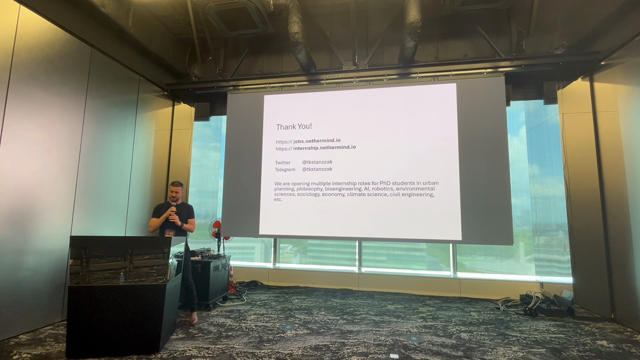
28:56Society Github
ETHTokyoSep 22, 2024
This talk will present the vision of the world that is build the same way as modern software. Version controlled and packaged public systems; AI, blockchain, and robotics existing to serve the humanity while following the Three Laws of Robotics; etc. The video features a discussion with a group of hackers about the future of Ethereum and its role in building decentralized technologies. The speaker touches on the early vision of Ethereum, including ideas like NFTs, prediction markets, and autonomous machines. They highlight the convergence of AI, blockchain, and robotics as critical for creating a decentralized world. The company Universal Solutions is mentioned as driving humanity to tackle challenges related to decentralized power and technology. The conversation delves into the importance of open-source security mechanisms for machines to ensure they act as protectors of humanity. The speaker advocates for verifiable computations and hardware within the blockchain space for real-time verification of machine behavior. The video also explores the concept of bizarre bazaars versus cathedrals in development models, emphasizing the need for a balance between centralized efficiency and open-source collaboration. The speaker imagines a future where decentralized repositories for AI models and governance mechanisms allow for transparent deployment and operation of various societal functions, such as healthcare, education, and public services. The idea extends to using blockchain not only for funding but also as a governance tool before deployment. Discussions include how society might protect itself against potential misuse of technology through collective, open-source efforts rather than centralized government control. Finally, the speaker envisions a world where even complex systems like
 14:18
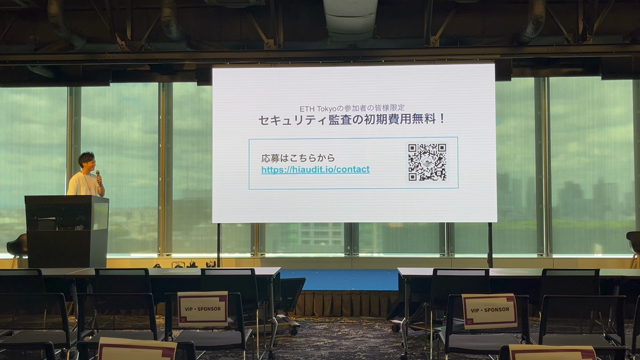
14:18Everyday, Everywhere, the Eve of the Revolution
ETHTokyoSep 21, 2024
Talk Session by Techfund. This video features a representative from a tech fund discussing the security aspects of the Web3 industry, including recent hacking cases and the overall trends in the sector. The speaker introduces their company, which has been supporting startups since 2014 and entered the blockchain space around 2016. They focus on security audits and have partnered with a Ukrainian security firm to stay at the forefront of vulnerability research. The presentation covers composability in blockchain, smart contract verification, and how these factors contribute to the growth and convenience of blockchain services. The speaker also addresses the increasing importance of security audits in protecting against threats and hacking incidents. They note that despite audits, about half of the projects that experienced leaks had been audited, highlighting the need for more robust security measures. The speaker encourages viewers to consider various audit companies and tools available, including their own tool that integrates multiple tools for comprehensive smart contract analysis. Finally, they mention their recent participation in a conference and invite attendees to consult with them at their booth for more information on their services and current promotions.
 03:45
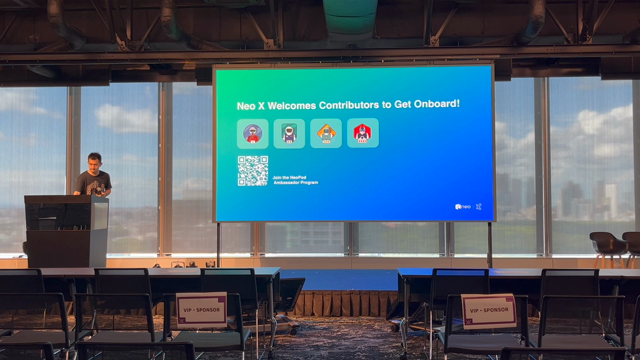
03:45Embarking on a New Chapter
ETHTokyoSep 20, 2024
Talk Session by Neo-X Steven, the head of development for Neo Blockchain, introduces NeoX, an EVM compatible sidechain designed to attract more EVM developers to the Neo ecosystem. Launched in July, NeoX offers full EVM compatibility, allowing existing DApps to integrate seamlessly. The platform emphasizes its anti-MEV features to protect transactions from front-running through encrypted transactions that only consensus nodes can decrypt. Additionally, NeoX maintains the original two-token model with Neo and GAS tokens and retains the DBFT consensus algorithm for one block finality. A native bridge is available for token transfers between Neo N3 and NeoX. Steven also mentions an Elevates program aimed at encouraging more Ethereum developers to join their ecosystem and invites contributors to get involved.
 39:10
39:10ETHBerlin04 Workshop: Tino Breddin - Integrating RPCh in your Dapp to privately connect to RPCs
ETHBerlinSep 4, 2024
ETHBerlin04 May 24-26, 2024, CIC Innovation Campus Technical Workshop: ETHBerlin04 Workshop: Tino Breddin - Integrating RPCh in your Dapp to privately connect to RPC endpoints ETHBerlin04 - https://ethberlin.org A Department of Decentralization event - https://dod.ngo The video features Tino Bredin discussing RPC (Remote Procedure Call) security, the privacy implications of using an RPC endpoint, and how to enhance the privacy of decentralized applications (dApps) for users. He highlights the importance of transport privacy, focusing on protecting metadata such as IP addresses that are often exposed during internet usage. To illustrate his point, he demonstrates a tool called Derp, which mimics an RPC provider and logs requests made through a user's wallet, revealing how easily metadata can link different user accounts. Bredin then introduces Hopper's solution to this privacy issue, which involves using the RPC-H SDK within a dApp to anonymize RPC requests by unlinking the user's IP address from their on-chain activity. He provides a hands-on example by showing how to integrate RPC-H into a basic blockchain explorer dApp that fetches and displays block data and transaction logs. The video includes a step-by-step guide on setting up DERP as an RPC endpoint in MetaMask, cloning a GitHub repository with the example dApp code, switching between branches with and without RPC-H integration, and installing necessary dependencies to run the application.
 40:31
40:31ETHBerlin04 Opening Ceremony
ETHBerlinSep 4, 2024
ETHBerlin04 May 24-26, 2024, CIC Innovation Campus Afri & Franzi from the DoD open the hackathon! ETHBerlin04 - https://ethberlin.org A Department of Decentralization event - https://dod.ngo The video features Francie and Afri welcoming participants to the opening ceremony of a hackathon event in East Berlin. They provide an overview of the event, emphasizing that it's a hands-on hackathon with no passive spectators, and encourage everyone to actively contribute. They welcome all hackers, volunteers, mentors, judges, speakers, experience hosts, and remind returning attendees about the event's purpose: to make a difference and build useful things. They urge new participants to read the manifesto for inspiration. The hosts outline house rules including the necessity of wearing a wristband for entry, inform attendees that the venue is open 24 hours with food and drinks provided, and stress that there will be no tolerance for code of conduct violations. They explain the venue's security system for door access using color-coded signals and encourage exploration of the multi-floor venue while cautioning against accessing restricted areas. They highlight essential information for hackers such as joining the matrix room for communication with mentors and other participants. The summary conveys that this video is an informative guide for attendees on how to navigate and make the most out of their hackathon experience at East Berlin.
 1:26:13
Closing Keynote
Web3SummitAug 21, 2024
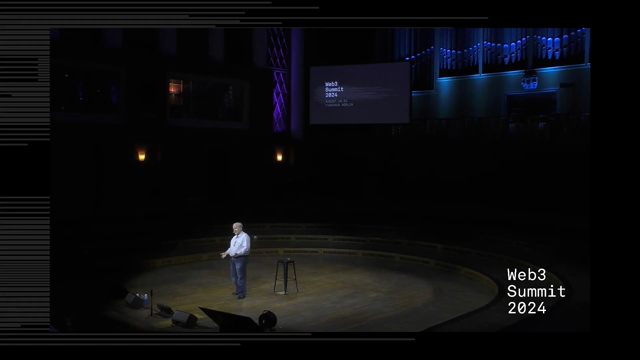
Closing Web3Summit Keynote given by the great Richard Stallman. The video features a talk by Richard Stallman, a prominent figure in the free software movement, who emphasizes the moral imperative of software freedom over the more pragmatic approach of open source. He introduces free software as a concept that respects user freedom and community, outlining the four essential freedoms that define it: the freedom to run the program for any purpose, to study and change the source code, to redistribute copies, and to distribute modified versions. Stallman highlights the dangers of proprietary software, which can control and harm users for corporate profit. He recounts the history of the GNU operating system and Linux kernel, which together provide a free software alternative. The video also discusses how maintaining freedom sometimes requires sacrifices and avoiding non-free applications or JavaScript. The goal is to encourage viewers to join the free software movement and maintain control over their digital lives.
 1:01:53
Phil Zimmermann
From PGP to ZRTP: Decentralized Privacy Protocols in a Centralized Ecosystem
Web3 Summit 2024Aug 19, 2024
Listen to the creator of PGP talking about Decentralized Privacy Protocols in a Centralized Ecosystem The video features a speaker discussing their experience in the tech industry, emphasizing a preference for bottom-up design over top-down approaches. They recount working on an automated tape library system in the 1980s and how that project's design philosophy influenced their later work on PGP (Pretty Good Privacy), a cryptographic software. The speaker highlights the challenges faced while developing PGP, including financial struggles and the omission of a trust model in PGP 1.0 due to time constraints. They also touch on the legal issues surrounding PGP, stemming from patent conflicts with RSA Data Security and subsequent federal investigation. Additionally, the speaker reflects on the early days of email protocols and how they were designed to be decentralized, contrasting it with the siloed nature of modern VoIP services despite using similar encryption protocols. They express skepticism about the necessity of blockchains for achieving decentralization but maintain a strong interest in decentralized systems. The speaker clarifies that when they refer to "crypto," they mean cryptography, not cryptocurrency, and shares anecdotes about their involvement in various projects and protocols over the years.
 21:20
21:20A Lightweight Architecture for Ethereum Archive Nodes
EthCCAug 9, 2024
The core idea is to maintain compacted, flattened, and fine-grained (i.e., transaction-level) historical states by flattening the minimum state changes of each transaction required for the world state. The video features a talk by Andy, the CEO of BlockSec and a professor at Zhejiang University, discussing their research on optimizing Ethereum archive nodes. The research is a collaborative effort between BlockSec, students, and other partners. Andy emphasizes the importance of building real systems with tangible impacts and outlines BlockSec's role in enhancing blockchain security through various products and solutions. Andy explains that blockchain optimization can be achieved at different layers, including consensus mechanisms, execution layers, and storage engines. Their work focuses on optimizing the storage engine to improve efficiency and reduce costs by modifying the state model within Ethereum's archive nodes. He provides an overview of Ethereum's storage layer, explaining that it operates as a state machine driven by transactions that change states. The state is an account-based model with each account having its own storage referenced by a storage root. All states are encoded in a Merkle Patricia Tree (MPT) for quick data authentication. Different types of Ethereum nodes exist with varying capabilities regarding historical data storage. Full nodes only maintain the latest world state for reorganization tolerance while archive nodes preserve all historical states but require significant disk space due to saving all intermediate MPTs at each block. Archive nodes are essential for detecting transaction attacks and smart contract vulnerabilities through historical transaction analysis. They also help
 23:51
23:51A security in depth approach to verifiable offchain computations
EthCCAug 8, 2024
Hashi and SafeJunction are permissionless abstraction layers to create secure and future proof dapps. Hashi was designed to avoid bridging lock-ins and to enable higher degrees of security. SafeJunction extends this concept beyond cross-chain bridging, to verifiable arbitrary computations. The video discusses the importance of security in-depth for off-chain computations, particularly in the context of blockchain scalability and the use of proofs. The speaker explains how layer 2 and layer 3 solutions inherit security from Ethereum's base layer through proofs, which are essential for various applications like scalability, interoperability between layers, and external data verification through oracles. The concept of a "proof layer" is introduced as an abstract idea that is critical for blockchain security but does not yet exist in a concrete form. The speaker then delves into three main use cases for proofs: improving scalability through vertical integration of layers, decomposability across different systems, and co-processing to offload heavy computations while maintaining transparency and privacy. They also discuss the potential future where everything in the blockchain ecosystem operates via proofs, with layer 1 blockchains primarily verifying these proofs. However, there are challenges today in achieving this vision due to inefficiencies, fragmentation, trust assumptions, and high costs associated with proof generation and verification. Additionally, there are concerns about large attack surfaces and dependencies on unreliable code libraries. To address these problems, the speaker suggests design principles such as avoiding vendor lock-ins, implementing security in depth by using multiple layers of protection, and designing systems that are future-proof to withstand potential risks over
 22:32
22:32Digital integrity of the human person, A new fundamental right || Alexis Roussel
SwarmJun 24, 2024
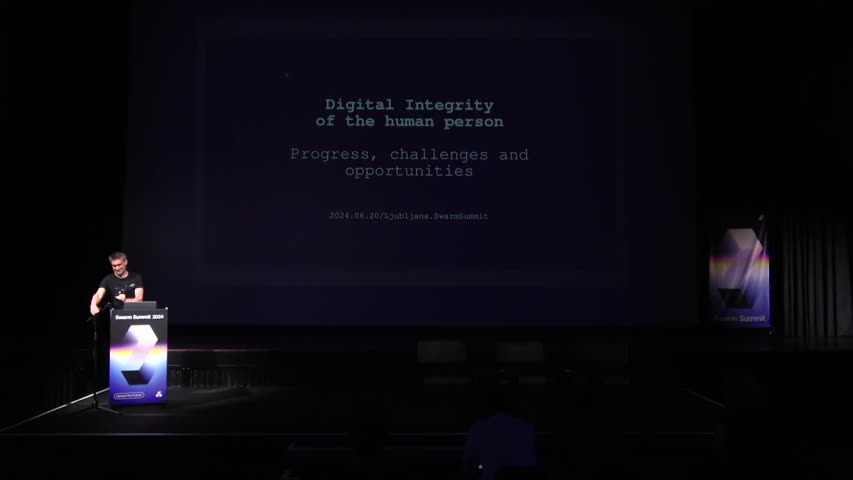
The right to respect for digital integrity is an emerging right to protect people's digital lives. This talk will introduce this new legal concept, its possible implications for data protection and how this concept is being introduced in the current legal framework. The talk will also be an update of the implementation work with the adoption of the right in the Constitution of Geneva voted with 94% approval rate on the 18th of june 2023. The video features a talk by Alex Roussel, CEO of NIM Technologies, on the topic of digital human rights and the concept of digital integrity. Roussel discusses his work on making the idea of digital integrity a recognized right, drawing parallels with physical and mental integrity protected by laws. He shares his success in getting 95% of voters in Geneva to approve a new digital right in 2023. Roussel explains that digital integrity should be an extension of existing rights, ensuring individuals have control over their personal data and are protected from non-consensual use of it. He emphasizes the importance of anonymity and privacy infrastructure, mentioning that NIM is building a mix net and VPN to support these goals. The talk also covers how digital integrity can be integrated into legal systems, citing examples from Switzerland where new rights have been added to the constitution. Roussel argues for transparent societal systems where personal data remains anonymous, allowing for private interactions between individuals. He concludes by stressing the need for decentralized, anonymous systems to protect against misuse by generative AI and other threats. The talk ends with audience questions on how simply adding "digital" to existing rights can effectively convey the necessary protections in legal contexts, with Roussel explaining how jurisprudence would adapt over time to refine these rights.
 18:59
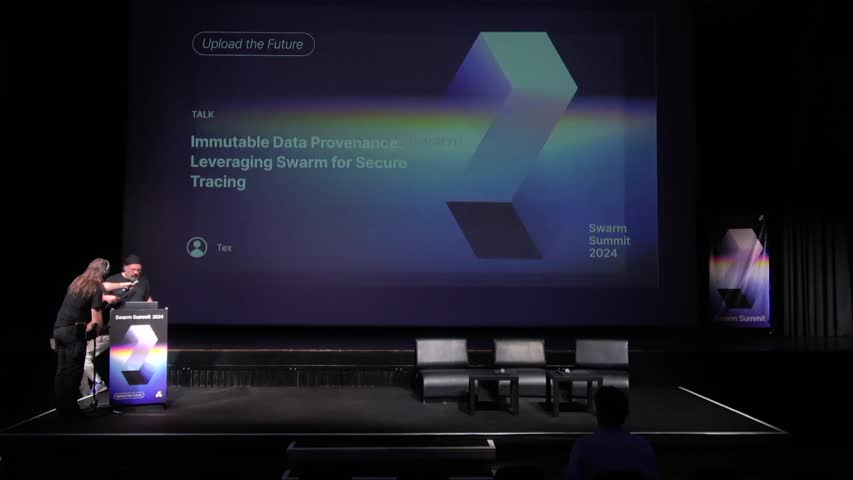
18:59Immutable Data Provenance: Leveraging Swarm for Secure Tracing || Tex
SwarmJun 21, 2024
Building Data Provenance - A quick overview of how data provenance; We will go throug what data provenance is. Iterate through existing standards and go through abstract implementation. The video features an individual named Tex discussing the concept of data provenance, the importance of authentication, auditing, and compliance within systems that synergize with blockchain technology. The speaker addresses the creation of a registry that aids in the current form of data management and emphasizes the use of Diffie-Hellman key exchange for securing data transactions on the blockchain. The video also delves into concepts such as smart contracts and notarization techniques that validate and secure data, ensuring its integrity over time. Additionally, it touches upon practical applications like legal evidence, contracts, intellectual property, and medical records management. The overarching theme is the significance of establishing a timestamped, verifiable record of data on the blockchain to ensure its historical accuracy and prevent tampering.
 18:35
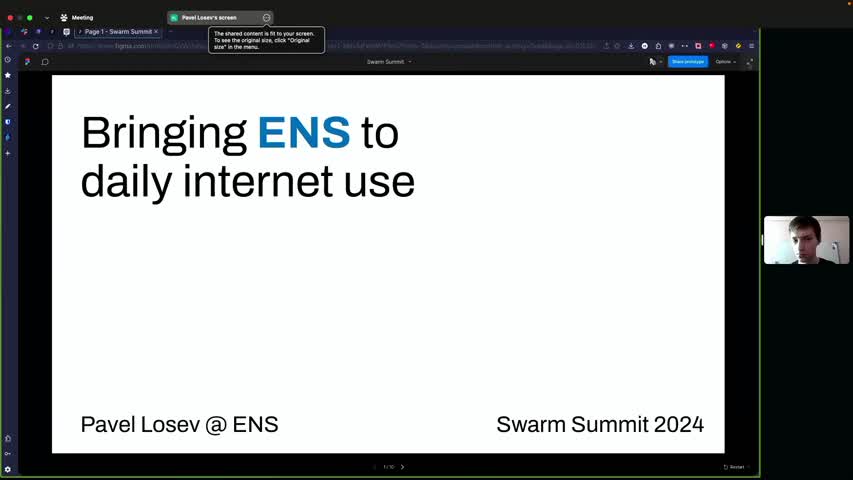
18:35Bringing ENS to daily internet use || Pavel Losev
SwarmJun 21, 2024
The talk will cover on different ways of how ENS-powered websites could be integrated into computers natively, without any need of gateways. It will compare 3 main approaches: Custom DNS Server, DNS client modules and a web extension. The video features a presentation by Pavel, a front developer at DNS, discussing how to integrate decentralized web (D-Web) domain names, specifically those ending in .eth, into everyday internet usage. He explains that .eth is an Ethereum-based alternative to the traditional DNS system with ownership managed by a DAO and resolutions done via smart contracts. Pavel reviews several methods for resolving .eth domain names, including HTTP gateways, browser integrations like in Brave, DNS servers with Web3 support, and running a local DNS server. He highlights the challenges of each method, such as censorship risks with HTTP gateways and limited support from major DNS providers. Pavel also provides a demo showing how he resolved .eth domains locally using various tools and discusses potential improvements for D-Web accessibility. The video concludes with an audience Q&A session where Pavel advises on handling domain squatting issues.
 11:52
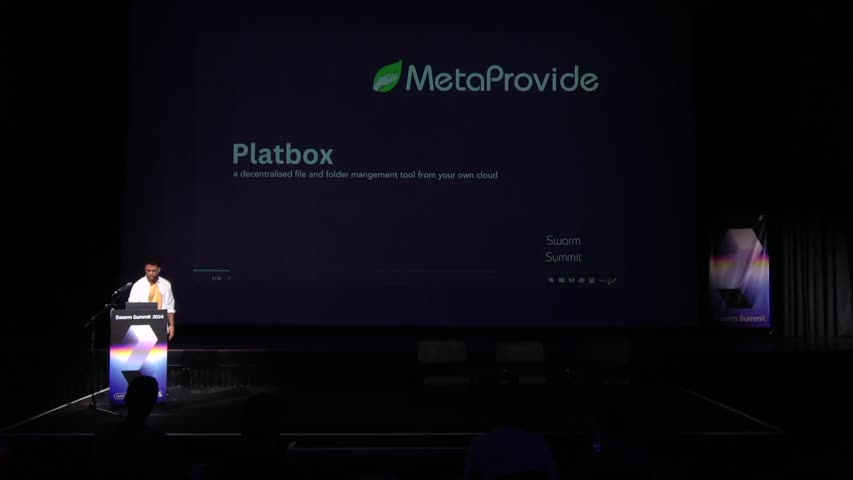
11:52PlatBox by MetaProvide, a decentralised file and folder management tool || Henry Bergström
SwarmJun 21, 2024
PlatBox helps companies to store, share, collaborate, and edit files using a "decentralised dropbox" by offering swarm-enabled decentralisation storage for Web2 and Web3 users, resulting in the truest form of data sovereignty without the need for understanding the complexity of Web3. The initial focus for this product are existing Nextcloud (organisations) and Moodle (education sector) users, where the tool can be imbedded into existing user interfaces. The video features a presentation about a decentralized file and folder management tool called PlatBox, which is now seeking a new name due to trademark issues. The tool integrates with users' own cloud storage and is built on top of NextCloud, an open-source self-hosted collaboration platform. The speaker shares the background of their team, MetaProvider, and their journey from creating a custom solution for well-being providers to shifting focus towards the broader cloud storage market. A demo showcases how the PlatBox plugin works within NextCloud, allowing users to manage and access files stored on Swarm, a decentralized storage system. The presenter emphasizes the goal of making sensitive data storage secure and "unstoppable" while keeping everyday data safe on users' own clouds. The presentation ends with a Q&A session addressing access control and potential expansion into other NextCloud services like voice facilities. The talk concludes with an announcement that the next topic will be about NFTs.
Insights into TEE Research and Deployment Framework for Blockchain Scalability | Filip Rezabek
ProtoLayersJun 20, 2024
Filip Rezabek from the Technical University of Munich describes the differences between Process-based and VM-based Trusted Execution Environments (TEEs), assessing their impact on blockchain scalability. He reviews the current state of TEE research, highlighting advancements and challenges. Additionally, the talk introduces a versatile framework designed for deploying and researching TEEs in both local and cloud settings This video features a speaker with experience in the crypto field, sharing insights about trusted execution environments (TEEs) at EVE Prague. The speaker discusses the definition of TEEs, their manufacturers, and potential use cases in blockchain and distributed systems. Emphasis is placed on TEE's ability to provide confidentiality and integrity for computations, as well as their role in scalability and privacy for blockchain applications. The talk delves into the technical aspects of attestation and the differences between process-based and VM-based TEE solutions from various manufacturers. Additionally, the speaker introduces a framework developed for assessing TEE capabilities within distributed systems and presents preliminary experimental results demonstrating the performance of TEEs compared to traditional computing environments. The presentation concludes with an invitation to explore their preprint publication for more detailed information.
 14:38
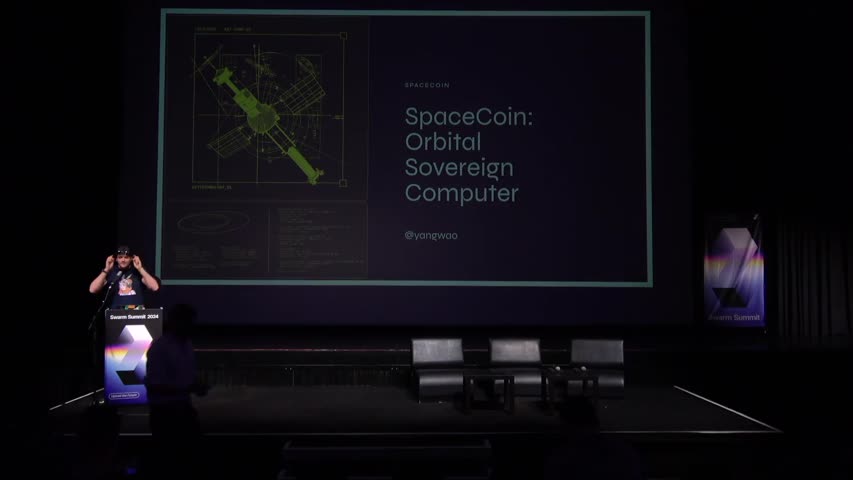
14:38Space compute onchain
SwarmJun 20, 2024
SpaceCoin is pioneering using CubeSats and blockchain technology to create a decentralized, autonomous network of orbital data centers and computing resources. The video features a speaker discussing the concept of space-based data centers and their potential integration into blockchain technology. The speaker has a background in Bitcoin, Ethereum, and space technology, including working on CubeSat software and participating in the European Space Agency (ESA) hackathon. They highlight the problems with terrestrial blockchains, such as susceptibility to attacks, natural disasters, and government interference. They propose that space-based data centers could offer solutions by providing unlimited land, freedom from national jurisdictions, lower energy consumption through solar energy harvesting in orbit, reduced latency for data transmission, and protection from physical attacks and natural disasters. The speaker also mentions high implementation costs and technical complexities as challenges but outlines a roadmap of progress in space-based computing since 2010 with experiments on the International Space Station (ISS) and partnerships with companies like Space Chain. The ultimate vision is to create a decentralized network of orbital data centers offering secure data processing services. Potential applications include space passports for extraterrestrial jurisdiction and secure banking operations. The presentation ends with an invitation to keep in touch through social media and solve a riddle left by the presenter. A question from the audience about the legal boundary of EU jurisdiction in relation to satellite data storage concludes the talk.
 28:49
28:49Defending malicious behavior in federated learning with blockchain
ZuBerlinJun 18, 2024
Clip The video features Jiahao Sun, the founder and CEO of Flock, discussing the company's mission and technology. Flock is a pun for federative learning blockchain, an idea stemming from a paper published in NeurIPS 2022 and further detailed in the journal "Transitioning AI." Jiahao's background includes working in traditional finance as head of AI at Eurobank Canada and as a researcher at Imperial College London. Flock aims to solve data silo issues in industries like finance and healthcare by combining federated learning with blockchain technology. Federated learning occurs on devices like smartphones, where data stays local while only model weight changes are sent to improve collective models. However, there's a risk of centralized control and data misuse, which Flock addresses using blockchain for transparency and security. The platform introduces an incentive mechanism where good behaviors are rewarded, and bad actors are penalized, ensuring honest participation. The system uses random selection for proposers who contribute to model training and voters who validate results. Malicious attempts are thwarted through this process, maintaining high accuracy even with a significant presence of bad actors. Jiahao also discusses experiments with the Kaggle Learning Club dataset that demonstrate the effectiveness of Flock's approach compared to traditional federated learning under malicious conditions.
 18:34
18:34Discussion 3: Proposer registration for commitments with Chainbound
ZuBerlinJun 12, 2024
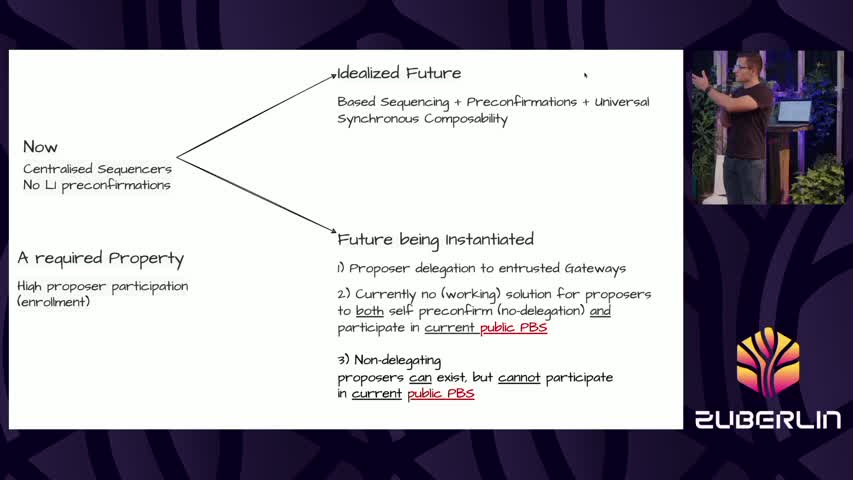
Clip The video discusses the current and idealized futures of blockchain technology, focusing on the challenges of proposer delegation, pre-confirmations, and universal synchronous composability. It highlights that there is no current solution allowing proposers to self-preconfirm while participating in the public PBS pipeline without changes to the pipeline itself. The discussion also explores how non-delegating proposers can exist but face difficulties participating in the current PBS system. The speaker suggests that high proposer participation is crucial for the vision of universal synchronous composability to be realized with high utility. Opinions on whether it's acceptable for all participants to delegate in the short term are shared, acknowledging that this is a contentious issue. The conversation shifts to issues of roll-up fragmentation, user experience challenges due to liquidity fragmentation across different roll-ups, and potential solutions like shared sequencing protocols. However, concerns about censorship resistance and sovereignty loss for roll-ups are raised. There's also a debate on whether L1 proposers will sequence for L2s and how pre-confirmation gateways might be allocated via a registration smart contract on L1. The video concludes with technical discussions about possible implementations, including using SGX for trust issues and how MEV could flow back to L2s through auction mechanisms. Overall, the video presents a deep
 20:25
20:25Radius
ZuBerlinJun 11, 2024
Clip The video features the co-founder of Radius discussing their approach to using basic sequencing for the decentralization and unification of ROLIPS. The talk covers the importance of basic sequencing in ensuring safety, censorship resistance, and liveness during the pre-settlement step of ROLIPS transactions. The presentation explains how ROLIPS inherits decentralization from Ethereum during the settlement phase but lacks these properties in pre-settlement. The speaker proposes a solution involving incentive alignment between users and Ethereum proposers to ensure transaction safety before they are sent to Ethereum. The talk delves into the challenges of achieving decentralization without causing layer 1 centralization or relying on sequencer and proposer relationships. It introduces a delegation contract as a potential solution, which involves a complex interaction between sequencers, builders, and proposers to hedge operational risks through auctions and contracts. Furthermore, the presenter discusses risk management strategies for builders and profit opportunities for sequencers while maintaining censorship resistance through an encrypted mempool that ensures transactions are processed without bias. Lastly, a liveness solution called RAFT is mentioned to handle sequencer failures. The speaker concludes by inviting discussion on further ideas for achieving decentralization in ROLIPS, particularly focusing on safety with basic sequencing and addressing challenges related to liveness and avoiding layer 1 central
 28:17
28:17LimeChain
ZuBerlinJun 11, 2024
Clip The video features a presentation by Daniel Ivanov from Limechain, who discusses the research and development of vanilla-based sequencing and preconfirmations in the context of roll-ups and blockchain interoperability. Funded by a grant from the EF, their work aims to provide neutral solutions for these technologies. The talk covers four major design decisions: discovery, leader selection, preconfirmation types, and integration with the L1PBS pipeline. Daniel explains various options for each design aspect and their implications for wallets, users, builders, relayers, and proposers in the blockchain ecosystem. He emphasizes the importance of standardizing certain aspects to achieve unmatched interoperability and rationalizes the current social consensus on preconfirmations. Daniel acknowledges that there are differing opinions within the community and seeks to establish a socially accepted view. Several scenarios are presented regarding how transactions are propagated among different actors (builders, relayers, proposers) in the network. The pros and cons of each scenario are examined, particularly focusing on issues like trust, delegation, and potential slashing risks for proposers. Daniel highlights the need for an EIP on the builder API as one of the missing pieces to move forward collaboratively but not fragmented. He concludes by posing questions to the community about improving these systems further. The presentation ends with a