About 480 results
 46:47
46:47Base Builder Friday: December 6, 2024
BaseOct 9, 2025
On the first Friday of each month we get together with Jesse Pollak and core Base builders from around the world for Base Builder Friday. Last Friday was the last one of 2024, here's the video :) Things Jesse talked about: ↳ Top of mind ↳ Reflections from Base's world tour ↳ AI agents on Base ↳ Q & A Happy holidays ❄️ 🎅
 20:37
20:37Jayant Krishnamurthy I What’s Stopping DeFi from Competing with TradFi I Pyth I Pragma San Fran 2024
ETHGlobalOct 9, 2025
Jayant Krishnamurthy, CTO and co-founder of Pyth Network, breaks down why DeFi struggles to compete with traditional finance (TradFi) and how infrastructure improvements can bridge the gap. He compares DeFi and TradFi across speed, cost, and trust, highlighting key pain points like high gas fees, slow transactions, and security risks. Krishnamurthy also explores how Pyth Network’s solutions—such as low-latency price feeds, on-chain randomness, and MEV reduction—are paving the way for a more efficient DeFi ecosystem. Learn how better infrastructure can enable DeFi to finally rival TradFi in usability and adoption. 00:00 - Introduction 00:42 - The Problem with DeFi 01:16 - TradFi vs. DeFi Comparison 03:20 - Infrastructure as the Key 05:15 - Lessons from Past Tech Shifts 07:50 - Blockchain’s Programmable Trust 09:49 - Pyth Network’s Solutions 12:17 - High-Frequency Price Feeds 13:20 - On-Chain Randomness 15:14 - Solving MEV 18:15 - Oracles & DeFi Growth 19:52 - Future of DeFi vs. TradFi 20:19 - Conclusion _ _ _ _ _ _ _ _ _ _ _ _ _ _ _ _ _ _ _ _ 🇺🇸 *Pragma San Francisco* Pragma San Francisco 2024 was a special gathering of founders and builders that took place October 16th and 17th at The Contemporary Jewish Museum in San Francisco, CA. Pragma San Francisco 2024 was an opportunity discuss the future of web3 and reflect on the past. Watch the full Pragma San Francisco playlist here: https://youtube.com/playlist?list=PLXzKMXK2aHh4LcwDpGf_itZrAu7XRNb07&si=3x3y9J3avgNTITUe ETHGlobal's Pragma series takes place in cities around the world, and is designed to be a different kind of event. Pragma is a one-stage conference with founders-only on stage, bringing together a small group of curated attendees and speakers to discuss the future of web3 and reflect on the past. _ _ _ _ _ _ _ _ _ _ _ _ _ _ _ _ _ _ _ _ ✅ *Follow Jayant Krishnamurthy* X: https://x.com/jayantkrish ✅ *Follow Pyth Network* X: https://x.com/PythNetwork ✅ *Follow ETHGlobal* X: https://x.com/ETHGlobal Warpcast: https://warpcast.com/ethglobal Website: https://ethglobal.com YouTube: https://www.youtube.com/c/ETHGlobal _ _ _ _ _ _ _ _ _ _ _ _ _ _ _ _ _ _ _ _ _Are you interested in Ethereum development and entrepreneurship?_ 👉 Sign up for the next ETHGlobal event: https://ethglobal.com/events 🎁 Get exclusive access and perks with ETHGlobal Plus! https://ethglobal.com/plus 📣 Want us to throw an event in your city? Tell us where! https://ethglobal.com/city _ _ _ _ _ _ _ _ _ _ _ _ _ _ _ _ _ _ _ _
 23:26
23:26Kartik Talwar
Fireside Chat with Kartik Talwar & Friederike Ernst at Pragma Prague 2025
ETHGlobalOct 9, 2025
In this fireside chat at Pragma Prague 2025, Kartik Talwar sits down with Friederike Ernst, co-founder of Gnosis, to explore Circles - a revolutionary approach to personal currencies. They discuss how Circles reimagines money creation using modern cryptography, eliminating banks as intermediaries while maintaining a web-of-trust model. The conversation covers practical implementation, group currencies, liquidity challenges, and real-world adoption strategies for this alternative monetary system that puts currency issuance directly in users' hands. 00:00 Introduction to Friederike Ernst and Circles concept 00:47 Defining Circles: Modern money with today's technology 01:26 How traditional money creation works through banks 02:40 Moving money issuance to individuals with cryptography 03:20 Settlement vs issuance: The role of banks in Circles 03:58 Circles mechanics: 24 daily issuance & demurrage 04:38 Personal currencies and the web-of-trust model 05:16 Protocol routing through trust connections 06:27 Abstracted pathfinding for transactions 07:02 Solving Sybil attacks through local network curation 07:37 Incentives for maintaining trust networks 08:10 Addressing liquidity challenges in daily transactions 08:45 Group currencies as liquidity solutions 09:27 Example: Self group implementation 10:02 Multiple identity solutions (Worldcoin, BrightID) 10:40 Pricing non-fungible personal currencies 11:15 Group currency valuation dynamics 11:49 Market-driven liquidity fragmentation 12:23 No enforced restrictions on currency behavior 12:56 Complementarity with proof-of-personhood systems 13:25 Agnostic identity verification approach 14:12 Decentralized ownership of currency networks 14:55 Circles adoption journey since 2020 launch 15:44 Challenging dollar dominance in global trade 16:22 Changing perceptions about money as technology 16:56 From cognitive shift to practical usage 17:31 New user-friendly app with QR code payments 18:04 Price stability and co-payment strategies 19:14 Localized pricing with group currencies 20:40 Incentivizing network growth and adoption 21:47 Positive early adoption experiences 22:24 Network effects and personal incentives 23:03 How to sign up for Circles V2 _ _ _ _ _ _ _ _ _ _ _ _ _ _ _ _ _ _ _ _ 🇨🇿 *Pragma Prague* Pragma Prague 2025 was held on May 29th at Holešovice Market in Prague, Czech Republic and was an in-person summit for builders and leaders in the web3 ecosystem. This event was in collaboration with ETH Prague. Watch the full Pragma Prague YouTube Playlist here: https://youtube.com/playlist?list=PLXzKMXK2aHh7vLS72NelQ2dOx2VgPNxJZ&si=lQumFEDOqD_CNswb ETHGlobal's Pragma series takes place in cities around the world, and is designed to be a different kind of event. Pragma is a one-stage conference with founders-only on stage, bringing together a small group of curated attendees and speakers to discuss the future of web3 and reflect on the past. _ _ _ _ _ _ _ _ _ _ _ _ _ _ _ _ _ _ _ _ ✅ Follow Friederike Ernst X: https://x.com/tw_tter ✅ Follow Gnosis X: https://x.com/gnosisDAO ✅ Follow Kartik Talwar X: https://x.com/TheRealKartik ✅ Follow ETHGlobal X: https://x.com/ETHGlobal Warpcast: https://warpcast.com/ethglobal Website: https://ethglobal.com YouTube: https://www.youtube.com/@UCfF9ZO8Ug4xk_AJd4aeT5HA _ _ _ _ _ _ _ _ _ _ _ _ _ _ _ _ _ _ _ _ Are you interested in Ethereum development and entrepreneurship? 👉 Sign up for the next ETHGlobal event: https://ethglobal.com/events 🎁 Get exclusive access and perks with ETHGlobal Plus! https://ethglobal.com/plus 📣 Want us to throw an event in your city? Tell us where! https://ethglobal.com/city _ _ _ _ _ _ _ _ _ _ _ _ _ _ _ _ _ _ _ _
 1:30:22
Regulating the Revolution: AI, Blockchain, and the Future of Policy
Michigan Ethereum MeetupOct 25, 2024
Are you curious about how blockchain and AI are transforming the regulatory landscape? Join the discussion with this powerhouse panel of experts. Featuring the former Director of Emerging Technology Policy at the US Department of Homeland Security, acclaimed legal experts in emerging tech policy, and an influential Web3 visionary. We'll dive into AI legislation, legal hurdles for Web3 development, and many key legal and compliance issues defining the future of emerging tech. Whether you're a creator, developer, or policymaker, you'll gain important insights into the rules that govern tomorrow's digital landscape. EVENT SPONSORS: - Stand With Crypto https://www.standwithcrypto.org/ - Digital Ascension Group https://www.digitalfamilyoffice.io/ - Detroit Ledger Tech sponsoring the Videography & AV https://detroitledger.tech/ TOPICS COVERED IN THIS DISCUSSION: - Regulatory Frameworks - Compliance and Legal Liabilities - Enforcement Challenges - Legal and Ethical Issues - Privacy and Security - Consumer Protection - DAOs and Legal Structures - Future Legal Trends and Global Impacts ******************* GUEST SPEAKERS ******************* RICK TAPIA Rick Tapia is an attorney, entrepreneur, international keynote speaker, and thought leader in the legal AI and emerging technologies space and is the General Counsel for Digital Ascension Group. Rick is also the CEO and Founder of DraftChain.AI, a legal technology company that is disrupting the legal industry by leveraging AI to streamline legal workflows. As an entrepreneur and attorney, he has successfully helped several emerging tech businesses succeed since 2016. Rick has an extensive background in the United States and Indiana politics that has fueled his vast network of connections to the entrepreneur world. NICK REESE Co-founder & COO of Frontier Foundry Corporation Mr. Reese most recently served as the first-ever Director of Emerging Technology Policy at the US Department of Homeland Security, where he advised the White House & senior Cabinet officials on the national security implications of emerging technologies. He is the author of multiple White House, Cabinet-level, & other federal government policies, Executive Orders, National Security Memoranda, & strategies related to emerging technologies. A noted expert in cyber operations, quantum computing, artificial intelligence, & outer space, he currently holds a faculty position at the NYU Center for Global Affairs, teaching graduate courses related to emerging technology and geopolitics. Mr. Reese has a 20+ year career in the US Military, Intelligence Community, & Homeland Security, with a focus on operations and bringing technical solutions to high-stakes national security challenges. MARK CIANCI Mark Cianci is a seasoned litigator with nearly 15 years of experience representing high-profile clients in complex litigation. Mark represents clients in the blockchain and cryptocurrency space in litigation and advises on a variety of regulatory and risk-mitigation considerations, including compliance with securities laws. He has a deep understanding of ongoing legal challenges in emerging technologies making him a leading voice on regulatory issues in these fields. BRANDON STREET Co-Founder and CEO of Creative Collab Mr. Street an American NFT entrepreneur building a leading collaboration incubator. Since 2021, he has joined 30+ NFT communities, partnered as a verified Sandbox agency, and founded an educational program offering NFT coaching and mentorship. He has also gained meaningful experience in regulation within the NFT and broader blockchain space by working with clients to ensure compliance with securities laws and navigate regulatory requirements. ELIZABETH HANSSON The evening's panel, "Regulating the Revolution", will be led by Elizabeth Hansson. Ms. Hansson is a community builder around emerging tech in Detroit. She is also a software engineer, blockchain consultant, and CTO in the blockchain space since 2016. ********** CREDITS ********** EVENT PARTNERS: - Media and Marketing: Thanks to Macro Visuals Media for your stellar job in Web3 marketing. (https://www.macrovisualsmedia.com/) - AV & Videography: Thanks to Adam Zientarski of DLT for taking care of us! - Event Photography: 888 Creative, and Macro Visuals Media. VENUE: Thank you to Urban Tech Xchange for hosting this event & helping to drive innovation in Detroit! HOST: This event Is hosted by Elizabeth Hansson and the Michigan Ethereum MeetUp. Contact MichiganEthereum@gmail.com for inquiries. #blockchain #policy #cryptocurrency #artificialintelligence #web3 #crypto #techpolicy #ai
 1:01:02
Getty Hill
The Future of Onchain Finance with Getty Hill
ETHChicagoOct 9, 2024
Is crypto the future? Always has been. Join us as we chat with Getty Hill, co-founder of GFX Labs, a pioneer in the DeFi space. Getty's journey from aerospace engineering to crypto is a testament to innovation and adaptability. Learn about the challenges and triumphs of building a crypto company in Chicago, the future of DeFi, and how GFX Labs is making financial tools more accessible. Getty shares insights on regulation, company culture, and the transformative potential of blockchain technology. Get ready to dive into the world of decentralized finance with one of its brightest minds. LINKS Oku https://oku.trade/ GFX Labs https://gfx.xyz/ Getty Hill on X https://twitter.com/getty_hill
 53:16
53:16Base Builder Friday: April 5, 2024
BaseOct 9, 2024
Base Builder Friday is a monthly call with core Base builders. This Friday's topics: ↳ Base's mission, vision, and strategy ↳ Huge Q1 progress ↳ Scaling up Base ↳ Upcoming events ↳ Q&A Build on Base: https://base.org/ Base on Farcaster: https://warpcast.com/~/channel/base Base on X: https://x.com/base
 14:05
14:05Jesse Pollak
Jesse Pollak • Lightning Talks • Based Memes
BaseOct 9, 2024
A lightning talk from Jesse Pollak about Base, the global onchain economy, based memes, and how they'll help bring the world onchain!
 25:26
25:26Base Builder Friday: July 12, 2024
BaseOct 9, 2024
Base Builder Friday is a monthly call with core Base builders. This Friday's topics: ↳ Base's mission, vision, and strategy ↳ Personal update from Jesse ↳ Buildathon highlights ↳ Onchain Summer ↳ Scaling and decentralization ↳ Smart wallets Build on Base: https://base.org/ Base on Farcaster: https://warpcast.com/~/channel/base Base on X: https://x.com/base
 54:05
54:05Base Builder Friday: August 9, 2024
BaseOct 9, 2024
Base Builder Friday is a monthly call with core Base builders. This Friday's topics: ↳ Day One ↳ Basecamp Highlights ↳ Basenames ↳ Buildathon Winners ↳ Onchain Content Network ↳ Top Resources for Builders ↳ Q&A Build on Base: https://base.org/ Base on Farcaster: https://warpcast.com/~/channel/base Base on X: https://x.com/base
 24:04
24:04Homage to Augur
ETHTokyoSep 21, 2024
This talk will discuss how to built crypto-economically secure oracles and governance mechanisms. It will centre on the design of the oracle used in Augur, an early Ethereum prediction market. The video discusses a particular early prediction market built around 2015, which the speaker believes used mechanisms superior to most projects developed since then. The speaker, who managed a significant project in 2014, reflects on the history and design of these mechanisms and their relevance to current blockchain technology. They touch upon the challenges of prediction markets, such as obtaining accurate real-world information and ensuring secure and reliable outcomes. The speaker also delves into theoretical aspects and potential solutions to these challenges, emphasizing the importance of effective communication and information sharing in blockchain systems.
 26:35
26:35Panel discussion: Securely Scaling Ethereum
ETHTokyoSep 21, 2024
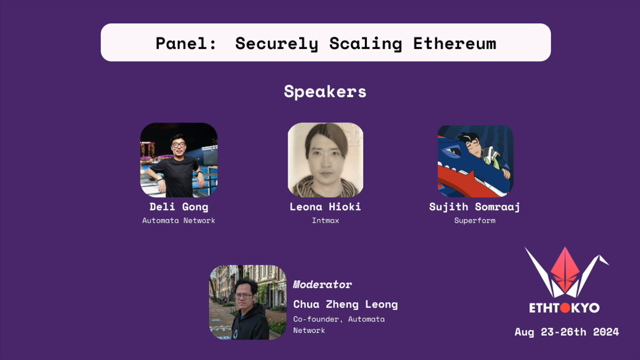
Discussing how to scale Ethereum to the next billion of the world. In this video, a panel discussion on scaling Ethereum securely features experts from different projects in the crypto space. The panelists discuss the future of Ethereum scalability, prioritizing security, usability, and decentralization. They explore the concept of endgame for Ethereum, touching upon topics like rollups, zero-knowledge proofs (ZKPs), and the importance of privacy in transactions. The conversation also delves into the trade-offs between scaling at layer one (L1) and layer two (L2), the role of rollups in Ethereum's future, and the challenges related to interoperability between different rollups. Additionally, they address whether Ethereum should cater to web3 or web2 use cases and the potential of using Ethereum for everyday transactions like buying coffee. The video concludes with a Q&A session from the audience.
 03:06
03:06About statelessness
ETHTokyoSep 20, 2024
Talk Session by Intmax. The video features Leona from Intimax discussing the importance of privacy in the crypto space and introducing Intimax as a stateless layer 2 solution that offers enhanced security and privacy. She addresses the controversy around privacy and invites the audience to consider their use of privacy-focused crypto tools. Leona explains how Intimax operates similarly to various crypto protocols, offering a compliant and transparent version of privacy solutions. She references a paper by prominent figures in the industry that enables users to prove their funds are not associated with criminal activity using zero-knowledge proofs (ZKP). Lastly, Leona announces the start of privacy mining in October, which users can participate in without specialized equipment, just a phone or laptop.
 24:02
24:02VDF-Based On-Chain Random Beacon: Practice and Challenges
ETHTokyoSep 18, 2024
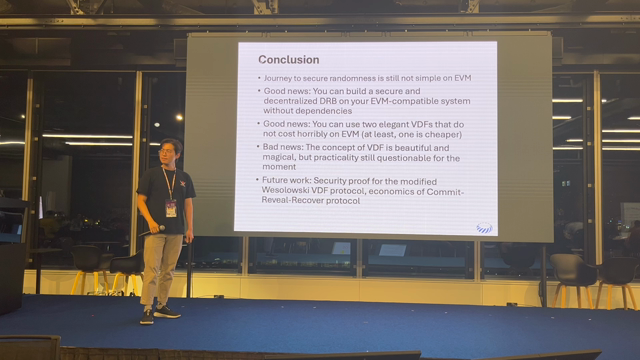
This talk will discuss constructing a VDF-based on-chain Distributed Random Beacon (DRB), introduce two VDF mechanisms, share optimization techniques, and compare applications of Commit-Reveal schemes enhanced by VDF, noting the challenges in blockchain environments. The video discusses the development of a distributed random beacon (DRV) for an L2 blockchain due to the lack of support from existing oracle services. The DRV is essential for applications that require secure random numbers, such as leader elections and lotteries. The presenter emphasizes the importance of liveness in DRVs, which ensures that random numbers are generated even if some participants disrupt the process. They introduce the commit-reveal-recover scheme using VDF (Verifiable Delay Function) as a solution to achieve strong liveness, allowing recovery of random numbers if the process is interrupted. The challenges of implementing VDF on Ethereum Virtual Machine (EVM) are addressed, focusing on verifying VDF evaluations within smart contracts. Two types of VDFs, Pitchfork and Wesolowski's, are compared in terms of gas costs and implementation complexity. The video also touches on the concept of hash-to-prime functions. Finally, strategies for implementing these VDFs are discussed, with insights into optimizing gas usage by balancing protocol repetitions and modular exponentiation checks on EVM for Pitchfork VDF implementation.
 21:34
21:34TLSNotary: Bridging Data from web2 to web3 Using Privacy-Preserving MPC
ETHTokyoSep 18, 2024
TLSNotary is an open-source project that utilizes MPC-TLS (Multi-Party Computation-Transport Layer Security) to enable users to prove and share their data while preserving their privacy. The video features a presentation by Chris from the TLS Notary team discussing the project's aim to securely bring data from Web 2.0 to Web 3.0 using privacy-preserving multi-party computation (MPC). He explains that TLS Notary is part of Privacy and Scaling Explorations, a research lab funded by the Ethereum Foundation, which focuses on programmable cryptography and building proof-of-concept applications. Chris provides an overview of Transport Layer Security (TLS), emphasizing its role in ensuring secure communication on the internet by confirming data origin and integrity but lacking portability. He illustrates this limitation with an example where Alice needs to prove her bank balance to Bob without Bob being able to trust the document's authenticity. TLS Notary aims to solve this problem by enabling data portability without relying on trusted third parties while preserving privacy through MPC TLS technology. Chris describes use cases such as creating a Web 3.0 ride-hailing service that leverages driver ratings from an existing platform like Uber without Uber's cooperation or knowledge. He delves into how TLS Notary works, explaining the roles of servers, provers, and verifiers in the original TLS and how TLS Notary introduces an additional verifier who participates in key exchange using MPC. This process ensures that no single party
 26:53
26:53Scaling Web3 Technology with Authentic DevRel & Collaborative Dev Innovation
ETHTokyoSep 18, 2024
Exploring the transformative impact of Snaps permissionless innovation in the Wallet ecosystem. Discover how authentic relationships and collaborative innovation are reshaping wallet technology in Web3. The video features a speaker named Francesco from the DevRel team at MetaMask discussing developer tooling with a focus on Snaps and permissionless innovation. He talks about the importance of Snaps for extending the functionality of MetaMask, allowing developers to integrate features like interoperability, transaction insights, privacy, and on-chain notifications. Francesco highlights that Snaps can support various blockchains and assets that are not natively supported by MetaMask. He also mentions the recent update to Flask V12 and notes that over 50 Snaps have been approved for use by the community. Francesco emphasizes permissionless innovation as crucial for community growth and details how developer relations (DevRel) play a role in supporting developers through educational content, tutorials, feedback loops, and fostering a safe space for discussion. He introduces the concept of a hierarchy of builder needs, akin to Maslow's hierarchy of needs, explaining how it applies to developers' requirements. Additionally, Francesco discusses the importance of understanding different levels of developer expertise when creating documentation and tutorials. He advises against product-specific conversion tactics in favor of value-driven onboarding that prioritizes educational content. The video also includes mention of an event called Builder Nights focused on deep technical topics. Lastly, Francesco provides frameworks for engaging with developers at different stages in
 --:--
--:--Interplanetary Banking System
ETHTokyoSep 17, 2024
This talk will talk about lending in the future, if our current infra is sufficient for truly tokenized economy and what is missing to support humans as multi-planetary species. The video features a presentation on the concept of an Interplanetary Banking System (IPBS), exploring how lending could operate in the future, including the possibility of mortgages on Mars. The speaker discusses the evolution of banking from face-to-face interactions to blockchain technology, which removes geographical constraints and is enforced by code rather than law. The presentation covers how financial transactions have evolved with communication advancements, from hand-delivered letters to instant global transactions via the internet and blockchain. The speaker outlines a hypothetical scenario where someone buys property on Mars and secures a mortgage with specific terms, using a tokenized asset as collateral. They delve into various aspects of this futuristic lending system, such as interest rates that could vary based on external conditions like sandstorms, borrower-specific default conditions, and different liquidation processes. The presentation emphasizes flexibility in lending protocols, advocating for modular designs that can adapt to change and cater to different needs. The speaker suggests that instead of trying to predict future requirements, we should create systems that are responsive and can integrate new modules for functions like interest calculation, default management, and liquidation. In summary, the video is about envisioning an adaptable and decentralized financial system for an interplanetary future where anyone can engage in financial transactions without the constraints of traditional banking systems or physical borders
 --:--
--:--Maximal Extractable Loss-Versus-Rebalancing
ETHTokyoSep 17, 2024
This talk will discuss mehtods to empirically determine the maximal extractable amount of such CEX-DEX arbitrage value in an attempt to measure the upper bound of this LVR problem to date. The video features Ricky Yudhoyaga from Sorella Labs discussing the hidden costs associated with being a liquidity provider (LP) in cryptocurrency markets, particularly in the context of Uniswap's V2 and V3 pools. He begins by explaining the difference between passive LPs and LPs who trade against informed traders, highlighting that informed traders have market insights that LPs lack, which can lead to LPs incurring losses. Ricky introduces the concept of LP's hidden costs or LVR (Liquidity Provider's Value at Risk) and discusses methods to quantify these costs. He details three approaches: a filtered markout based on historical trades, an implied volatility-based model, and a max LVR method. The filtered markout method calculates the difference between the price at which a trade is executed and the price shortly after, adjusted for volume and whether it's a buy or sell. This method also distinguishes between informed and uninformed trades by looking for signals such as high priority fees. Ricky presents data from an open-source MEV classification tool called Brontis developed by Sorella Labs, which shows that LPs have potentially lost over $200 million since March due to not performing proper delta hedging. He also discusses how varying the time delay in
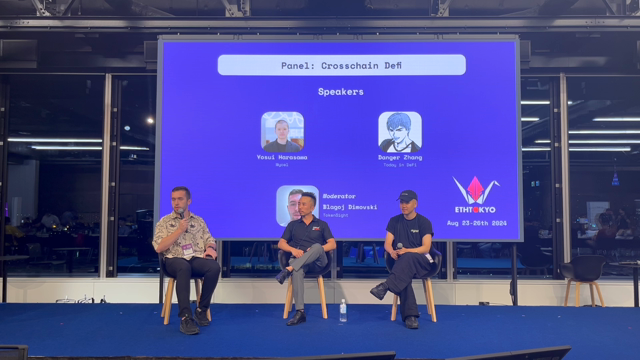 --:--
--:--Panel discussion: Cross-chain DeFi
ETHTokyoSep 17, 2024
Discussing the future of globally interoperable finance The video features a panel discussion moderated by Plago, CEO and co-founder of TokenSight, a DEX trading platform. Joining him are Danger, a DeFi trader and media runner, and Yosui, co-founder of MySell, which provides infrastructure for state machines. They discuss the concept of cross-chain DeFi, its categorization, current challenges like liquidity fragmentation and security issues, as well as the complexity of cross-chain transactions. They also touch upon the future of cross-chain DeFi with potential solutions like chain abstraction and improved user experiences through protocol layers and aggregators. The conversation concludes with optimism about advancements in the field and an invitation for audience questions.
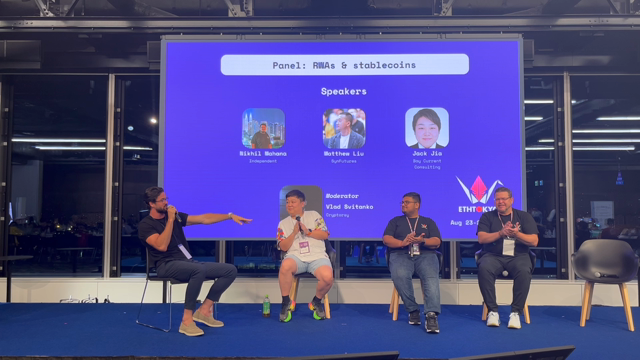 --:--
--:--Panel discussion: RWAs and Stablecoins
ETHTokyoSep 17, 2024
The FSA is actively working on stablecoin regulations. We anticipate that many stablecoins will be issued by Japanese banks this year. However, the most crucial aspect will be determining how these stablecoins will be utilized after they are issued. The video features a discussion on the current and future state of real-world assets (RWAs) and stablecoins in the cryptocurrency space. Vlad, the founder and CEO of a leading marketing studio based in Dubai, hosts the show, emphasizing the importance of RWAs as a driving force in the industry. The panel includes experts like Mathew Vanikert, who has experience with stablecoins and programmable money; Jack from a Japanese consulting firm leading web strategy; and Nikhil, a blockchain developer from India. The conversation explores various topics such as the common use cases for RWAs beyond real estate, like tokenizing movies or intellectual property. The panelists also discuss strategies for raising capital through utility tokens versus security tokens and emphasize the need for legitimacy and investor protection in these ventures. They touch upon challenges such as ensuring mass adoption, government regulation, industry readiness, and technological infrastructure. The panelists agree that while technology is prepared for widespread use of RWAs on blockchain, there are still significant barriers to overcome including regulatory issues and market readiness. The summary encapsulates an engaging discussion that covers the potential of RWAs and stablecoins in transforming traditional financial markets and assets through blockchain technology.
 20:34
20:34Relay Mining: Cryptographically Incentivizing Non-Validating Nodes
EthCCSep 9, 2024
Scaling at the protocol layer is not the only way to scale dapps. We must innovate at the application layer, to enable developers to scale across blockchains, and not just a single chain. Summary: The video features a presentation by Olshansky, the head of protocol at Grove, discussing the incentive structure for read-only relays in the Pocket Network, a decentralized RPC protocol. Having previously worked in various tech companies and being an early ETH adopter, Olshansky introduces Relay Mining as a solution to incentivize non-validating nodes within blockchain networks. He emphasizes the importance of high-quality supply for read operations on blockchains and explains how this concept extends beyond Web3 to decentralized social platforms and large language models (LLMs). Olshansky details the issues with current blockchain infrastructure primarily designed for write operations, whereas most real applications require more read operations from nodes. He then explains how Relay Mining works as a new primitive that rewards nodes for serving RPC requests, using cryptographic techniques like sparse Merkle trees and non-interactive fraud proofs. He also touches on how decentralization is not an end goal but rather a byproduct of a permissionless and incentivized system. The talk includes technical deep dives into the relay mining process, session matching between applications and suppliers, and the commit-and-reveal scheme used for verifiable on-chain transactions. Finally, Olshansky discusses future work including expanding Pocket Network to support LLMs and calls for collaboration with those
 1:22:00
ETHBerlin04 Closing Ceremony and Winner Announcements
ETHBerlinSep 6, 2024
ETHBerlin04 May 24-26, 2024, CIC Innovation Campus The DoD closes the hackathon with a special guest on stage and awarding all hackathon winners. ETHBerlin04 - https://ethberlin.org A Department of Decentralization event - https://dod.ngo The video is about the closing ceremony of ETH Berlin, where the speaker expresses gratitude to the participants, especially the hackers who worked through the night. The speaker highlights that the Department of Decentralization, which organizes events like ETH Berlin, is a non-profit collective run by volunteers and funded by donations, grants, and sponsorships. The event saw 802 attendees with various contributors including hackers, volunteers, judges, mentors, and speakers. A total of 83 projects were submitted across different tracks and categories. The speaker also informs viewers about the need to create a Zoopas profile to vote for the Hacker's Favorite award and mentions that Vitalik Buterin will be joining them on stage for an interview. During this interview, Vitalik shares his favorite Ethereum moments related to Berlin and discusses his personal connection to the city. He reminisces about coding in Berlin with other Ethereum co-founders and attending significant Ethereum events in the city. The video concludes with a reflection on DEFCON 0, Ethereum's first developer conference held in Berlin.
 42:04
42:04ETHBerlin04 Workshop: Odysseas, GregTheGreek - ZK vs TEE: Wat to do (as a product builder)?
ETHBerlinSep 5, 2024
ETHBerlin04 May 24-26, 2024, CIC Innovation Campus Technical Workshop: Odysseas, GregTheGreek - ZK vs TEE: Wat do (as a product builder)? This session delves into TEEs and ZK for Ethereum product builders with limited technical depth in these areas. We will examine key considerations such as performance, trust assumptions, cost efficiency, and the complexity of integration to determine their suitability for privacy and verifiable computation in applications. ETHBerlin04 - https://ethberlin.org A Department of Decentralization event - https://dod.ngo The video features a discussion by product builders in the crypto technology field, focusing on the decision-making process when choosing between two cryptographic technologies for product development. The speakers emphasize their perspective as product creators rather than researchers, aiming to help viewers understand how to ship products quickly while considering the trade-offs and advantages of two specific technologies: T's (Trusted Execution Environments) and ZK (Zero Knowledge Proofs). The video includes audience participation where members provide definitions of ZK and T's. Zero Knowledge Proofs are described as cryptographic protocols that allow proving knowledge or computations without revealing all the details, while Trusted Execution Environments are explained as secure chips that prevent data leakage during computations. The main difference highlighted between the two technologies is that T's are hardware-based solutions for privacy and security, while ZK is a software-based approach. The speakers point out that each has its own advantages depending on whether one prioritizes privacy or verifiable computation. The discussion then shifts to five key verticals to consider when choosing between ZK and T's for product development: performance, security, trust assumptions, ease of integration, and maturity. These factors are crucial in deciding which technology aligns best with a team's goals, especially regarding how quickly a product can be brought to market. The video
 26:55
26:55ETHBerlin04 Workshop: Richard Liu, Rob Knight - How to add ZKPs to your app (with Zupass)?
ETHBerlinSep 5, 2024
ETHBerlin04 May 24-26, 2024, CIC Innovation Campus Technical Workshop: Richard Liu, Rob Knight - How to add ZKPs to your app (with Zupass)? No prior circom or ZK experience needed for this workshop, where we'll run through a simple example of a sybil-resistant app that requests a "proof of ETHBerlin hacker visa". Hackers may receive a cryptographic surprise during this workshop. ETHBerlin04 - https://ethberlin.org A Department of Decentralization event - https://dod.ngo The provided text does not contain any meaningful content to summarize for a video description. It consists only of a series of dots, which may indicate placeholder text or an error in the input. Users would not be able to understand what the video is about based on this summary.
 30:35
30:35ETHBerlin04 Keynote: Ameen Soleimani - The Fight for Privacy
ETHBerlinSep 4, 2024
ETHBerlin04 May 24-26, 2024, CIC Innovation Campus Keynote: Ameen Soleimani - The Fight for Privacy ETHBerlin04 - https://ethberlin.org - A Department of Decentralization event - https://dod.ngo The video features a speaker at ETH Berlin discussing the importance of privacy and the issues surrounding the Tornado Cash protocol, a privacy tool for cryptocurrency transactions. The speaker gives a historical perspective on military doctrine and relates it to current events in the crypto space, emphasizing the need for individual creativity and caution against designing systems that could be misused by future bad actors. The speaker argues that privacy is essential as governments may abuse power and full surveillance with Central Bank Digital Currencies (CBDCs) is looming. They cite how good record-keeping (KYC) facilitated high casualties during the Holocaust as an example of misuse. Tornado Cash, which was funded by MolochDAO, is presented as a necessary tool for preserving privacy in financial transactions. However, it faced legal challenges after being used by North Korean hackers to launder stolen funds. The developers of Tornado Cash were arrested and faced serious charges despite their intent to create a secure, private system. The speaker discusses the legal battles of two developers, Roman Storm and Alexey Pertsev, highlighting the potential overreach of law enforcement and questioning the fairness of holding developers responsible for how their open-source tools are used. They mention various support efforts from the community, including amicus briefs filed on behalf of Tornado Cash devs against
 32:05
32:05ETHBerlin04 Keynote: Edmund Edgar - Anarchy, Truth and Justice
ETHBerlinSep 4, 2024
ETHBerlin04 May 24-26, 2024, CIC Innovation Campus Keynote: Edmund Edgar - Anarchy, Truth and Justice This talk will look at some historical attempts to create systems and societies that do not depend on government or institutional power, from the Diggers to the Free Software movement. Then we will look at tools and techniques we can use to govern and sustain crypto-economic systems and talk about how to increase their impact and protect them against bribery, cooption and destruction. ETHBerlin04 - https://ethberlin.org A Department of Decentralization event - https://dod.ngo The video discusses the intersection of political anarchy, crypto-economics, and the history of anarchist movements, with a focus on how these concepts relate to Ethereum and the broader aims of decentralization. The speaker touches on historical examples of anarchy from the diggers in England to the Russian revolution and how these movements were often temporary but sought freedom from coercive institutions. They also draw parallels between these historical movements and the temporary autonomous zones suggested by Hakim Bey. Additionally, they mention Satoshi Nakamoto's perspective on gaining a new territory of freedom for several years through Bitcoin. The video also considers the success of the free software movement and its principles, suggesting that while it's possible to co-opt free software projects, their open nature allows for forking and continued community-driven development. The overarching theme is how various forms of anarchy have influenced and continue to influence decentralized systems like Ethereum, with an emphasis on resisting central power and promoting individual freedom.
 33:06
33:06ETHBerlin04 Workshop: Pedro Gomes - Re-inventing login with Sign-in-with-Ethereum
ETHBerlinSep 4, 2024
ETHBerlin04 May 24-26, 2024, CIC Innovation Campus Technical Workshop: Pedro Gomes - Re-inventing login with Sign-in-with-Ethereum We will learn how powerful SIWE can be used as a tool for building different use-cases such as identity, attestations, permissions and messaging. ETHBerlin04 - https://ethberlin.org A Department of Decentralization event - https://dod.ngo Pedro Gomez, founder of WallConnect, presents a video on "Reinventing Login with SignWithEthereum" and aims to demonstrate live coding. He begins by simplifying the concept of authentication in Web3, emphasizing the transition from traditional login methods to wallet connections and the importance of user convenience with fewer clicks. Pedro explains that Web3 differs from Web2 by empowering users with self-sovereignty through wallets instead of server-based authentication modules. He introduces SignWithEthereum as a standard that ensures proper user verification by signing a simple text message. Pedro delves into the technical specifics of SignWithEthereum, highlighting the need for certain parameters such as domain, address, URI, version, chain ID, nonce, and timestamps. Pedro also discusses the challenges of nonce generation and recommends using open-source libraries like NextAuth for Next.js applications to handle this. He further showcases WalletConnect's Web3Modal library for an improved user experience. The video includes a practical coding session where Pedro builds a private image upload feature using SignWithEthereum for authentication. He guides viewers through setting up a project with Next.js and integrating NextAuth for server-side authentication management. The tutorial covers adding session providers to maintain user state across server-rendered pages and demonstrates how
 35:24
35:24ETHBerlin04 Keynote: Peter van Valkenburg - Are there limits to the reach of US Sanctions laws?
ETHBerlinSep 4, 2024
ETHBerlin04 May 24-26, 2024, CIC Innovation Campus Peter van Valkenburg - Are there limits to the reach of US Sanctions laws? ETHBerlin04 - https://ethberlin.org A Department of Decentralization event - https://dod.ngo The video features a speaker discussing the implications of the Tornado Cash prosecutions and how US sanctions laws could potentially affect developers. The speaker, a lawyer from Coin Center, emphasizes the importance of legal advice for those working on privacy tools and censorship-resistant software. They explore the reach and limits of US sanctions laws, specifically the International Emergency Economic Powers Act, and argue that sanctioning immutable smart contracts like those used by Tornado Cash may overstep legal boundaries. The video also touches on constitutional principles of free speech and privacy, highlighting the need for well-reasoned policy arguments to protect civil liberties in the digital world. The talk is part of a series addressing recent legal actions against developers of privacy-focused crypto tools and aims to provide clarity on the legal risks involved in such work.
 36:33
36:33ETHBerlin04 Keynote: Nick Almond - Building for Big V Value
ETHBerlinSep 4, 2024
ETHBerlin04 May 24-26, 2024, CIC Innovation Campus Keynote: Nick Almond - Building for Big V Value ETHBerlin04 - https://ethberlin.org A Department of Decentralization event - https://dod.ngo The video features a speaker with a background in physics and decentralized governance who has been involved in the crypto industry for several years. He shares his perspective on the current state of cryptocurrency, emphasizing the need to focus on creating value (big V value) rather than just inflating metrics such as token prices and daily active users (small v value). He discusses concepts like Goodhart's Law, which suggests that once a measure becomes a target, it ceases to be a good measure, and how this principle applies to the crypto industry's fixation on numbers. The speaker criticizes the trend of short-termism and the creation of meme coins that lack substantive use cases. He also touches upon regulatory avoidance and the superficial appeal of decentralization, suggesting that these tendencies are steering the industry away from its potential to make meaningful contributions. The talk is intended as a call to action for change, urging developers and participants in the crypto space to prioritize genuine utility and societal benefit in their projects.
 16:17
16:17ETHBerlin04 Keynote: Fatemeh Fannizadeh - We need Censorships
ETHBerlinSep 4, 2024
ETHBerlin04 May 24-26, 2024, CIC Innovation Campus Keynote: Fatemeh Fannizadeh - We need Censorships ETHBerlin04 - https://ethberlin.org A Department of Decentralization event - https://dod.ngo The video features a speaker discussing the concept of censorship, particularly in the context of Ethereum and blockchain technology. The speaker, who is a Swiss lawyer with an Iranian background, shares personal anecdotes and touches upon philosophical aspects rather than providing legal advice. They explore what censorship entails—limiting access to data—and how it is implemented in various contexts, including on social media platforms like Instagram and in countries like Iran. The talk addresses the necessity of some level of censorship or moderation for societal functioning but emphasizes the importance of individual agency and transparency to allow informed curation. The speaker then delves into how censorship manifests in Ethereum across different layers: consensus, application (dApps), and social. Examples are given, such as validators deciding whether to process transactions from sanctioned addresses and actions taken by various platforms against Iranian users. The core issue raised is who gets to decide what is censored on the blockchain and whether such decisions are democratic or not. The speaker suggests that we should "censor blockchain censorship" to maintain an unstoppable and robust technology. They propose exploring surveillance resistance and inclusion lists as potential solutions to prevent undue censorship on Ethereum. Finally, the speaker calls for every user and application to have the option for curation and moderation, aligning with the Cypherpunk ethos of sovereignty through
 26:03
26:03Capitalizing Onchain Momentum With Web3 Marketing
ETHTokyoSep 3, 2024
This talk will introduce a tool pack for builders to be equipped with; new models of incentives, and methodologies of entering the market and engage the community. The video features a speaker discussing the parallels between the historical Gold Rush and the modern digital era, emphasizing the shift from physical tools to digital ones like smartphones and internet connections. The speaker introduces himself as a founder and CEO of a web marketing studio based in Dubai with experience in growing companies within the web3 space. He aims to discuss how to capitalize on blockchain momentum, stressing that crypto is a hope market driven by perceived value, which is heavily influenced by marketing. Marketing in web3 differs from traditional marketing because it focuses on building communities and networks rather than just selling products. He presents a framework for community building using the acronym "TRIBE," which stands for Togetherness, Rituals, Identity, Belonging, and Engagement. The speaker highlights the importance of understanding customer journeys and analytics in web3 marketing. He criticizes outdated marketing methods that fail to resonate with audiences and emphasizes the need for clear communication that appeals to both crypto enthusiasts and newcomers. The video also covers strategies for acquiring attention, activating audiences, engaging users, and generating revenue. The speaker concludes by stressing the importance of giving before asking and building strong relationships with customers rather than exploiting them.
 26:49
26:49Harry Halpin
Making Blockchain Anarchist Again: NymVPN
Web3 Summit 2024Aug 21, 2024
Distracted by short-term financial gain, humanity is finding itself sleep-walking into a universal surveillance state aiming to monitor and control our every action via omnipresent AI technologies. How to fight back? What we at Nym are doing is returning to the anarchist roots of blockchain by enabling two crucial technologies pioneered by the cypherpunks: mixnets for anonymous internet access and anonymous credentials for private payments that give users control over their identity. The video features a speaker reflecting on the importance of the Web3 summit in the development and funding of their privacy-focused blockchain project, NIM. The speaker credits the summit for facilitating vital connections and recounts a serendipitous encounter with an investor that led to significant funding for their project. They express concern over political developments, particularly the support some in the crypto community show for authoritarian figures, and criticize those who seek power approval for mass adoption. The speaker emphasizes that crypto-anarchism stands for no masters or authorities, aligning with personal computing's roots in democratizing technology and resisting power centralization. The speaker also discusses the origins of cryptocurrency in response to financial crises and social movements like Occupy, pointing out the irony of former activists now endorsing establishment figures. They warn against repeating historical mistakes where industrialists supported fascist leaders for personal gain. Instead, they advocate returning to technology's potential to create decentralized power structures and challenge both commercial and state centralization. Finally, they introduce NIM's mixnet technology, which provides improved anonymity compared to VPNs and Tor by mixing internet traffic to prevent metadata analysis. The speaker plans to demonstrate this technology later in their talk.
 24:49
24:49Zaki Manian
Memecoins, Restaking, and Memechains: Where is this all going?
Web3 Summit 2024Aug 20, 2024
Join @zmanian to explore the future of memecoins, restaking, and memechains. The video features Zaki, an experienced figure in the crypto space, discussing the current state of the industry and his perspective on its development. He begins by mentioning his involvement with various projects and protocols, including co-founding a DeFi vault protocol and contributing to the Cosmos ecosystem. Zaki addresses the pervasive sense of existential despair within the industry and aims to explore both short-term gains and long-term outcomes from a decade's worth of work in crypto. He identifies four main crypto products used globally: yield, volatility, leverage, and payments. He emphasizes that these products serve real needs outside of Western countries where crypto solves practical problems. Zaki then critiques the current "meta" in crypto, which he feels is dominated by memes and short-term gains rather than services providing tangible utility. He discusses stablecoins as a non-meme product with clear market fit, especially valuable for accessing global reserve currency outside North America and Western Europe. Zaki goes on to describe 2024's potential short-term games in crypto, such as Hyperliquid's unique token distribution model for users. Further, he talks about building infrastructure around these games to support user onboarding. DeFi is highlighted as not just a product but essential infrastructure supporting various aspects like lending protocols and dynamic vaults. However, he
 23:40
23:40Wassim Alsindi
The Chain Mail Gaze
Web3 Summit 2024Aug 19, 2024
With their dreams of new ‘Network State’ empires, resource extraction, and colonial domination, today’s tech overlords are the descendants of Europe’s mediaeval Crusaders: well-financed, zealous fanatics remaking the world in the name of their greater good. Through a psycho-political reading of scarcity, chauvinism, and colonialism, The Chain Mail Gaze connects Crusader ideologues’ desire for blood, land, and booty, to emerging ‘frontiers’ mediated by contemporary technologies. The video features a speaker named Wissie Malcindy discussing the concept of friction in the context of work and how it relates to a broader spectrum of ideas. The talk delves into various subjects, including rural friction, funding mechanisms, the dynamics of influence and bilingualism, and the evolution of communities over time. The speaker touches on complex themes like anarchy pricing, disappearance of certain elements over years, cultural shifts due to toxic masculinity, and the impact of technological advancements like blockchain and automation. The narrative also explores Bitcoin's role in this landscape, highlighting its temporal properties and its function as a "chronogenic apparatus" that creates new forms of temporality independent from traditional calendars or clocks. The discussion includes reflections on how Bitcoin operates as a clock, its energy requirements, its perception by maximalists, and its broader societal implications. Additionally, the speaker examines the concept of petro-masculinity and how it relates to ecological concerns in parts of the UK. The talk concludes by considering Bitcoin's creator Satoshi Nakamoto's disappearance and how Bitcoin enthusiasts communicate within their networks. Overall, the video presents a complex intersection of technology, society, time perception, and environmental issues through the lens of cryptocurrency.
 25:40
25:40Bill Laboon
The Prehistory of Blockchain
Web3 Summit 2024Aug 19, 2024
In this talk, we will go over the prehistory of blockchain - the ideas and projects that inspired and guided Satoshi in creating Bitcoin. There were several earlier attempts at a digital currency, such as David Chaum's eCash, Nick Szabo's Bit Gold, and Wei Dai's b-Money. Proof of work was used in Adam Back's hashcash. And all of these rested on more fundamental ideas, like the very concepts of a blockchain data structure and digital signatures. This talk will cover the groundwork laid by these pioneers that eventually led to Bitcoin and modern blockchain technology. The video features Bill Laboon from the Web3 Foundation discussing the history and development of technologies that preceded Bitcoin. He explains that Bitcoin's creation was influenced by previous attempts at electronic cash, trustlessness, and decentralization. The talk covers four key areas: the blockchain data structure, proof of work, public key cryptography, and the concept of digital cash. Laboon delves into the origins of blockchain as a decentralized timestamping tool, citing a paper by Haber and Stornetta from the 90s and their company Surety's innovative use of publishing hashes in the New York Times to ensure verifiability. He highlights that these concepts and technologies existed well before Bitcoin's first block was mined, emphasizing that blockchain has a longer history than commonly known and has evolved significantly over time.
 19:41
19:41Benchmarking data for the settlement of crypto derivatives
EthCCAug 9, 2024
This keynote is an in-depth presentation on the benchmarking data used in the context of crypto derivatives settlement, both on and off chain, specifically diving into regulated use cases and benchmark data provided by independent index providers. The video discusses the significance of benchmarks in the settlement of crypto derivatives, highlighting their role as reference prices. The speaker explains that benchmarks can be sourced online or from trusted third parties and stresses the importance of using regulated benchmarks to prevent manipulation, drawing parallels to the Libor scandal. The current state of the crypto derivatives market is examined, noting its volume compared to spot markets and the growth in open interest for Bitcoin and ETH futures. Examples of exchanges using regulated benchmarks for settlement are provided, and the requirements for creating reliable crypto benchmarks are outlined, including regulatory compliance, data quality, robust methodology, and a stable platform. The talk aims to convey the maturing process of the crypto industry by adopting best practices from traditional finance.
 16:58
16:58Enabling Decentralized Networks With DePin and PoC
EthCCJul 18, 2024
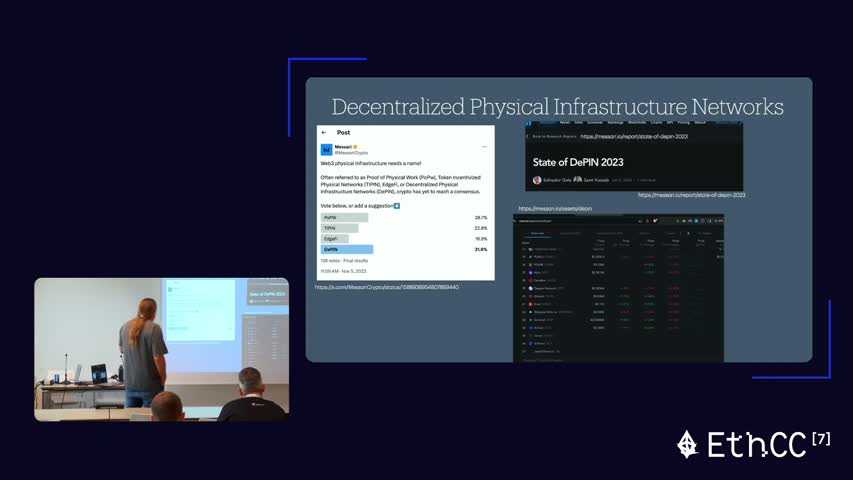
We introduce Proof of Capacity (PoC) that allows on-chain verification of off-chain cryptographic proofs over (almost any) arbitrary hardware commitments to decentralized network. We discuss PoC's role in enabling decentralized network stacks. The video discusses the evolution of the term "Deepin" in the cryptocurrency space, which was chosen to describe a particular sector involving decentralized networks and physical work. The speaker notes that Misari, a crypto analytics firm, conducted a Twitter poll in late 2022 to settle on this term, and later published an influential overview of the state of Deepin in 2023. The video highlights that there are over 60 tokens or projects associated with Deepin, indicating its significance. The speaker explains that Deepin encompasses both physical and digital resources, with a focus on digital resources like computing power. Projects like Filecoin are mentioned for their contributions to digital storage solutions. The speaker emphasizes the importance of proof systems in verifying storage and computing resources, noting the challenges unique to computing power compared to storage. Fluence is introduced as a decentralized cloud compute platform that aggregates CPU (and potentially GPU) resources for developers to purchase capacity. The platform uses WebAssembly and Docker for deploying general compute tasks. It is governed by a DAO and has its own token. The importance of supply preceding demand in protocol structure is stressed, with emphasis on creating incentives for resource providers to commit capacity without immediate demand. The speaker warns against protocols incentivizing non-existent capacity as it can be detrimental. Proof systems
 30:55
30:55Alignment
EthCCJul 18, 2024
Talk about alignment of interests between users of a protocol and how it's now technically possible (with EIPs and tokenomics). Would be wonderfull with Abdelhamid Bakhta from Starkware. The video features Alita Kalbatai, who has 11 years of experience in cryptocurrency and has been involved in non-profit activities in France and business for several years. She discusses the concept of alignment in cryptocurrency, emphasizing its importance for the sustainability and robustness of systems. Alita argues that aligning individual interests with collective goals is crucial and explores this idea through the lens of game theory and the concept of "conscious agents" who prioritize a common objective over self-interest. She suggests that by changing the agents rather than the game, more effective economic interactions can be designed within cryptocurrency systems to achieve strong equilibrium between self-interest and communal benefit.
 25:41
25:41How soft-liquidation works in curve lending
EthCCJul 18, 2024
I explain how soft-liquidation works in curve lending with real life positions, the technical implementation of soft-liquidation and what's needed to open a permissionless lending market on curve. I cover benefits and risk for users and projects. The video features Martin from Curve discussing soft liquidation within the context of Curve Lending and Curve USD. Martin, a DeFi veteran and full-time contributor at Curve since September, aims to explain soft liquidation in an accessible way for all viewers. He touches on his background and role as a facilitator integrating external developments into Curve. Martin initially defines Curve as an Automated Market Maker (AMM) that has evolved to include its own stablecoin, Curve USD, and a lending market. He highlights the significant cash flow generated from fees on both the AMM and the minting of Curve USD, with a recent week bringing in $70k for token holders. He explains that Curve is not just an AMM anymore; it earns most of its revenue from its stablecoin, making it crucial to promote Curve USD. Martin also discusses the concept of soft liquidation as part of the stablecoin ecosystem, designed to address liquidity issues faced by the founder of Curve. The video further delves into how soft liquidation functions within the minting process of Curve USD and its lending market. Martin presents various data views, showing high borrow rates and explaining how collateral is managed with ETH and Curve USD. He describes soft liquidation as needing a price feed, liquidity, and collateral within certain
 16:52
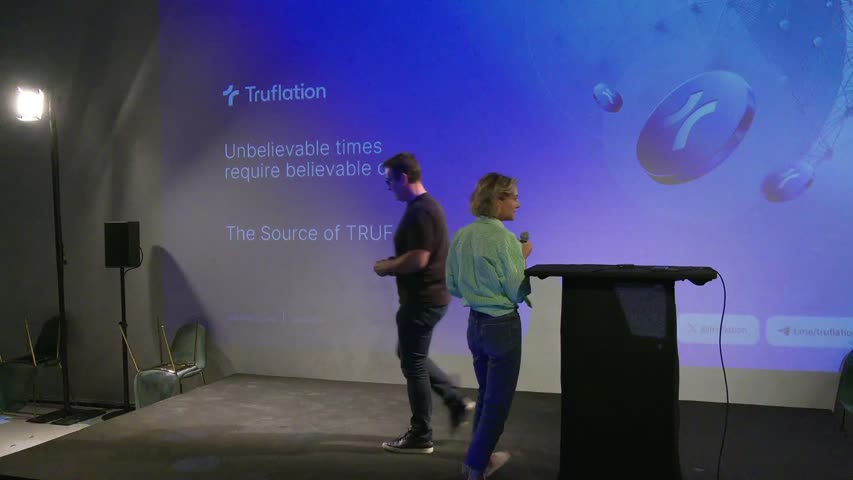
16:52Old Notes to New Coins: Collaborative Strategies for Small Issuers (Matthew Commons)
Stable SummitJul 16, 2024
Old Notes to New Coins: Collaborative Strategies for Small Issuers The video features Matthew Commons, president of the VerifiedUSD Foundation, speaking at an industry event. He discusses the history of stablecoins and private currencies, highlighting that while stablecoins are a recent development, private currencies have existed since ancient times. He introduces his organization's stablecoin, USDV, which is backed by real-world assets and utilizes technology for decentralized minting and tracking capital inflow. Commons then draws parallels between the current state of stablecoins and the free banking era in the United States (1837-1866), a time when private currencies flourished alongside significant economic growth. He emphasizes the importance of transparency and shared risk and reward in such systems, as demonstrated by historical practices like banknote reporters and interbank networks. The talk aims to provide insights on applying historical lessons to modern-day currency systems and fostering partnerships within the crypto community.
 12:39
12:39Creating a Unified Liquidity Layer Across Web3 || Jonathan Lim,
Stable SummitJul 12, 2024
Creating a Unified Liquidity Layer Across Web3 The video features Jonathan Lim, a product manager at Circle, discussing the current state and future of stablecoins. He begins by engaging the audience with a mood check and then proceeds to talk about his dislike for the term "stablecoins," suggesting that it implies a lack of dynamism, which he disagrees with. Lim highlights the market validation of stablecoins through traditional financial players entering the space. He shares statistics about the Cross-Chain Transfer Protocol (CCTP), including $10 billion transferred since launch, $250 million in weekly volume, 1 million unique transactions, and involvement from over 50 active developers. Lim emphasizes the importance of network effects and shows how adoption increased as more chains were added to CCTP. He discusses capital efficiency in terms of USDC circulation moving cross-chain and presents data on increasing interchain velocity. The impact on users is shown through the generation of 47K multi-chain wallets since CCTP's launch. He briefly touches on an incentive campaign spike in wallet creation due to airdrop farming but clarifies that it's not a primary use case for CCTP. Lim's vision is for CCTP to help users enjoy multi-chain benefits without drawbacks like fragmentation. He illustrates cross-chain volume with a chart showing thick lines between certain nodes, indicating high
 13:55
13:55Live Demo: Enabling fully on chain payments || Sebastian Burkhard
Stable SummitJul 12, 2024
Live Demo: Enabling fully on chain payments This video features a speaker with a decade of experience in building banking infrastructure, discussing the future of stablecoins in emerging markets by 2030. The speaker, who has a background in leading a successful payment processing company in Latin America, believes stablecoins will become the primary form of money in these regions. They outline three main use cases for stablecoins: as a store of value based on USD (e.g., USDC, USDT, DAI), as investment products linked to U.S. treasuries (e.g., USDM, Ondo), and for financial infrastructure tied to local currencies and payment instruments. A significant point made is the difficulty for individuals in emerging economies to access U.S. dollars and how stablecoins provide an easier and more accessible hedge against local inflation. The video also highlights the barriers faced by people from emerging markets when trying to invest in U.S. markets due to high minimum account requirements compared to their average wages. The speaker invites questions via email at the end of the presentation.
 59:20
59:20Yield bearing Stablecoins: Design Trends & Redefining Value Distribution
Stable SummitJul 11, 2024
panel The video features a panel discussion on yield-bearing stablecoins with a diverse group of panelists, each representing their own unique stablecoin. The host, Nate from Token Dynamics, introduces the topic and the panelists, who then each give an overview of their respective stablecoin projects and how they approach yield generation. Amin Soleimani discusses his project's float coins, which are not pegged to a specific value but aim to stabilize based on internal supply and demand dynamics. Nick Van Ack describes his company's one-to-one stablecoin model that shares income with businesses to drive utility and liquidity. Uriah Klagesmund shares insights from his PhD research on stablecoins and discusses Gyroscope's resilient design and efficient liquidity pool model. Matthew Commons talks about the Verified USD Foundation's use of tokenized US Treasury bills for backing their stablecoin and their Omnichain fungible token standard. Lastly, Pablo the Penguin explains QIDAO's multi-chain stablecoin that allows borrowing against various collaterals. The panel aims to explore where the yield comes from in each protocol, looking for commonalities and differences among them. They discuss concepts like farm-to-table yield, organic versus inorganic yield sources, and sustainable long-term revenue generation methods within the context of stablecoins.
 05:42
05:42"I couldn’t help but wonder…Does crypto UX have to be so bad?" || Laura Suttie, Valora
Stable SummitJul 11, 2024
Kenote by Valora This video features Laura Suttie from the Valora product team discussing the challenges of user experience (UX) in the crypto space, particularly for new users. She highlights the complexity of interacting with decentralized apps (dApps) on mobile devices, noting that although a significant portion of dApp traffic comes from mobile users, very few dApps offer a mobile app. Laura emphasizes Valora's commitment to simplifying the UX by focusing on mobile solutions and showcases a feature that allows users to easily earn on stablecoins within their app. She encourages developers to utilize Valora's mobile stack for creating better UX and invites viewers to connect with the team for further collaboration in improving Web3 experiences.
 10:21
10:21Reconstructing the Monetary Stack || Joao Reginatto, CSO, M^0 Labs
Stable SummitJul 11, 2024
Keynote by M^0 Labs The video features a speaker discussing the concept of stablecoins and the potential to reconstruct the monetary stack. The speaker, who has experience working at Circle and leading the build-out of a stablecoin, critiques the term "stablecoin," suggesting it limits the broader implications and possibilities of the technology. They advocate for thinking beyond price stability to consider how major currencies like the dollar could operate on the internet, comparing early digital newspapers to the current rudimentary stage of digital currencies. The speaker then delves into their personal view of money as a layered concept, with belief systems at its base and applications on top, while highlighting a middle "middleware" layer that is often overlooked. They argue that this layer has room for innovation, particularly in issuance, governance, and settlement processes, which are currently based on outdated systems. The discussion turns to M0, an infrastructure aimed at creating an open federation for crypto dollar issuances. M0's approach involves on-chain protocols and off-chain technology that allow businesses to mint fungible stablecoins by pledging collateral like short-term US Treasuries. This system aims to directly connect money issuers with a base layer representing a claim on dollars without intermediaries. Finally, the speaker warns that many current efforts in stablecoin development may fail due to lack of
 29:52
29:52Multichain support || Viktor Tron
SwarmJun 21, 2024
No description The video is a thank you message, although the content of the gratitude or context is not specified in the text provided. The summary does not offer details about what the video contains beyond an expression of thanks.
Ethereum's memetics and future with Vitalik & Martin Köppelmann
ZuBerlinJun 21, 2024
A description The video features a panel discussion on the evolution of Ethereum over its first decade, the culture within the crypto community, and the future of Ethereum's development and impact. The speakers explore the contrast between technical advancements and the slower progress in practical applications, discussing how to better align Ethereum's growth with tangible benefits for users. They reflect on their own experiences with explaining cryptocurrency to non-experts and consider the role of speculation in driving adoption. The panel also delves into challenges such as user experience (UX) improvements, the importance of stablecoins, and Ethereum's scalability. Additionally, they touch on topics like key management, privacy concerns, and potential directions for Ethereum to remain relevant and impactful. Audience interaction includes questions about improving Ethereum technology for wider use and personal motivations for being part of the Ethereum ecosystem. The discussion concludes with thoughts on what excites and concerns them about Ethereum's future, highlighting both its potential for creating a more open financial system and fears of re-centralization or misuse by powerful AI systems.
Insights into TEE Research and Deployment Framework for Blockchain Scalability | Filip Rezabek
ProtoLayersJun 20, 2024
Filip Rezabek from the Technical University of Munich describes the differences between Process-based and VM-based Trusted Execution Environments (TEEs), assessing their impact on blockchain scalability. He reviews the current state of TEE research, highlighting advancements and challenges. Additionally, the talk introduces a versatile framework designed for deploying and researching TEEs in both local and cloud settings This video features a speaker with experience in the crypto field, sharing insights about trusted execution environments (TEEs) at EVE Prague. The speaker discusses the definition of TEEs, their manufacturers, and potential use cases in blockchain and distributed systems. Emphasis is placed on TEE's ability to provide confidentiality and integrity for computations, as well as their role in scalability and privacy for blockchain applications. The talk delves into the technical aspects of attestation and the differences between process-based and VM-based TEE solutions from various manufacturers. Additionally, the speaker introduces a framework developed for assessing TEE capabilities within distributed systems and presents preliminary experimental results demonstrating the performance of TEEs compared to traditional computing environments. The presentation concludes with an invitation to explore their preprint publication for more detailed information.
 32:49
32:49Gnosis 3.0 || Phillippe Schommers
SwarmJun 20, 2024
No description The video features a comprehensive talk about Gnosis, covering its ecosystem, history, and various projects. The speaker begins by discussing the origins of Gnosis as a prediction market on Ethereum and its evolution into a builder of Ethereum-centric infrastructure. They highlight Gnosis Chain, which aims for horizontal scaling of Ethereum with a focus on decentralization and credible neutrality. The talk then covers several Gnosis projects: 1. Gnosis Chain: A blockchain similar to Ethereum with a beacon chain, validators, and hard forks. It uses the native token XDAI for transactions and GNO for staking. 2. Safe (formerly known as Gnosis Safe): A smart account or multisig wallet that's self-custodial with over $100 billion in assets stored. 3. CowSwap: An aggregator finding the best prices across DEXes and protecting users from MEV. 4. Karpatsky: A DAO treasury and risk management company managing over $3 billion worth of assets. 5. OpenEthereum: Maintenance of the Ethereum client after Parity abandoned it to ensure client diversity. 6. Zodiac: An open standard for DAOs allowing for more interconnectedness. The speaker then outlines the vision for Gnosis 3.0, which includes around 30 teams working on
 14:38
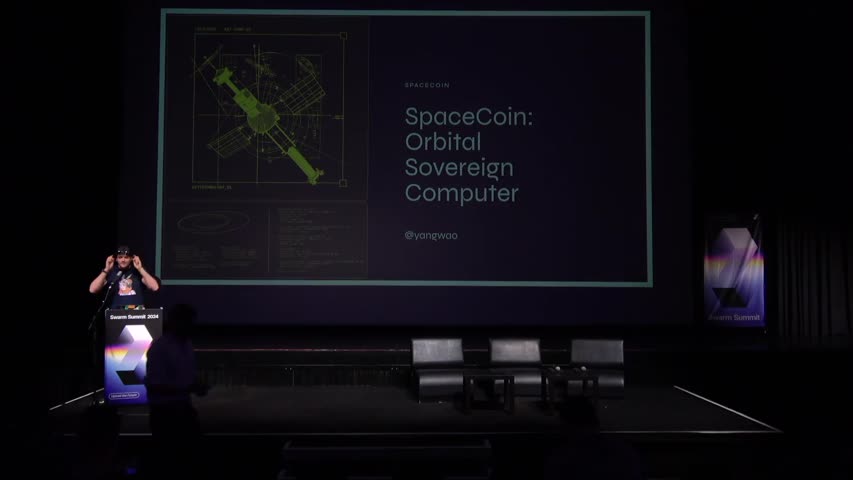
14:38Space compute onchain
SwarmJun 20, 2024
SpaceCoin is pioneering using CubeSats and blockchain technology to create a decentralized, autonomous network of orbital data centers and computing resources. The video features a speaker discussing the concept of space-based data centers and their potential integration into blockchain technology. The speaker has a background in Bitcoin, Ethereum, and space technology, including working on CubeSat software and participating in the European Space Agency (ESA) hackathon. They highlight the problems with terrestrial blockchains, such as susceptibility to attacks, natural disasters, and government interference. They propose that space-based data centers could offer solutions by providing unlimited land, freedom from national jurisdictions, lower energy consumption through solar energy harvesting in orbit, reduced latency for data transmission, and protection from physical attacks and natural disasters. The speaker also mentions high implementation costs and technical complexities as challenges but outlines a roadmap of progress in space-based computing since 2010 with experiments on the International Space Station (ISS) and partnerships with companies like Space Chain. The ultimate vision is to create a decentralized network of orbital data centers offering secure data processing services. Potential applications include space passports for extraterrestrial jurisdiction and secure banking operations. The presentation ends with an invitation to keep in touch through social media and solve a riddle left by the presenter. A question from the audience about the legal boundary of EU jurisdiction in relation to satellite data storage concludes the talk.
 15:22
15:22Running a Swarm node inside a browser
SwarmJun 20, 2024
Going through the limitations and possibilities of running a SWARM node inside a browser to make connecting to the network more convenient. The video features Josef from SolarFunk discussing the implementation and improvements of a new feature added to Swarm, as well as enhancements to their "glubi" (nodes or hubs). He addresses various web-related challenges encountered during development, including issues with web wallets like MetaMask, and the handling of cryptocurrencies and tokens. The presentation aims to share insights into the project's progress and address numerous questions that arose during its development.
 22:41
22:41Road to Autarky: a gamified exploration of dynamics of technical progress
ZuBerlinJun 19, 2024
Clip The video features a speaker discussing the importance of model composability and composable systems in the context of agentic AI and blockchain infrastructure. The speaker emphasizes that while many people view AI models as simple query-response tools, real-world applications often involve more complex systems composed of specialized models. These models can be combined to perform complex functions and improve accuracy through ensemble techniques. The talk also covers the inefficiencies of running computations on blockchains due to their replicated state machine nature. To address this, a novel approach called Validation Computation Separation (VCS) is introduced, involving inference nodes that perform stateless computations and transmit proofs to the network for validation, balancing scalability with decentralization. The speaker further explores the use of machine learning in quoting dynamic fees for automated market maker (AMM) swaps, potentially reducing losses for liquidity providers (LPs). They highlight how traditional finance uses various risk and forecasting models that are not yet common in Web3 but could become foundational with further development. Looking ahead, the focus will be on creating a collaborative research environment to develop models specifically designed for Web3 protocols. The infrastructure will support various model architectures and hardware acceleration for inference and proof generation. Additionally, an ERC standard is being developed to define agent interactions on EVM-based chains. Lastly, questions
 19:52
19:52DecAI Overview (Casey)
ZuBerlinJun 18, 2024
Clip The video features a speaker with a background in AI and crypto, discussing the current landscape at the intersection of these two fields. The speaker, who has experience both at Google and in crypto mining, shares insights gained from meeting with numerous companies in the crypto space. The talk covers a range of topics including decentralized GPUs, inference networks, edge computing, data generation and labeling, ZKML (Zero-Knowledge Machine Learning), fully homomorphic encryption, and AI agents. The speaker expresses skepticism about certain areas like AI agents due to scalability issues and the premature nature of these technologies. They also highlight an experiment where AI was used to categorize companies based on Twitter data, discussing both successes and shortcomings of this approach. Additionally, they touch upon the potential for crypto to address core issues in AI such as copyright, privacy, and user ownership. Throughout the video, various subcategories within each main topic are discussed along with specific companies that are making strides in those areas. The speaker is keen on creating a dynamic market map that reflects current trends and is open to community contributions. They also emphasize their excitement about data generation categories due to their potential high utility in crypto. The session concludes with questions from the audience about specific aspects of the market landscape and an acknowledgment of ongoing developments that might change existing
 39:44
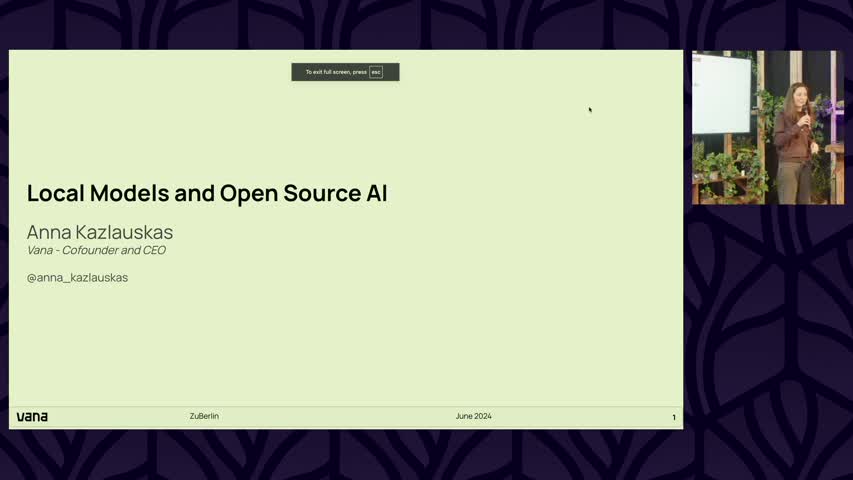
39:44Local models & open-source AI
ZuBerlinJun 18, 2024
Clip In this video, Anna, the co-founder and CEO of Vana, discusses her background in machine learning research and crypto, her journey from mining Ethereum to dropping out of school to start a machine learning company, and her work at Vana focusing on self-sovereign technologies for AI and data. She explores the concept of decentralized AI, emphasizing that it doesn't necessarily mean putting everything on the blockchain but can be achieved through local open-source models. Anna contrasts crypto's early fringe use cases with those of AI, such as generating explicit images using private local models. She explains the process of training diffusion models, tweaking model parameters for desired outcomes, and the importance of open-source models for maintaining privacy and control over AI. Anna highlights community-driven projects where contributors iteratively improve models, like in open-source software development. She also touches on funding challenges faced by open-source AI due to difficulties in monetizing freely available models and how this reliance has shifted towards big tech companies. Addressing data privacy concerns, she discusses Vana's approach to secure data contribution without risking leaks. The video concludes with a Q&A session where Anna addresses various topics including the potential risks and benefits of open-source AI models, decentralized approaches to model funding and training, the importance of keeping frontier models open source for
 44:27
44:27AI & Generative AI Overview
ZuBerlinJun 18, 2024
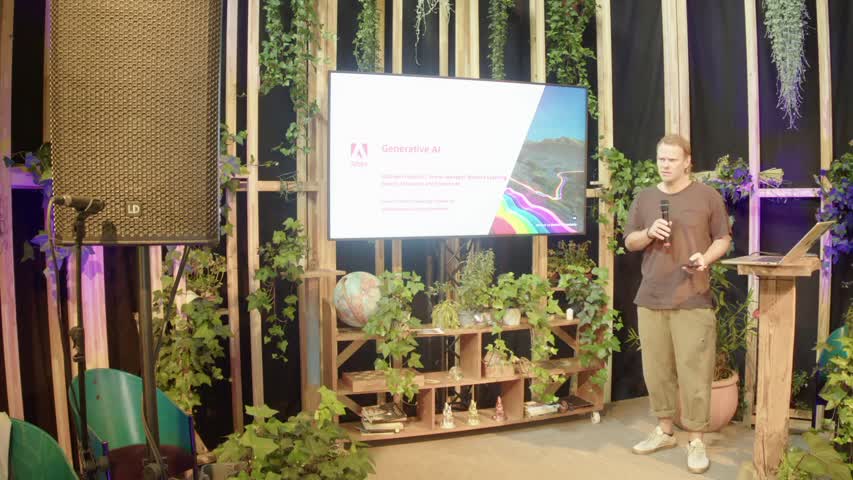
Clip The video features a speaker, Michael Friedrich, discussing various topics related to generative AI and its implications in the crypto and technical world. He begins by engaging the audience with questions about their use of AI tools like ChatGPT and its competitors. Michael introduces himself, mentioning his seven-year tenure at Adobe, his work on AI and ML platforms, and personal interests including surfing and FPV drone racing. He then delves into the definition of generative AI, illustrating its evolution from text-to-image applications to multimodal ones that include speech output. The conversation touches on the hype around generative AI in business marketing and its potential trajectory towards achieving human-level intelligence. Michael skips over basic explanations of transformer architecture due to the audience's familiarity, moving on to discuss large language models (LLMs), their structure, function, and how they learn from data inputs to predict outputs. He highlights the astonishing capabilities of LLMs like GPT-3 and GPT-4 in understanding language and generating coherent responses. Questions from the audience lead to discussions about unpredictability in AI outputs, the concept of creativity in models, and how randomness plays a role in generating new content. The speaker also addresses concerns about whether AIs can be considered conscious beings. Further into the talk, Michael explores the
 27:52
27:52Resource Plasma by Christopher Goes
ZuBerlinJun 14, 2024
Clip The video features a speaker named Christopher discussing the concept of "resource plasma" and its relation to Ethereum scaling solutions. Initially, the talk was intended to cover Enoma Intent Machines in Ethereum but shifted to focus more broadly on plasma. Christopher begins with an audience survey about their familiarity with plasma before diving into the main content. The presentation is structured into five parts: 1. Explaining what plasma is: Plasma is a family of Ethereum scaling solutions that differ from roll-ups because they do not require the main chain validators to store all data. 2. Discussing problems with plasma: Three main issues are identified—dependency tracking, developer-facing complexity, and incentive-compatible generalization. 3. Introducing the Enoma resource machine (ARM): ARM is an alternative state architecture that organizes state differently than traditional blockchain virtual machines. 4. Describing resource plasma: Resource plasma combines ARM with plasma, aiming to address some of the identified problems. 5. Addressing the hard problem of plasma: The talk concludes by acknowledging that while resource plasma can help with certain issues, incentive-compatible generalization remains a fundamental challenge that requires application-specific considerations. Christopher elaborates on how resource plasma operates, its advantages over traditional plasma constructions, and how it simplifies certain aspects like dependency tracking. However, he also
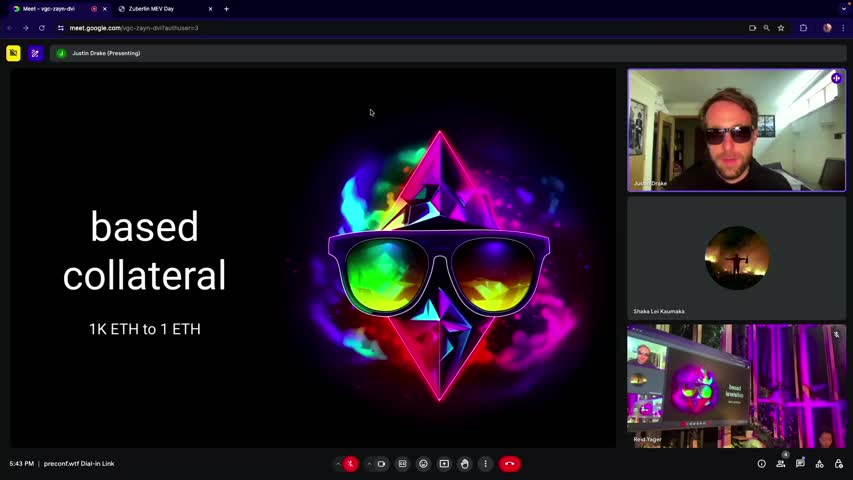 24:45
24:45[Debate] Steelman Challenge: we are all building the same damn thing! 4
ZuBerlinJun 13, 2024
Clip The video discusses a new proposal for handling maximum extractable value (MEV) and pre-confirmations in blockchain networks post-merge. The speaker illustrates the distribution of MEV boost bids using a graph, highlighting that 99% of MEV blocks are valued under one ETH, and no blocks have exceeded 1000 ETH since the merge. They critique the old proposal that required 1000 ETH of collateral as a sequencer, noting its high barrier to entry, unnecessary risk, inefficiency, and lack of user compensation when things go wrong. The new proposal suggests only requiring one ETH of collateral to cover most pre-confirmations and using additional insurance for any larger requirements. This system would make it easier for smaller operators to participate, reduce risks for operators, and ensure users are compensated for any faults. The discussion also covers how to prevent insurance fraud using secure enclaves like SGX to track and limit insurance capital allocation. Questions from participants address concerns about sybil resistance in a permissionless setting, the potential impacts on base rollups with registry requirements, compensating hack victims from MEV proceeds, and ensuring the security and feasibility of the proposed insurance mechanism. The speaker elaborates on how secure enclaves can prevent over-allocation of insurance funds and maintain trust in the
 25:20
25:20[Debate] Steelman Challenge: we are all building the same damn thing! 1
ZuBerlinJun 13, 2024
Clip The video appears to be a technical discussion or presentation focused on the topic of MEV (Miner Extractable Value) in the context of cryptocurrency and blockchain technology. The speaker discusses how MEV impacts user outcomes, validator outcomes, and the security of blockchain systems. They emphasize the importance of aligning these outcomes and considering how different proposals affect the distribution of MEV. The speaker also touches on topics such as sandwiching (a type of front-running), privacy in transactions, and the potential for centralization. They argue that MEV cannot be eliminated but can be harnessed for beneficial purposes. The presentation includes a Q&A session with panelists who discuss various aspects of MEV, privacy, and economic incentives within blockchain ecosystems. The summary is that the video is likely to be highly technical, aimed at an audience familiar with cryptocurrency concepts, and focused on the nuanced implications of MEV in blockchain systems.
 21:47
21:47Talk | Overload the Execution Proposer instead (From MEV-Boost to ePBS to APS) (Barnabé)
ZuBerlinJun 13, 2024
Clip The video features a speaker discussing the intricacies of precomp builders and the separation of attester and proposer roles within a blockchain network. The talk delves into various design concepts like PBS (Proposer Builder Separation) and APS (Attester-Proposer Separation), explaining their importance in mitigating centralization risks, reducing MEV (Maximal Extractable Value) reward viability, and providing a clean protocol interface. The speaker elaborates on the conceptual differences between proposing and building rights, as well as between beacon proposing and execution proposing. They explore the current MEV Boost system where validators, acting as proposers, seek builders to determine block contents. The talk also covers EPBS (Enshrined Proposal Builder Separation), which involves fair exchange via protocol, allowing proposers to commit to builders within the network. Further discussion points include the potential for different market structures under EPBS, questions about bid cancellations, and the concept of burning MEV to capture value from builder-to-proposer transactions. The speaker also suggests an iterative roadmap towards APS, with steps including creating a logical role for execution proposers separate from beacon proposers, running slot auctions in advance to capture bid value more effectively, and considering alternative designs like execution tickets. The talk concludes by highlighting how
 34:28
34:28Discussion 2: Delegation / no delegate with Limechain
ZuBerlinJun 12, 2024
Clip This video discusses a new model for pre-confirmation in cryptocurrency transactions that reduces the required collateral from 1,000 ETH to just 1 ETH. The speaker explains the original rationale for the high collateral amount was to cover the worst-case scenario of maximum extractable value (MEV) in a single block. However, this approach is costly as it requires overpaying for security every time. To improve this, a distinction is made between inclusion pre-confirmations, which guarantee a base fee and are economically beneficial when there's no contention on state, and execution pre-confirmations, which are more complex and relate to trades like Uniswap transactions. The speaker proposes an insurance market model where users pay for coverage based on the actual risk of price movement during transaction confirmation time rather than a flat worst-case fee. This model allows solo validators with minimal collateral to provide pre-confirmations and introduces benefits such as increased access for solo stakers, better risk-reward balance, and stronger user assurance through insurance rather than sheer collateral amount. The video also addresses potential user experience aspects, how wallets could handle these changes, and how trust networks might impact gateway reputations. Additionally, it touches on issues like denial of service attacks on validators, decentralized encrypted mempools to protect user transactions from front
 30:34
30:34Relays, Wat Next? Speaker: ultra sound, Titan, Aestus
ZuBerlinJun 12, 2024
Clip The video features a panel discussion with representatives from various Ethereum infrastructure projects discussing their work on relay systems, their interest in precompiles, and the technical and economic challenges they face in the evolving crypto ecosystem. They explore the dynamics of running a relay, including operational costs, funding, and competition. The panelists share their thoughts on precomps as a potential game-changer for user experience on Ethereum and layer two networks but express concerns about trust issues and collateralization challenges. They also discuss the importance of collaboration among relay operators, the need for open-source contributions to improve critical infrastructure, and the potential financial viability of operating a pre-comp gateway. The conversation concludes with reflections on market structure, incentives for shared infrastructure, and the balance between competition and centralization in the relay space.