About 3 results
 18:08
18:08Tokenizing the Data Economy with Lighthouse I Nandit Mehra
ETHGlobalNov 9, 2025
Nandit Mehra, founder of Lighthouse, presents on tokenizing the data economy at Pragma. Lighthouse offers permanent, decentralized storage using IPFS and Filecoin, addressing high storage costs, lack of security, and SDK fragmentation. Their platform features an endowment pool for perpetual storage, BLS threshold cryptography for encryption and access control, and a unified SDK. Lighthouse supports onchain logic for data access, enabling NFT and token-gated applications. Notable integrations include Eternal AI, Ocean Protocol, and NFT.Storage. To address AI’s growing data hunger, Lighthouse launched 1MB.io, a platform to store, encrypt, tokenize, and monetize data, leveraging ZKTLS for real-world data verification. 1MB.io enables developers to mint, trade, and monetize data coins, supporting privacy-preserving data sharing and new data marketplaces. The talk highlights the potential for data monetization, deep integration with DePIN, and regulatory support for data portability (GDPR). Lighthouse’s solutions empower developers and users to participate in the evolving, decentralized data economy. 00:00 Introduction 00:33 What is Lighthouse? 01:03 Problems in Decentralized Storage 02:19 Lighthouse Solutions Overview 03:02 Permanent Storage & Endowment Pool 03:59 Encryption & Access Control 05:35 AI & NFT Use Cases (Eternal AI, Ocean Protocol) 06:50 NFT.Storage & Data Preservation 07:48 DePIN Integrations & Web Hash 08:21 Scale & Adoption Metrics 08:54 Data Siloing & AI Data Hunger 09:59 Private & Synthetic Data Opportunities 10:55 Frequent Data Retrieval & 1MB.io Introduction 11:44 Tokenizing & Monetizing Data with 1MB.io 12:44 ZKTLS for Data Verification 13:25 Data Coin Applications & Marketplace 14:01 1MB.io Platform Architecture 15:03 DePIN, Data Monetization, and Market Growth 16:42 Hackathon Ideas & Regulatory Aspects 17:40 Closing Remarks _ _ _ _ _ _ _ _ _ _ _ _ _ _ _ _ _ _ _ _ 🇮🇳 *Pragma New Delhi* Pragma New Delhi 2025 was held on September 25th at the JW Marriott Hotel in Aerocity New Delhi and was an in-person summit for builders and leaders in the web3 ecosystem. Watch the full Pragma New Delhi YouTube Playlist here: ETHGlobal's Pragma series takes place in cities around the world, and is designed to be a different kind of event. Pragma is a one-stage conference with founders-only on stage, bringing together a small group of curated attendees and speakers to discuss the future of web3 and reflect on the past. _ _ _ _ _ _ _ _ _ _ _ _ _ _ _ _ _ _ _ _ ✅ Follow Nandit Mehra X: https://x.com/nanditmehra ✅ Follow Lighthouse X: https://x.com/LighthouseWeb3 ✅ Follow ETHGlobal X: https://x.com/ETHGlobal Warpcast: https://warpcast.com/ethglobal Website: https://ethglobal.com YouTube: https://www.youtube.com/@UCfF9ZO8Ug4xk_AJd4aeT5HA _ _ _ _ _ _ _ _ _ _ _ _ _ _ _ _ _ _ _ _ Are you interested in Ethereum development and entrepreneurship? 👉 Sign up for the next ETHGlobal event: https://ethglobal.com/events 🎁 Get exclusive access and perks with ETHGlobal Plus! https://ethglobal.com/plus 📣 Want us to throw an event in your city? Tell us where! https://ethglobal.com/city _ _ _ _ _ _ _ _ _ _ _ _ _ _ _ _ _ _ _ _
 31:30
31:30Create Data Coin and Agent with Lighthouse I Nandit Mehra
ETHGlobalNov 9, 2025
Nandit (with Akash) introduces Lighthouse—a developer platform for permanent, verifiable, and access-controlled storage—and their new product 1mb.io, which lets you launch “data coins” and data agents to reward users (or A.I. agents) for contributing valuable datasets. Lighthouse tackles three pain points: long-term data is expensive/hard to verify, access control on decentralized storage is weak, and the tooling is fragmented. Their solution combines (1) permanent storage funded by an on-chain endowment that pays Filecoin miners so you “pay once, store forever,” (2) threshold-crypto access control where each file has its own key, sharded across 5 nodes with 3-of-5 recovery, and (3) a unified SDK (JS & Python) plus web app/CLI. Files are encrypted client-side before upload, and decryption can be token-gated by on-chain logic (NFT ownership, token balances, timelocks, or pay-to-unlock). Current users include Eternal AI (open-source model hosting), Ocean (data marketplace), large-scale NFT storage, and Webhash (ENS sites served from Lighthouse). On top of this, 1mb.io turns data into an asset. Creators deploy a data coin (Sepolia testnet or mainnets like Base/Polygon/VeChain/World Chain), encrypt & host datasets on Lighthouse, set contribution/reward rules, and optionally trade the coin via a built-in Uniswap integration. Examples: a Ride-Sharing DAO paying Uber users who privately prove ride histories via ZK-TLS (Reclaim/Opacity); Pantry Points paying Zomato users for order data; and Miles, an AI augmentation engine where contributors upload real images/maps, pick conditions (e.g., “heavy rain”), and receive coins while an agent generates synthetic data to enlarge the dataset. The live workshop showed: uploading (plain/encrypted), API key creation, SDK calls for upload, uploadEncrypted, share/revoke access, and token-gating checks; then the data-coin creation flow (naming, chain, vesting, lock asset like USDC). Hackathon guidance: just storing on Lighthouse is good, but to be prize-competitive you should launch a data coin on 1mb.io, encrypt/token-gate access, and use the coin in your protocol’s flows (payments, contributor rewards, gated dashboards). Lighthouse doesn’t supply AI models (bring your own); data verification is up to builders (e.g., ZK proofs), and the market will reward higher-quality coins/datasets. SDKs are framework-agnostic, so you can integrate with OpenAI/agents/MCP, etc. 00:10 What Lighthouse solves (permanent storage, secure access, unified SDK) 02:27 How permanent storage works (on-chain endowment → Filecoin miners) 02:54 Threshold-crypto access control (per-file keys, 3-of-5 shards) 04:36 Token-gated decryption via on-chain logic (NFTs, tokens, timelocks, paywalls) 05:35 Who’s using it (Eternal AI, Ocean, NFT storage, Webhash) 06:38 Why 1mb.io (monetize private/siloed data; reward users/agents) 08:10 Data-coin flow (deploy coin, encrypt/upload, reward contributors, DEX trading) 09:06 Stack view (Lighthouse base + 1mb layer + dataset marketplaces) 10:47 Example verticals (chat history, loyalty, maps; synthetic data generation) 15:03 Live: upload (plain/encrypted), API key, SDK usage 17:31 Networks supported & token-gating docs 17:57 Live: create a data coin (chain, vesting, lock asset) 20:31 Live app: Miles synthetic data agent (rewards per image) 21:52 Live app: Pantry Points (ZK-TLS + Zomato orders → rewards) 23:22 Q&A: how to qualify for bounties (launch a data coin, integrate gating/payments) 27:53 AI model sourcing (BYO), data verification (ZK proofs), framework compatibility _ _ _ _ _ _ _ _ _ _ _ _ _ _ _ _ _ _ _ _ 💻 ETHOnline 2025 This workshop is specifically for ETHOnline 2025, a 21-day hackathon held October 10 - 31, 2025, bringing together the most skilled web3 developers, designers and product builders from all around the globe for a weekend-long adventure to advance the Ethereum ecosystem! _ _ _ _ _ _ _ _ _ _ _ _ _ _ _ _ _ _ _ _ ✅ Follow Lighthouse X: https://x.com/LighthouseWeb3 ✅ Follow ETHGlobal X: https://x.com/ETHGlobal Warpcast: https://warpcast.com/ethglobal Website: https://ethglobal.com YouTube: https://www.youtube.com/c/ETHGlobal _ _ _ _ _ _ _ _ _ _ _ _ _ _ _ _ _ _ _ _ _Are you interested in Ethereum development and entrepreneurship?_ 👉 Sign up for the next ETHGlobal event: https://ethglobal.com/events 🎁 Get exclusive access and perks with ETHGlobal Plus! https://ethglobal.com/plus 📣 Want us to throw an event in your city? Tell us where! https://ethglobal.com/city
 32:03
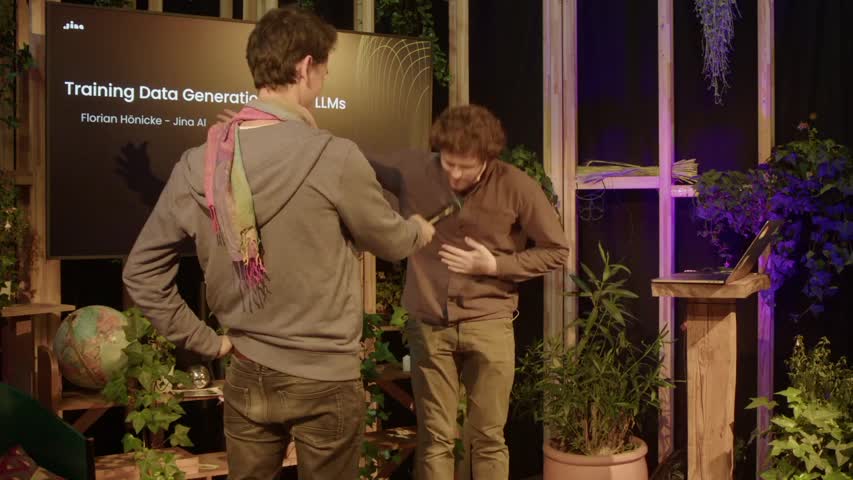
32:03Synthetic Data for ML (Jina AI, Florian Hönicke)
ZuBerlinJun 19, 2024
Clip The video features a discussion on synthetic data and its growing importance in training AI models, with predictions that 60% of training data will be synthetic by the end of the year. The speaker emphasizes the benefits of using synthetic data, such as domain specificity, cost reduction, bias control, and consistent labeling. They explore different research papers on generating question-answer pairs for training AI models and discuss various methods and their effectiveness. The talk also covers the limitations of language models in generating unique and domain-specific queries, the superiority of human-generated data in specific domains, and different approaches to improve data generation. The speaker suggests starting with synthetic data generation and shares insights into adversarial example generation as well as the potential of decision-making algorithms. Questions from the audience address concerns about bias amplification, data quality trade-offs, and the efficiency of synthetic versus human-generated data.