About 10 results
 34:33
34:33Tamar Menteshashvili, Vicktoria Klich, Bumblefudge ㅤ
Building Global Developer Communities
Web3 Summit 2024Aug 20, 2024
The importance of building global developer communities being discussed with @tamarincrypto, @VicktoriaKlich, @mpiekarska8 and bumblefudge The video features a welcoming of panelists to the stage, with a repetitive emphasis on being the first one to do something, although it is not specified what that something is. The summary should inform users that the content includes a greeting and possibly a discussion or presentation by panelists, but the actual subject matter remains unclear due to the repetition in the provided text.
 33:28
33:28Protoapps and Consumer Apps in the DeAI World
New FoundationAug 6, 2024
Building consumer apps in the deAI space for mass adoption, Farcaster, creators and beyond. The video features a panel discussion on the topic of "proto apps" and the integration of AI with the crypto world. The panel includes co-founder David Phelps, who coined the term "proto apps," Celia from Ritual, Hugo Hopman from New Foundation, and Jeff Shi from Flock IO. They explore how web 3 technologies enable open-source development and data sharing, contrasting with the closed, siloed approach of web 2. Examples include how contests can be run on various chains with community involvement and how AI is moving from a centralized model to one where algorithms are decentralized. The panelists discuss the implications for developers and founders in building on this new internet stack, emphasizing collaboration and composability in the ecosystem.
 59:20
59:20Yield bearing Stablecoins: Design Trends & Redefining Value Distribution
Stable SummitJul 11, 2024
panel The video features a panel discussion on yield-bearing stablecoins with a diverse group of panelists, each representing their own unique stablecoin. The host, Nate from Token Dynamics, introduces the topic and the panelists, who then each give an overview of their respective stablecoin projects and how they approach yield generation. Amin Soleimani discusses his project's float coins, which are not pegged to a specific value but aim to stabilize based on internal supply and demand dynamics. Nick Van Ack describes his company's one-to-one stablecoin model that shares income with businesses to drive utility and liquidity. Uriah Klagesmund shares insights from his PhD research on stablecoins and discusses Gyroscope's resilient design and efficient liquidity pool model. Matthew Commons talks about the Verified USD Foundation's use of tokenized US Treasury bills for backing their stablecoin and their Omnichain fungible token standard. Lastly, Pablo the Penguin explains QIDAO's multi-chain stablecoin that allows borrowing against various collaterals. The panel aims to explore where the yield comes from in each protocol, looking for commonalities and differences among them. They discuss concepts like farm-to-table yield, organic versus inorganic yield sources, and sustainable long-term revenue generation methods within the context of stablecoins.
Ethereum's memetics and future with Vitalik & Martin Köppelmann
ZuBerlinJun 21, 2024
A description The video features a panel discussion on the evolution of Ethereum over its first decade, the culture within the crypto community, and the future of Ethereum's development and impact. The speakers explore the contrast between technical advancements and the slower progress in practical applications, discussing how to better align Ethereum's growth with tangible benefits for users. They reflect on their own experiences with explaining cryptocurrency to non-experts and consider the role of speculation in driving adoption. The panel also delves into challenges such as user experience (UX) improvements, the importance of stablecoins, and Ethereum's scalability. Additionally, they touch on topics like key management, privacy concerns, and potential directions for Ethereum to remain relevant and impactful. Audience interaction includes questions about improving Ethereum technology for wider use and personal motivations for being part of the Ethereum ecosystem. The discussion concludes with thoughts on what excites and concerns them about Ethereum's future, highlighting both its potential for creating a more open financial system and fears of re-centralization or misuse by powerful AI systems.
 37:00
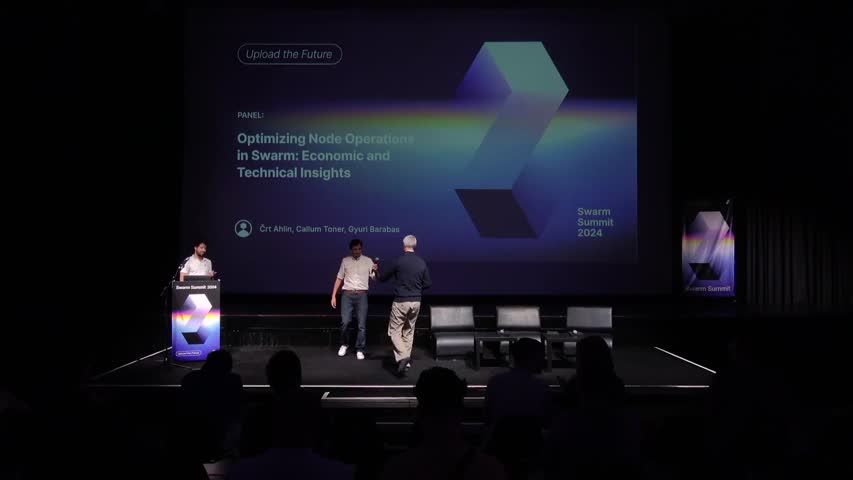
37:00Panel: Optimizing Node Operations in Swarm: Economic and Technical Insights
SwarmJun 20, 2024
We will delve into the roles and interactions of node operators within the Swarm network, focusing on their dual role as storage providers and stakeholders in the ecosystem. The video features a speaker named Cserteh Linn who introduces a panel discussion with Yuriy Barabak and Kalom, focusing on topics relevant to node operators within a decentralized storage network. The agenda includes an overview of the node operators' role in the ecosystem and a discussion on upcoming changes that could impact their operations. They explain how storage providers, who are full nodes with staking capabilities, offer storage space to data providers in exchange for payment. Data users also pay for bandwidth when downloading data. While there is an indirect connection between data providers and users outside of the Swarm network, node operators have costs such as running hardware, bandwidth, electricity, personnel, and staking. The panel addresses recent updates that affect node operators' profitability by discussing the concept of "freezing" nodes in the storage incentives lottery. Freezing occurs when a node's cryptographic hash doesn't match the chosen "oracle of truth," leading to temporary exclusion from the game. To mitigate harsh penalties for honest nodes due to imperfect system syncing, they've implemented "stochastic freezing," which only gives a 20% chance of being frozen if a mismatch occurs. The discussion includes technical details about the probability of freezing before and after updates, noting improvements from 30% down to below 5%. This
 21:52
21:52[Debate] Steelman Challenge: we are all building the same damn thing! 6
ZuBerlinJun 13, 2024
Clip This video features a panel discussion with key players in the cryptocurrency supply chain, including builders and relay operators. They delve into the adoption of pre-confirmations (pre-cons) and their impact on block construction. The panelists discuss how pre-cons serve as an additional constraint in block building, affecting transaction ordering and potential reverts. They also explore the shifting power dynamics between builders and relays, with pre-cons potentially democratizing order flow. The conversation further touches on the challenges of pricing pre-confirmations, considering factors such as time constraints, block space availability, and the uncertainty of transaction arrival. The panelists theorize about optimal pricing functions for pre-cons and compare block building to ad auctions due to its complexity and interdependencies. From a searcher's perspective, they debate the utility of pre-confirmations for sex-dex arbitrage, considering the premiums associated with guaranteeing execution within a block. The discussion also highlights the evolving role of relays in ensuring transaction confirmation speed and reliability. Overall, the video provides insights into how pre-confirmations might change business operations for builders and relays while affecting strategies for searchers within the cryptocurrency supply chain.
 49:14
49:14Panel | Ethereum in-Protocol vs. Out of Protocol R&D Symbiosis
ZuBerlinJun 13, 2024
Clip The video features a panel discussion among core developers and researchers within the Ethereum ecosystem. They delve into the intricacies of Ethereum's research and development (R&D) pipeline, highlighting how ideas evolve from inception to implementation on the mainnet, often taking years. Tim provides an overview of this pipeline, emphasizing the collaborative and iterative process between researchers, client teams, and the broader community. The conversation transitions to how different members of the ecosystem engage with R&D at various stages. Tomas shares insights from Nethermind's perspective on growing within the ecosystem and supporting research projects early on. The panelists also discuss the importance of budgeting for experimentation to strengthen ideas before they are considered for a hard fork. Vitalik expresses his preference for EIP-1559 due to its comprehensive analysis by economist Tim Roughgarden. The discussion then turns to the complexity of communicating research through EIPs and blog posts, with Barnabé explaining his approach to sharing ideas publicly for feedback. Justin describes Ethereum's R&D as a pipeline with 'resistors' representing different stages like research, development, and community acceptance. He envisions an 'endgame spec' where all the best ideas are combined in a holistic view of Ethereum's future. The panel touches upon topics like account abstraction,
 30:34
30:34Relays, Wat Next? Speaker: ultra sound, Titan, Aestus
ZuBerlinJun 12, 2024
Clip The video features a panel discussion with representatives from various Ethereum infrastructure projects discussing their work on relay systems, their interest in precompiles, and the technical and economic challenges they face in the evolving crypto ecosystem. They explore the dynamics of running a relay, including operational costs, funding, and competition. The panelists share their thoughts on precomps as a potential game-changer for user experience on Ethereum and layer two networks but express concerns about trust issues and collateralization challenges. They also discuss the importance of collaboration among relay operators, the need for open-source contributions to improve critical infrastructure, and the potential financial viability of operating a pre-comp gateway. The conversation concludes with reflections on market structure, incentives for shared infrastructure, and the balance between competition and centralization in the relay space.
 21:04
21:04Panel Discussion with Justin Drake, Vitalik Buterin, Barnabe Monnot and Dankrad Feist
ZuBerlinJun 11, 2024
Panel discussion The video features a panel discussion on the viability and sense of pursuing base sequencing within a firm's research team. Initially, one member was highly supportive, while others were more cautious. The panel seeks to gauge current opinions on the topic, with participants scoring their support out of 10 and discussing their reservations or questions. Barnaby, who has thought about base sequencing the least, rates his support at 4 out of 10 due to having more questions than answers. He expresses uncertainty about pre-confirmations and wonders how much he needs to buy into the whole package versus selecting parts that make sense to him. Bankrat is generally supportive of base sequencing but skeptical about centralizing all sequencing and proving in one place. Vitalik echoes this sentiment, supporting base roll-ups but expressing concern over the practicalities of achieving low latency for guaranteed transaction speeds. The panel delves into various technical aspects of base sequencing, such as synchronous versus asynchronous transactions, centralized versus decentralized sequencers, and potential centralization risks. They also discuss user experience improvements such as cross-rollup operations feeling unified and seamless. The conversation touches on economic incentives for applications to become their own roll-ups to capture congestion fees and how this might lead to a more diverse ecosystem. Ultimately, the panelists agree that from a user
 07:54
07:54Andrew Vermouth
How to scale effective UX
Conflux - Web3 UX UnconferenceNov 16, 2023
No description The video features Andrew Vermouth from Remix IDE discussing the evolution of internet technology and the inherent tension between consolidation, scalability, and economic capture versus the decentralized, private, and secure ethos of the Ethereum ecosystem. He reflects on how past internet technologies have transitioned from a DIY open-source culture to being dominated by large corporations through the selling of attention, ads, and cloud services. He questions whether Web 2 still dominates with its abstraction of user experience and what that abstraction might look like for Web 3. Andrew speculates on a future where user experience is invisible and integrated into real-world interactions without screens, suggesting that cryptography could be key to this transformation. He closes by pondering if we are repeating past mistakes in technological advancement or moving towards an unknown yet transformative user experience. The discussion opens up to audience questions about maintaining freedom in the face of technological progress and economic interests.