About 5 results
 18:00
18:00High Performance Memory For The World Computer - Muriel Médard
ETHGlobalOct 9, 2025
Muriel Médard, co-founder and CEO of Optimum, presents on high performance memory for the "world computer," focusing on scalable, efficient memory access in decentralized systems like Web3 and Ethereum. Drawing from her MIT research, she introduces Optimum's products—Optimum P2P, DROM, and DAM—which address memory propagation, data availability, and state management. Central to their approach is Random Linear Network Coding (RLNC), a technology Médard co-invented, enabling decentralized, composable data encoding for improved bandwidth and reduced latency. Benchmark results show Optimum P2P significantly outperforms traditional gossip protocols, especially under network congestion, benefiting validators, dApps, and end users by mitigating transaction delays and high gas fees. Médard emphasizes the importance of specialized memory solutions for scaling blockchain infrastructure and invites collaboration with those interested in throughput, delay, and memory propagation. 00:00 Introduction 00:31 Speaker Background & Motivation 01:22 Tech Transfer from MIT & Optimum’s Mission 02:02 Defining Memory in Decentralized Systems 03:11 The Role of Memory in Computation & Web3 Stack 05:28 Challenges: Bandwidth, Storage, and Scaling 06:09 Optimum’s Product Suite Overview 06:32 Random Linear Network Coding (RLNC) Introduction 07:13 Performance Benchmarks & Testnet Results 08:45 Nonlinear Network Behavior & Congestion 10:10 Benefits Under Network Stress 10:35 How RLNC Works 12:15 Unique Features: Equation Composition & Decentralization 13:22 Impact: Bandwidth, Latency, and Tradeoffs 15:22 Who Benefits: Validators, dApps, End Users 16:51 Collaboration & Specialization in Blockchain Infrastructure 17:50 Conclusion _ _ _ _ _ _ _ _ _ _ _ _ _ _ _ _ _ _ _ _ 🇫🇷 *Pragma Cannes* Pragma Cannes 2025 was held on July 3rd at the Carlton Cannes in Cannes, France and was an in-person summit for builders and leaders in the web3 ecosystem. Watch the full Pragma Cannes YouTube Playlist here: https://www.youtube.com/playlist?list=PLXzKMXK2aHh6jZYPY5-YIBzvMtUT3ajjI ETHGlobal's Pragma series takes place in cities around the world, and is designed to be a different kind of event. Pragma is a one-stage conference with founders-only on stage, bringing together a small group of curated attendees and speakers to discuss the future of web3 and reflect on the past. _ _ _ _ _ _ _ _ _ _ _ _ _ _ _ _ _ _ _ _ ✅ Follow Muriel Médard X: https://x.com/MurielMedard ✅ Follow Optimum X: https://x.com/get_optimum ✅ Follow ETHGlobal X: https://x.com/ETHGlobal Warpcast: https://warpcast.com/ethglobal Website: https://ethglobal.com YouTube: https://www.youtube.com/@UCfF9ZO8Ug4xk_AJd4aeT5HA _ _ _ _ _ _ _ _ _ _ _ _ _ _ _ _ _ _ _ _ Are you interested in Ethereum development and entrepreneurship? 👉 Sign up for the next ETHGlobal event: https://ethglobal.com/events 🎁 Get exclusive access and perks with ETHGlobal Plus! https://ethglobal.com/plus 📣 Want us to throw an event in your city? Tell us where! https://ethglobal.com/city _ _ _ _ _ _ _ _ _ _ _ _ _ _ _ _ _ _ _ _
 27:23
27:23Juan Benet
Juan Benet I InterPlanetary Consensus I Protocol Labs I Pragma Denver 2024
ETHGlobalOct 9, 2024
Join Juan Benet, founder of Protocol Labs, in this deep-dive fireside chat from Pragma Denver 2024 as he unveils InterPlanetary Consensus (IPC) — a radically scalable architecture for blockchain systems inspired by interplanetary design principles. Interviewed by ETHGlobal’s Kartik Talwar, Juan discusses how IPC builds on IPFS and Filecoin, enabling billions of transactions per second, hierarchical subnets, finality in partitioned chains, and real-time application logic like gaming, social networks, and decentralized infrastructure. Juan also shares Protocol Labs’ evolution into a massive open-source R&D network, why current blockchain scalability is insufficient for consumer apps, and how we can rethink developer primitives, bridge infrastructure, and public goods funding to usher in a new wave of performant, decentralized technologies. 00:00 Intro to InterPlanetary Consensus with Juan Benet 00:55 Why consumer apps don’t use Web3 yet 02:09 IPC: A new architecture for blockchain scalability 03:18 Designing systems across planetary latency 05:18 Hierarchical tree of chains explained 06:58 Partition tolerance and recursive subnets 08:35 Finality and checkpointing in IPC 09:47 Filecoin FVM and custom subnet logic 10:46 Application-specific blockchain orchestration 11:51 IPC vs traditional rollups 13:20 MMO example: fast logic vs secure state 14:18 Tradeoffs and complexity of subnet interoperability 15:17 Designing calling conventions between chains 17:28 Vision behind founding Protocol Labs 20:32 The true cost of R&D and tech translation 22:05 Funding gaps between science and products 23:34 How public goods funding can bridge the R&D gap 25:02 Protocol Labs as an open R&D network 26:02 Rethinking startup culture in decentralized ecosystems 27:01 Closing: IPC and the future of scale in Web3 _ _ _ _ _ _ _ _ _ _ _ _ _ _ _ _ _ _ _ _ 🇺🇸 *Pragma Denver* Pragma Denver 2024 took place at The Arch in Denver on February 28, 2024, and was an in-person summit for builders and leaders in the web3 ecosystem. Pragma is a one-stage conference with founders-only on stage, bringing together a small group of curated attendees and speakers to discuss the future of web3 and reflect on the past. Watch the full Pragma Denver playlist here: https://youtube.com/playlist?list=PLXzKMXK2aHh4lJw0vruQ4prh8iMDUk89i&si=ayJ64Sgcqew1fdFk ETHGlobal's Pragma series takes place in cities around the world, and is designed to be a different kind of event. Ever since we first introduced our new event series, Pragma, in Tokyo in the spring of 2023, we have been fostering a curated, global community of individuals who deeply care about web3. _ _ _ _ _ _ _ _ _ _ _ _ _ _ _ _ _ _ _ _ ✅ *Follow Juan Benet* X: https://x.com/juanbenet ✅ *Follow Protocol Labs* X: https://x.com/protocollabs ✅ *Follow ETHGlobal* X: https://x.com/ETHGlobal Warpcast: https://warpcast.com/ethglobal Website: https://ethglobal.com YouTube: https://www.youtube.com/c/ETHGlobal _ _ _ _ _ _ _ _ _ _ _ _ _ _ _ _ _ _ _ _ _Are you interested in Ethereum development and entrepreneurship?_ 👉 Sign up for the next ETHGlobal event: https://ethglobal.com/events 🎁 Get exclusive access and perks with ETHGlobal Plus! https://ethglobal.com/plus 📣 Want us to throw an event in your city? Tell us where! https://ethglobal.com/city _ _ _ _ _ _ _ _ _ _ _ _ _ _ _ _ _ _ _ _
 22:25
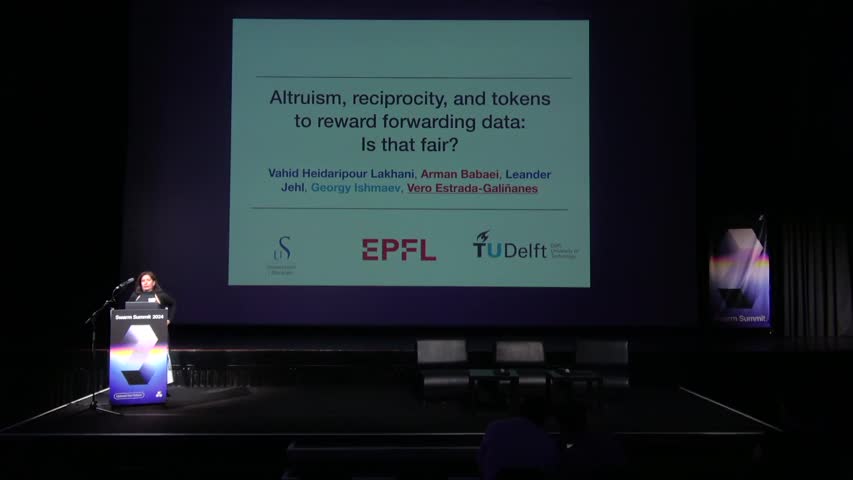
22:25Altruism, reciprocity, and tokens to reward forwarding data: Is that fair? || Vero Estrada-Galiñanes
SwarmJun 21, 2024
Decentralized storage networks use different mechanisms to distribute rewards among participants. A caveat is that rewards are often disproportionally concentrated in the hands of a small number of participants, i.e., early adopters or highly-resourced participants. We notice many design decisions, often poorly understood, can impact in the effectiveness of reward mechanisms. The video presents a paper on algorithm reciprocity and tokens as incentives for contributing data in decentralized systems, discussed at the IEEE Blockchain Conference. The research, conducted by a team from EPFL, University of Estavangar, and TUDELF, explores combining monetary rewards with other incentive mechanisms to encourage equitable participation and prevent centralization in networks like Swarm. The paper focuses on bandwidth sharing rather than storage and introduces the T4 token model. It examines how different parameters affect the fairness of reward distribution among nodes, using simulations with various settings. Key findings include the impact of gateway distribution on income fairness and the benefits of neighbor shuffling to improve fairness. The presentation concludes with an invitation to review the paper for detailed results and methodologies.
 31:07
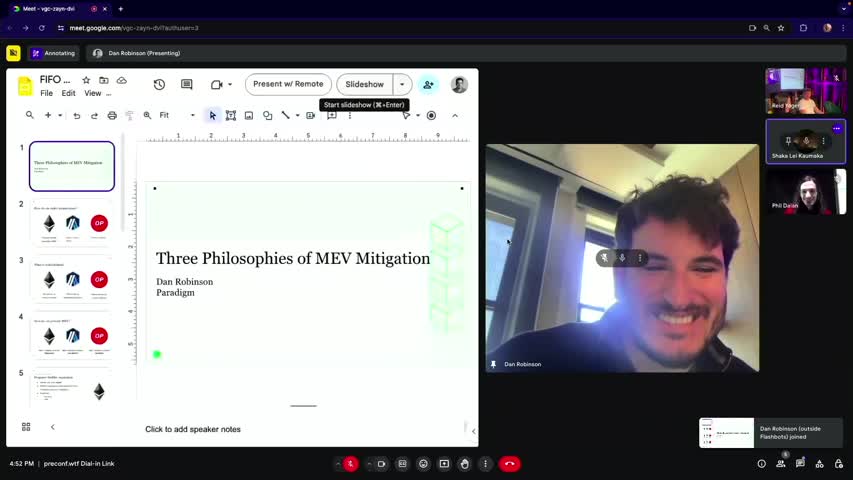
31:07[Debate] Steelman Challenge: we are all building the same damn thing! 2
ZuBerlinJun 13, 2024
Clip The video discusses three philosophies of mitigating maximal extractable value (MEV) and their implications for blockchain design, particularly in terms of transaction ordering policies. The first philosophy emphasizes blockchains as incentive engines, focusing on proposer incentives for healthy block production. The second views blockchains as timestamping services, prioritizing first-in, first-out (FIFO) transaction ordering to reflect real-world time. The third treats blockchains as auction platforms, ensuring fair and decentralized auctions through priority ordering. Each philosophy leads to different MEV mitigation strategies. Proposal builder separation (PBS) aligns the block proposer with users and applications to create value-maximizing blocks. FIFO aims to reduce MEV by minimizing latency and discretion in transaction ordering. Priority ordering mitigates MEV through fair auctions that allow users and applications to capture MEV themselves. The video further explores how these philosophies are implemented in current blockchain systems and the challenges they pose in achieving decentralization while mitigating MEV effectively. It concludes that while no single philosophy has all the answers, it's crucial to consider how improvements under one paradigm may affect the others when making protocol changes.
 26:32
26:32Understanding Decentralized Data and Computation | ETHDenver 2022
Ethereum DenverOct 9, 2022
In this video, we delve into the fascinating world of hybrid smart contracts, decentralized oracle networks, and decentralized data external computation. Join us as Patrick Collins, a developer advocate at Chainlink Labs, takes us on a journey to understand the story behind these innovative concepts and their significance in the realm of smart contracts. One of the key aspects we explore is the purpose of smart contracts and why they are crucial in today's digital landscape. As we unravel this topic further, you'll gain insights into trust minimized agreements and how they play a pivotal role in ensuring secure transactions. With Patrick's expertise guiding us through this complex terrain, you can expect to grasp the intricacies involved in building such groundbreaking technologies. Whether you're new to blockchain or well-versed in its workings, this video promises to provide valuable knowledge that will expand your understanding. Join us as we uncover the mysteries surrounding hybrid smart contracts, decentralized oracle networks, and decentralized data external computation. #SmartContracts #blockchainrevolution TLDR: The key idea of the video is that Chainlink's decentralized data and computation capabilities enable the creation of unbreakable agreements in decentralized finance protocols and offer economic opportunities by eliminating the need for trust assumptions. 00:00 📚 The speaker discusses hybrid smart contracts, decentralized oracle networks, and decentralized data external computation, emphasizing the importance of understanding the purpose of smart contracts and the story behind their development, while also urging the audience to reflect on their motivations for participating in the hackathon. 01:34 🔑 Decentralized data and computation offer economic opportunities and address the issue of trust by creating unbreakable promises and eliminating the need for centralized power in systems like banking. 06:01 🔒 Cryptographic agreements in the blockchain community eliminate the need for trust assumptions, ensuring guaranteed execution of contract terms and moving towards a world where truth is valued over trust. 09:21 🔗 Chainlink enables smart contracts to access decentralized data and computation, solving the oracle problem and allowing for the creation of unbreakable agreements in DeFi protocols. 15:44 📚 D5 protocols like synthetics, SushiSwap, Compound, and Aave enable the creation of decentralized finance applications, while chain link offers features like decimal handling and off-chain randomness for building decentralized protocols, NFTs, and gaming. 18:14 🔗 Chainlink VRF provides provably random numbers on-chain, used for randomized lotteries, gaming applications, and NFTs, while Chainlink Keepers offer decentralized event-driven execution through off-chain nodes. 21:04 📊 Chainlink's decentralized data and computation eliminates the need for intermediaries, allowing for programmable events and customizable nodes to execute transactions and call APIs, enabling feature-rich smart contracts. 23:40 📚 Chain.link is a valuable resource for learning about decentralized data and computation, with comprehensive documentation and step-by-step guides, and using Chainlink in smart contracts can qualify for prizes at ETHDenver hackathon.