About 6 results
 --:--
--:--Maximal Extractable Loss-Versus-Rebalancing
ETHTokyoSep 17, 2024
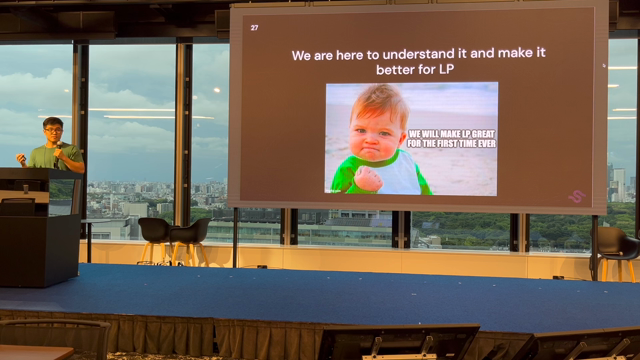
This talk will discuss mehtods to empirically determine the maximal extractable amount of such CEX-DEX arbitrage value in an attempt to measure the upper bound of this LVR problem to date. The video features Ricky Yudhoyaga from Sorella Labs discussing the hidden costs associated with being a liquidity provider (LP) in cryptocurrency markets, particularly in the context of Uniswap's V2 and V3 pools. He begins by explaining the difference between passive LPs and LPs who trade against informed traders, highlighting that informed traders have market insights that LPs lack, which can lead to LPs incurring losses. Ricky introduces the concept of LP's hidden costs or LVR (Liquidity Provider's Value at Risk) and discusses methods to quantify these costs. He details three approaches: a filtered markout based on historical trades, an implied volatility-based model, and a max LVR method. The filtered markout method calculates the difference between the price at which a trade is executed and the price shortly after, adjusted for volume and whether it's a buy or sell. This method also distinguishes between informed and uninformed trades by looking for signals such as high priority fees. Ricky presents data from an open-source MEV classification tool called Brontis developed by Sorella Labs, which shows that LPs have potentially lost over $200 million since March due to not performing proper delta hedging. He also discusses how varying the time delay in
 16:51
16:51Data is Creative Energy
New FoundationJul 18, 2024
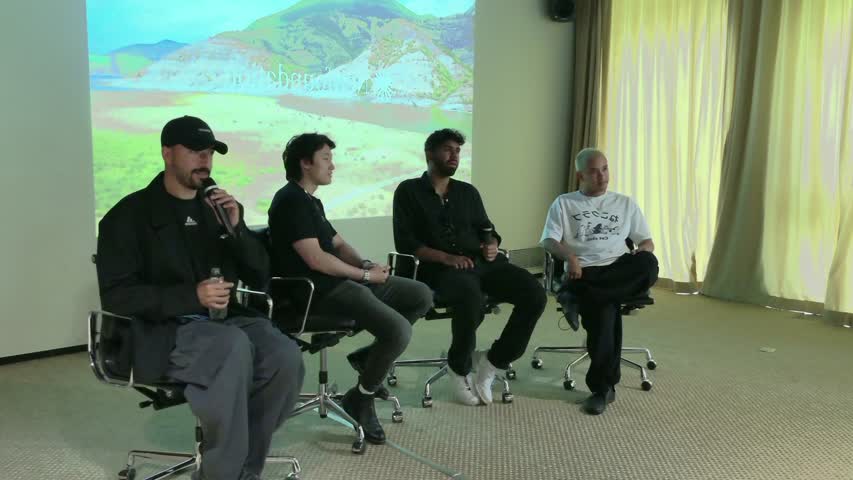
Organic and synthetic intelligence create net-new dynamic knowledge and advance our societies, economies and the state of the art, forming a new exponential asset class. Anna Kazlauskas (Vana), Jason Yhao (Story Protocol), Saneel Sreeni (Ritual), Erika Mann (Newfoundation) Covering insights on: • User owned data and user-owned foundation models • IP on-chain for stronger security guarantees and to provide attribution, provenance, & traceability of creations The video features a discussion with several key figures in the blockchain and AI industries, exploring the intersection of intellectual property (IP), data, and non-fungible tokens (NFTs). One speaker represents a platform aiming to tokenize IP on the blockchain to enable creators to monetize their work in the age of AI. They discuss how their platform uses NFTs and smart contracts to represent media files and their associated rights, allowing creators to set terms for how their IP is used. Another participant talks about building an L1 blockchain that makes AI models programmable and accessible on-chain, focusing on rewarding model creators and ensuring data integrity. The third speaker represents a network that allows individuals to earn from their personal data by putting it on-chain. They mention a partnership with Reddit DataDAO, which has created a model trained on user-owned data, highlighting the potential for data to be used for social activism. The conversation also delves into how markets might value creative output as represented by data, comparing current opaque market practices with potential future market discoveries enabled by blockchain technology. They discuss how pricing might evolve, with creators setting initial prices for their IP and marketplaces aiding in price discovery through auctions or AI assistance. Lastly, they address the roadmap for each project, emphasizing tokenization of assets as
 21:21
21:21Moving from IPFS to Swarm || Ramesh Pallikara
SwarmJun 24, 2024
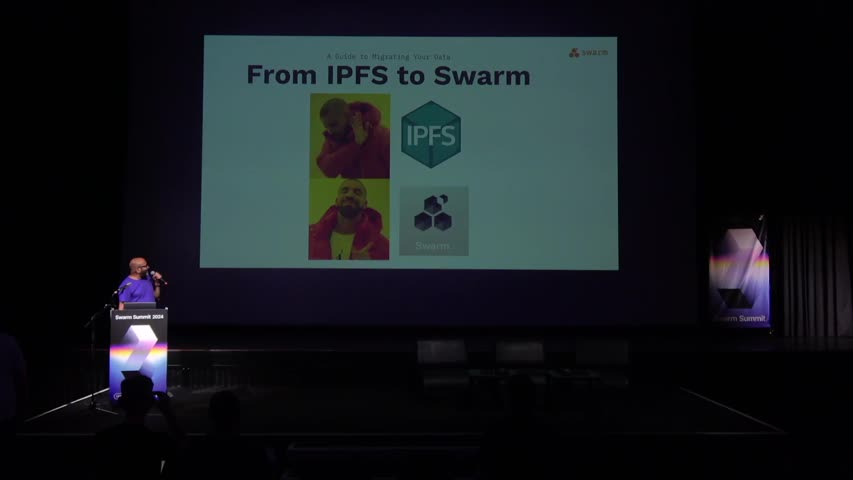
A talk that focuses on what everyone needs to know about IPFS and Swarm, its pros and cons and how to use Swarm instead of IPFS. The video features Ramesh, a developer relations representative at Swarm, who has over 20 years of full-stack development experience and has been working with IPFS and Swarm for nearly three years. He discusses the benefits of using Swarm as an alternative to IPFS for certain drawbacks users may encounter. Ramesh clarifies that while he appreciates IPFS, he believes Swarm offers superior solutions for data availability, download speeds, and decentralization without the need for constant node operation or reliance on third-party services. He explains the technical aspects of IPFS, including its content addressing system through CIDs (content identifiers) and IPNS (Interplanetary Name Service) for mutable pointers to content. Addressing misconceptions about IPFS, he notes that it is not entirely free unless users run their own nodes or use pinning services with limitations. Ramesh then compares Swarm to IPFS in terms of atomic units, download speeds, censorship resistance, privacy, payment systems, and incentives for running nodes. He clarifies terminology differences between the two platforms regarding pinning and CIDs. The video also includes a tutorial on migrating from IPFS to Swarm using command-line tools and libraries like BJS for dApps. Ramesh invites viewers to try out Swarm and join their Discord
 18:59
18:59Immutable Data Provenance: Leveraging Swarm for Secure Tracing || Tex
SwarmJun 21, 2024
Building Data Provenance - A quick overview of how data provenance; We will go throug what data provenance is. Iterate through existing standards and go through abstract implementation. The video features an individual named Tex discussing the concept of data provenance, the importance of authentication, auditing, and compliance within systems that synergize with blockchain technology. The speaker addresses the creation of a registry that aids in the current form of data management and emphasizes the use of Diffie-Hellman key exchange for securing data transactions on the blockchain. The video also delves into concepts such as smart contracts and notarization techniques that validate and secure data, ensuring its integrity over time. Additionally, it touches upon practical applications like legal evidence, contracts, intellectual property, and medical records management. The overarching theme is the significance of establishing a timestamped, verifiable record of data on the blockchain to ensure its historical accuracy and prevent tampering.
 06:50
06:50Hubee Registry: Resources for AI on Swarm || Tex
SwarmJun 21, 2024
Decentralized hub framework - Hubee; we are creating a public registry of models, datasets and resources for AI community to publish. The provided text appears to be repetitive and nonsensical, containing the repeated phrase "kaj je vlastno zvuk" (which translates to "what is the actual sound" in Slovenian) and ending with multiple iterations of "In tako je" (meaning "And so it is"). It does not contain coherent information that can be summarized for a video description. If this is intended to be a description for a video, it would not help users understand what the video is about before watching it. Please provide a clear and concise text if you would like a summary created.
 19:52
19:52DecAI Overview (Casey)
ZuBerlinJun 18, 2024
Clip The video features a speaker with a background in AI and crypto, discussing the current landscape at the intersection of these two fields. The speaker, who has experience both at Google and in crypto mining, shares insights gained from meeting with numerous companies in the crypto space. The talk covers a range of topics including decentralized GPUs, inference networks, edge computing, data generation and labeling, ZKML (Zero-Knowledge Machine Learning), fully homomorphic encryption, and AI agents. The speaker expresses skepticism about certain areas like AI agents due to scalability issues and the premature nature of these technologies. They also highlight an experiment where AI was used to categorize companies based on Twitter data, discussing both successes and shortcomings of this approach. Additionally, they touch upon the potential for crypto to address core issues in AI such as copyright, privacy, and user ownership. Throughout the video, various subcategories within each main topic are discussed along with specific companies that are making strides in those areas. The speaker is keen on creating a dynamic market map that reflects current trends and is open to community contributions. They also emphasize their excitement about data generation categories due to their potential high utility in crypto. The session concludes with questions from the audience about specific aspects of the market landscape and an acknowledgment of ongoing developments that might change existing