About 5 results
 16:58
16:58Enabling Decentralized Networks With DePin and PoC
EthCCJul 18, 2024
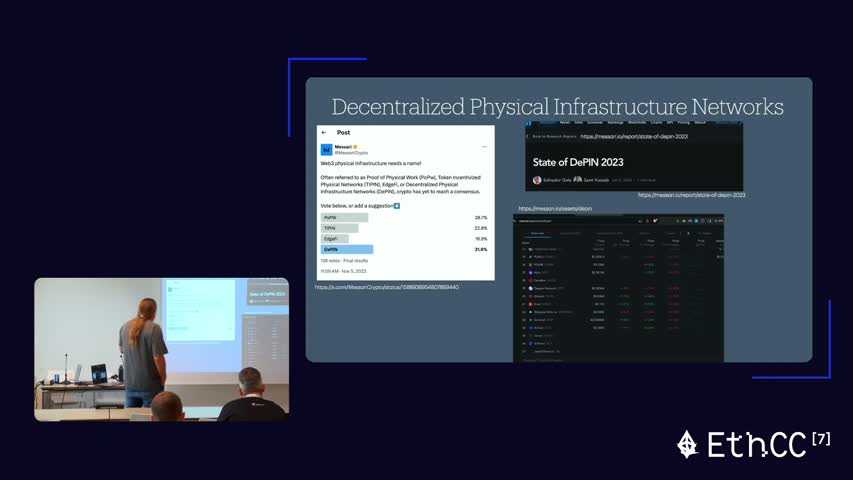
We introduce Proof of Capacity (PoC) that allows on-chain verification of off-chain cryptographic proofs over (almost any) arbitrary hardware commitments to decentralized network. We discuss PoC's role in enabling decentralized network stacks. The video discusses the evolution of the term "Deepin" in the cryptocurrency space, which was chosen to describe a particular sector involving decentralized networks and physical work. The speaker notes that Misari, a crypto analytics firm, conducted a Twitter poll in late 2022 to settle on this term, and later published an influential overview of the state of Deepin in 2023. The video highlights that there are over 60 tokens or projects associated with Deepin, indicating its significance. The speaker explains that Deepin encompasses both physical and digital resources, with a focus on digital resources like computing power. Projects like Filecoin are mentioned for their contributions to digital storage solutions. The speaker emphasizes the importance of proof systems in verifying storage and computing resources, noting the challenges unique to computing power compared to storage. Fluence is introduced as a decentralized cloud compute platform that aggregates CPU (and potentially GPU) resources for developers to purchase capacity. The platform uses WebAssembly and Docker for deploying general compute tasks. It is governed by a DAO and has its own token. The importance of supply preceding demand in protocol structure is stressed, with emphasis on creating incentives for resource providers to commit capacity without immediate demand. The speaker warns against protocols incentivizing non-existent capacity as it can be detrimental. Proof systems
 06:50
06:50Hubee Registry: Resources for AI on Swarm || Tex
SwarmJun 21, 2024
Decentralized hub framework - Hubee; we are creating a public registry of models, datasets and resources for AI community to publish. The provided text appears to be repetitive and nonsensical, containing the repeated phrase "kaj je vlastno zvuk" (which translates to "what is the actual sound" in Slovenian) and ending with multiple iterations of "In tako je" (meaning "And so it is"). It does not contain coherent information that can be summarized for a video description. If this is intended to be a description for a video, it would not help users understand what the video is about before watching it. Please provide a clear and concise text if you would like a summary created.
 11:52
11:52PlatBox by MetaProvide, a decentralised file and folder management tool || Henry Bergström
SwarmJun 21, 2024
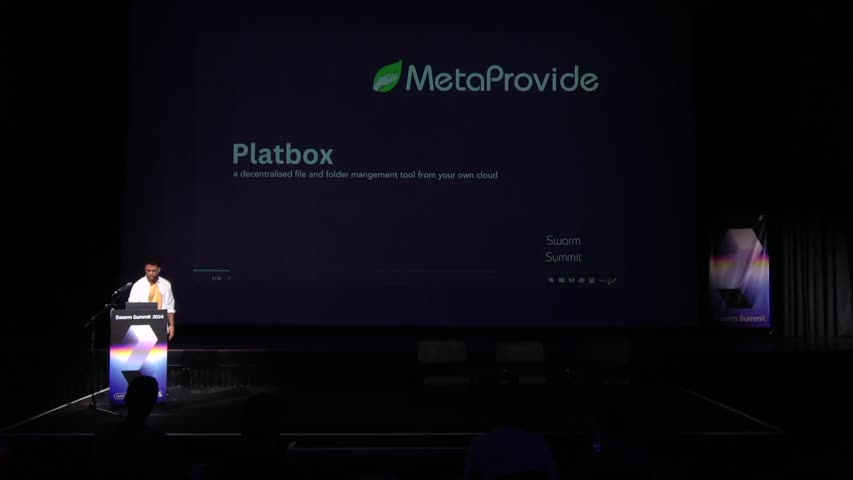
PlatBox helps companies to store, share, collaborate, and edit files using a "decentralised dropbox" by offering swarm-enabled decentralisation storage for Web2 and Web3 users, resulting in the truest form of data sovereignty without the need for understanding the complexity of Web3. The initial focus for this product are existing Nextcloud (organisations) and Moodle (education sector) users, where the tool can be imbedded into existing user interfaces. The video features a presentation about a decentralized file and folder management tool called PlatBox, which is now seeking a new name due to trademark issues. The tool integrates with users' own cloud storage and is built on top of NextCloud, an open-source self-hosted collaboration platform. The speaker shares the background of their team, MetaProvider, and their journey from creating a custom solution for well-being providers to shifting focus towards the broader cloud storage market. A demo showcases how the PlatBox plugin works within NextCloud, allowing users to manage and access files stored on Swarm, a decentralized storage system. The presenter emphasizes the goal of making sensitive data storage secure and "unstoppable" while keeping everyday data safe on users' own clouds. The presentation ends with a Q&A session addressing access control and potential expansion into other NextCloud services like voice facilities. The talk concludes with an announcement that the next topic will be about NFTs.
 34:09
34:09Practical use cases of Swarm that you can do today || Áron Soos
SwarmJun 21, 2024
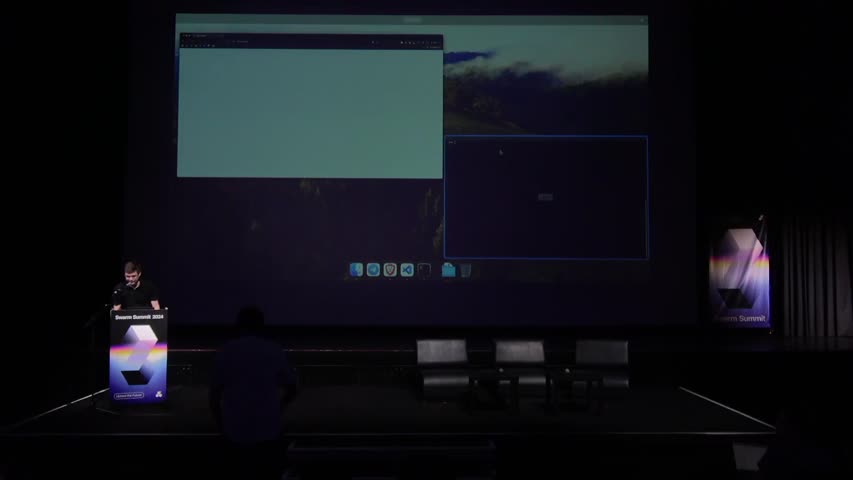
What does Swarm look like from a user's perspective? What are the available tools and how to navigate through them? This workshop will walk you through real-world use cases and show off the capabilities of the Swarm network. The video tutorial demonstrates how to set up and use various tools for interacting with the Swarm decentralized storage network. The presenter starts by showing how to start a B node on the mainnet and then introduces the Swarm CLI for managing node status and interacting with the network. Viewers learn how to use different commands to check node status, install postage batches, and upload/download content. The video further explores using the B dashboard for a graphical interface to manage Swarm interactions, including uploading files and checking postage stamps. The presenter also explains the concept of immutable and mutable postage stamps for content management. Next, the tutorial covers EtherJot, a markdown-first blogging tool that requires a local B node and a postage stamp. The presenter shows how to start a blog, customize it with themes and plugins, manage assets, and enable dynamic features like comments using Swarm's feeds. Additionally, the video discusses exposing Web3 content to Web2 users through ENS domains and eth.limo service. It also introduces gateway proxy as a tool for curating content, managing postage stamps, and securing gateways. Finally, the presenter briefly showcases Swarm Desktop for managing B nodes and accessing applications like EtherJot. Questions from the audience lead to discussions on mapping human-readable URLs to Swarm hashes using DNS, Gateway Proxy rem
Insights into TEE Research and Deployment Framework for Blockchain Scalability | Filip Rezabek
ProtoLayersJun 20, 2024
Filip Rezabek from the Technical University of Munich describes the differences between Process-based and VM-based Trusted Execution Environments (TEEs), assessing their impact on blockchain scalability. He reviews the current state of TEE research, highlighting advancements and challenges. Additionally, the talk introduces a versatile framework designed for deploying and researching TEEs in both local and cloud settings This video features a speaker with experience in the crypto field, sharing insights about trusted execution environments (TEEs) at EVE Prague. The speaker discusses the definition of TEEs, their manufacturers, and potential use cases in blockchain and distributed systems. Emphasis is placed on TEE's ability to provide confidentiality and integrity for computations, as well as their role in scalability and privacy for blockchain applications. The talk delves into the technical aspects of attestation and the differences between process-based and VM-based TEE solutions from various manufacturers. Additionally, the speaker introduces a framework developed for assessing TEE capabilities within distributed systems and presents preliminary experimental results demonstrating the performance of TEEs compared to traditional computing environments. The presentation concludes with an invitation to explore their preprint publication for more detailed information.