About 3 results
 22:20
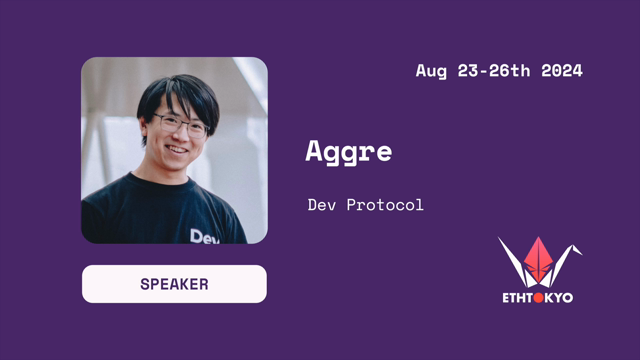
22:20True real-life token-enabled projects: Mechanisms and Impacts
ETHTokyoSep 18, 2024
This talk will explore how applications built on Dev Protocol have supported various tokenized projects that are viable in the real life, including creators, stores, and social infrastructure. The video features a team that is developing blockchain protocols across Japan, Switzerland, and India. The speaker, who typically resides in Tokyo and enjoys watching anime daily, introduces the concept that 97% of the world's population does not use blockchain. The video appears to discuss the impact of blockchain technology on those who do use it, potentially including perspectives from various sectors such as public sector professionals and business owners.
 25:23
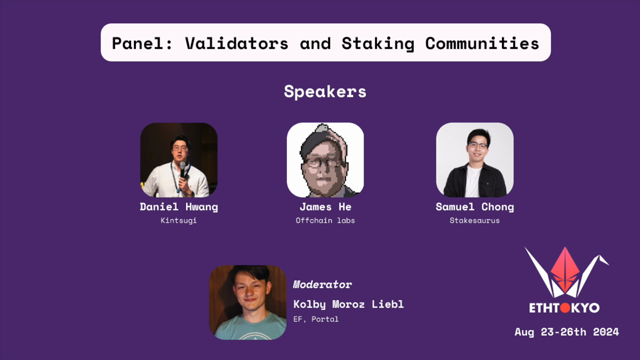
25:23Panel discussion: Validators and Staking Communities
ETHTokyoSep 18, 2024
Knowing how to run blockchain nodes is a high leverage skill and highly monetizing. Need to invest time and effort for sure but no prior technical background is needed. The video features a panel discussion with Daniel from Kintsugi, Sam aka Stakersaurus, James He from Prism, and Colby from the Ethereum Foundation (EF). They discuss various challenges and topics related to Ethereum staking and validators. Daniel talks about running Ethereum validators and the challenges of incentivization, particularly in developing countries. Sam shares his work on expanding the solo staker talent pool in Asia and his role with Lido's Community Staking Module. James addresses technical issues with validator queues and upcoming improvements in the next hard fork. Colby touches upon execution destruction and the potential conflict of interest for the EF in staking. They debate issues such as liquid vs. solo staking, capital efficiency, user experience problems, hardware costs for validators, decentralization concerns, OFAC compliance among staking providers, and how it conflicts with censorship resistance. There's also a discussion on the dominance of large staking protocols like Lido and their impact on network centralization. The conversation highlights ideological differences between maintaining decentralization principles versus practical realities like legal compliance. They conclude that more solo stakers are needed to maintain decentralization and suggest that improvements to Ethereum's core development process could help address some of these concerns. The video aims to provide insights into the complexities of Ethereum staking
 30:03
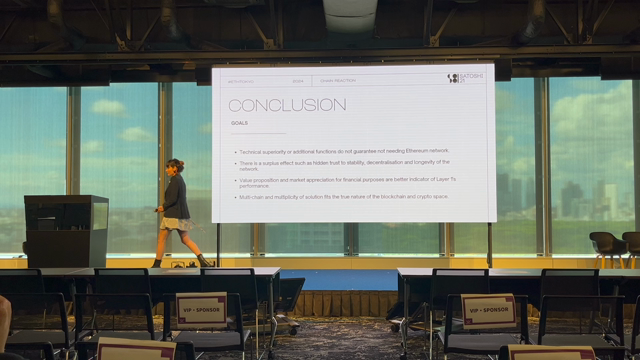
30:03End of the Ethereum Killer Narrative; The Future of Onchain Businesses
ETHTokyoSep 3, 2024
This talk will discuss how advancements in scalability solutions are empowering Ethereum to accommodate a vast network of transactions and interactions, fostering seamless operations for onchain businesses of all scales. The video features Melissa Kurtcan, founder and CEO of Satoshi21 Venture Studio, discussing insights from the Chain Reaction Incubator in Southeast Asia and her six years of experience in the cryptocurrency industry. She aims to address the fundamental principles and ideologies of blockchain technology, especially in light of the recent FTX incident. Melissa questions the validity of the "Ethereum killer" narrative, suggesting it might be more marketing hype than reality. She emphasizes that blockchain is ideologically different from other technologies because it solves technical problems with an ideological approach. The talk will cover Bitcoin's value proposition as decentralized digital scarcity and Ethereum's evolution towards programmable decentralization. Melissa critiques the blockchain trilemma (decentralization, security, scalability) and suggests a multi-chain ecosystem for achieving these goals alongside privacy. She outlines that to challenge an existing layer one blockchain like Ethereum, a new platform must offer a paradigm shift and execute perfectly to gain market penetration. The summary is that technical superiority alone won't lead to mass adoption without underlying ideology, and she argues against narratives that claim established blockchains like Ethereum are outdated.