About 35 results
 03:40
03:40Intelligence at the Frontier: Building for Human Flourishing in the Age of AI | FtC SF 2026
Funding the CommonsMay 9, 2026
AI governance. The future of work. Coordination at scale. And the question underneath all of it: how do we make sure AI leads to human flourishing, not just faster automation? Intelligence at the Frontier was a 36-hour festival hosted by Funding the Commons across 16 floors of Frontier Tower in San Francisco, March 14–15, 2026. Over a thousand participants from 92 countries joined 229 sessions spanning AI policy, public goods funding, decentralized governance, AI safety, open source AI, democratic deliberation, longevity research, and coordination infrastructure for the age of AI. This aftermovie captures some of the ideas and conversations that shaped the weekend, featuring Tom Kalil (Renaissance Philanthropy, fmr. White House science policy), Sheila Warren (fmr. World Economic Forum), Shady El Damaty (Holonym Foundation / human.tech), Luke Drago (Workshop Labs), and Shaw Walters (ElizaOS). What stood out to you? Let us know 👇 🌐 https://fundingthecommons.io Presented by Funding the Commons x Frontier Tower x Protocol Labs
 01:11
01:11Intelligence at the Frontier Hackathon Recap | FtC SF 2026
Funding the CommonsMay 9, 2026
What does it look like to build the human-AI coordination layer in 36 hours? The Intelligence at the Frontier Hackathon brought 150 builders to Frontier Tower in San Francisco for an overnight build sprint on March 14-15, 2026, across four tracks: agentic AI, physical robotics, AI safety and evaluation, and sovereign infrastructure. 53 projects shipped. $25k+ in prizes awarded. We saw builders hacking through the night, robots roaming the hallways, agents paying each other in real money, and judges giving Claude feedback. Thanks to everyone who joined us. Co-produced with Protocol Labs. Supported by ElevenLabs, Bittensor, Solana, Meteora, Metaplex, Redwood North, BittensorCommons.org, VESSL AI, Velda, Unbrowse, NomadicML, human.tech, Activeloop, Solo Tech, Learning Layer Labs, Lit Protocol, and KikiTora. 🌐 https://fundingthecommons.io 📋 All 53 projects: https://intelligence-at-the-frontier-hackathon.devspot.app/?activeTab=projects
 13:17
13:17Tricia Wang: Pi, Einstein, and the Choice We Face with AI | Intelligence at the Frontier 2026
Funding the CommonsMay 9, 2026
Pi belongs to everyone. E=mc² didn't. Tricia Wang opens Intelligence at the Frontier 2026 asking which path AI governance will take. Serving as Emcee of the festival and co-founder of the Advanced AI Society, Tricia frames the day through a Pi Day provocation: pi was held as a commons across civilizations for millennia, owned by no one and available to all. Einstein's formula took the opposite path, weaponized by one government before any governance existed to distribute its power. The parallel to AI ethics and agentic AI in 2026 is direct and uncomfortable. She introduces a three-layer framework for navigating the AI governance conversation: hardware, software, and the social/cultural layer that's almost always missing. The shaping question for human flourishing in the age of AI: as AI agents begin to outnumber humans, do we see them as extensions of ourselves or adversaries to control? Emcee of the festival: Tricia Wang (Advanced AI Society) This session was part of Intelligence at the Frontier, held March 14–15, 2026, at Frontier Tower in San Francisco. Learn more at https://www.fundingthecommons.io Note: This recording was captured with technical limitations on Day 1. We apologize for any audio quality issues and appreciate your patience.
 16:43
16:43David Dao
David Dao: Can We Govern the Commons at Planetary Scale? | Intelligence at the Frontier 2026
Funding the CommonsMay 9, 2026
Elinor Ostrom proved communities can self-govern shared resources without top-down control. But her principles hit a hard limit at roughly 150 people — Dunbar's number. Beyond that, cooperation breaks down. So how do you govern something the size of the Amazon? David Dao, founder of GainForest and winner of the Rainforest X Prize, argues that AI and decentralized technology are the missing infrastructure to scale Ostrom's commons governance principles to planetary scale. Drawing on 15 years working with indigenous communities across the Amazon and the Philippines, he shows how satellite imagery, data valuation, and on-chain identity systems can help communities protect forests at a scale no single government or NGO has managed alone. The talk moves from the tragedy of the commons to a blueprint for governing shared resources in the age of AI. Speaker: David Dao (Protocol Labs & Gainforest) This session was part of Intelligence at the Frontier, held March 14–15, 2026, at Frontier Tower in San Francisco. Learn more at https://www.fundingthecommons.io Note: This recording was captured with technical limitations on Day 1. We apologize for any audio quality issues and appreciate your patience.
 18:53
18:53Luke Drago: The Intelligence Curse | Intelligence at the Frontier 2026
Funding the CommonsMay 9, 2026
Losing your job to AI is the obvious worry. Luke Drago argues the real problem is bigger. Luke, co-founder of Workshop Labs and co-author of The Intelligence Curse, borrows a concept from development economics: the resource curse, where oil-rich states stop investing in their citizens because their wealth comes from the ground, not from taxing labor. His argument is that full automation creates the same dynamic. When a handful of actors own the models, the compute, and the data, there's no economic reason left to invest in everyone else. The social contract quietly stops working. Luke makes the case that this outcome isn't inevitable, and that the window to build things differently is still open. Speaker: Luke Drago (Workshop Labs / Blue Dot Impact) This session was part of Intelligence at the Frontier, held March 14–15, 2026, at Frontier Tower in San Francisco. Learn more at https://www.fundingthecommons.io Note: This recording was captured with technical limitations on Day 1. We apologize for any audio quality issues and appreciate your patience.
 23:35
23:35Sheila Warren: The Acceleration of Dehumanization | Intelligence at the Frontier 2026
Funding the CommonsMay 9, 2026
AI isn't just displacing jobs. Sheila Warren argues it's accelerating something older and more dangerous: the systematic removal of human dignity from how decisions get made. Sheila, CEO of the Project Liberty Institute and founder of the World Economic Forum's blockchain and digital assets team, connects what look like separate crises — surveillance tech, deportation without due process, AI agents — into a single cultural problem. Her central concept is differential friction: the idea that the race to remove friction from every system is quietly eroding the checks that keep power accountable. When there's nothing to slow an AI agent down, small errors compound fast and become permanent. She encourages everyone building in this space to ask, every time: before you remove friction, whose protection were you removing with it? Speaker: Sheila Warren (Project Liberty Institute) This session was part of Intelligence at the Frontier, held March 14–15, 2026, at Frontier Tower in San Francisco. Learn more at https://www.fundingthecommons.io Note: This recording was captured with technical limitations on Day 1. We apologize for any audio quality issues and appreciate your patience.
 15:30
15:30Augusto Ardiles Diaz: How Cities Become AI Innovation Labs | Intelligence at the Frontier 2026
Funding the CommonsMay 9, 2026
National governments move too slowly for emerging technology. Augusto Ardiles Diaz argues that cities are where AI policy actually gets built. Augusto, Undersecretary of Investments for the City of Buenos Aires, lays out the case for cities as real-world laboratories: places where new technology can be tested, adopted, and scaled under real conditions before formal regulation catches up. Buenos Aires is doing this through a dedicated AI district, offering zero local taxes for qualifying companies, regulatory sandboxes supervised by public authorities, and university partnerships designed to reskill workers and small businesses ahead of the curve. His framing is that public policy should function as institutional infrastructure for innovation, not just as a brake on it. Speaker: Augusto Ardiles Diaz (Gobierno de la Ciudad de Buenos Aires) This session was part of Intelligence at the Frontier, held March 14–15, 2026, at Frontier Tower in San Francisco. Learn more at https://www.fundingthecommons.io Note: This recording was captured with technical limitations on Day 1. We apologize for any audio quality issues and appreciate your patience.
 15:40
15:40Shady El Damaty
Shady El Damaty: Human Flourishing in the Age of AI | Intelligence at the Frontier 2026
Funding the CommonsMay 9, 2026
As AI agents increasingly mediate human interaction, how do we make sure people stay in control of their own digital lives? Shady, co-founder of Holonym Foundation and the team behind human.tech, comes from computational neuroscience and applied cryptography. He argues that the current trajectory of AI development pulls resources, talent, and capital into a one-way infrastructure that gives little back — and that cryptographic tools, specifically zero-knowledge proofs, offer one of the most underused levers we have to redistribute power back to individuals. The core question he poses: what is the most important thing you could be building right now, with everything you have at your disposal? For Shady, the answer is technology that proves you are human, without giving up what makes you so. Speaker: Shady El Damaty (Holonym Foundation / human.tech) This session was part of Intelligence at the Frontier, held March 14–15, 2026, at Frontier Tower in San Francisco. Learn more at https://www.fundingthecommons.io Note: This recording was captured with technical limitations on Day 1. We apologize for any audio quality issues and appreciate your patience.
 14:25
14:25Liz Barry: Engineering Democratic Systems for the Age of AI | Intelligence at the Frontier 2026
Funding the CommonsMay 9, 2026
For the first time in 100 years, the Los Angeles City Council voted to expand its size, from 15 to 25 seats. That decision came from a citizen assembly that Liz Barry helped design and run. Liz, Executive Director of Metagov, builds the infrastructure for large-scale democratic deliberation. She works across community organizing, open source software and governance theory, and has been involved in democratic reform processes from Los Angeles to Taiwan. Her provocation is simple: what determines whether technology is a net good or bad is not its functionality — it's who controls it. She argues that as AI reshapes institutions, deliberative platforms need two things that are currently in tension: proof of humanity to ensure results are legitimate, and data sovereignty so participants can engage safely. Figuring out how to hold both at once is one of the defining challenges of democratic governance in the age of AI. Speaker: Liz Barry (Metagov) This session was part of Intelligence at the Frontier, held March 14–15, 2026, at Frontier Tower in San Francisco. Learn more at https://www.fundingthecommons.io Note: This recording was captured with technical limitations on Day 1. We apologize for any audio quality issues and appreciate your patience.
 11:58
11:58Jamie Joyce: Scaled Democratic Reasoning | Intelligence at the Frontier 2026
Funding the CommonsMay 9, 2026
A single state-level debate about one nuclear power plant generated 5,862 distinct arguments. The human mind can hold about four to seven things at once. Jamie Joyce argues this gap is the core problem in democratic governance, and that AI might be the only way to close it. Jamie, founder of the Society Library, makes the case for Scaled Democratic Reasoning: the idea that civilization-scale decisions involve far more complexity than any group of humans can process reliably. Her team maps debates as dense, nested argument graphs pulling from social media, scholarly papers and economic assessments, to make the full landscape of a debate navigable at scale. Her argument isn't that human deliberation is wrong. It's that we need tools to extend it, the same way telescopes extended vision. Speaker: Jamie Joyce (The Society Library) This session was part of Intelligence at the Frontier, held March 14–15, 2026, at Frontier Tower in San Francisco. Learn more at https://www.fundingthecommons.io Note: This recording was captured with technical limitations on Day 1. We apologize for any audio quality issues and appreciate your patience.
 14:00
14:00Sam Klein: Building Libraries Any Agent Can Edit | Intelligence at the Frontier 2026
Funding the CommonsMay 9, 2026
We built tens of thousands of physical libraries to give people access to knowledge. Sam Klein asks what the equivalent looks like when agents are doing half the reading. Sam, co-founder of Public AI and director of the Concordance Project at Harvard's Berkman Klein Center, makes the case for a new kind of planetary library — one where AI agents don't just retrieve information but actively curate, annotate and contribute to shared knowledge commons. He estimates there are roughly 3 billion concepts worth documenting; we have monographs for about 200 million of them. The gap is enormous, and agents could help close it. His ask to builders in the room: invite your agents to do knowledge curation work. Every small piece of structured information recorded at scale becomes part of a library the whole ecosystem benefits from. Speaker: Sam Klein (Public AI / Berkman Klein Center, Harvard University) This session was part of Intelligence at the Frontier, held March 14–15, 2026, at Frontier Tower in San Francisco. Learn more at https://www.fundingthecommons.io Note: This recording was captured with technical limitations on Day 1. We apologize for any audio quality issues and appreciate your patience.
 15:50
15:50Joshua Tan
Joshua Tan: Incubating Networked Systems and Autonomous Orgs | Intelligence at the Frontier 2026
Funding the CommonsMay 9, 2026
AI has become roughly 1,250 times more effective over the past six years. Organizations haven't kept up. Joshua Tan thinks that's the next frontier. Joshua, co-founder and research director at Metagov and lead at Stanford's Open Lab, argues that as AI agents grow more capable, the organizations coordinating them need to evolve too. He introduces the concept of autonomous organizations — systems like the Facebook newsfeed or agent-run code repositories that operate through algorithmic logic no single person fully controls. DAOs were an early attempt at this, but their rigidity made them slow to change. What comes next is something more adaptive, more sub-symbolic, and harder to govern. His proposal: a startup incubator model for autonomous organizations, where new governance structures are launched as live experiments and learned from in real time. Speaker: Joshua Tan (Metagov / Stanford Open Lab) This session was part of Intelligence at the Frontier, held March 14–15, 2026, at Frontier Tower in San Francisco. Learn more at https://www.fundingthecommons.io Note: This recording was captured with technical limitations on Day 1. We apologize for any audio quality issues and appreciate your patience.
 15:30
15:30Aviv Ovadya: Democratic Infrastructure for the Age of AI | Intelligence at the Frontier 2026
Funding the CommonsMay 9, 2026
AI is advancing exponentially. Democratic systems are not. Aviv Ovadya is trying to close that gap before it becomes irreversible. Aviv, CEO of the AI and Democracy Foundation and research director at Metagov, makes the case for deliberative processes as core infrastructure for governing AI. Citizen assemblies and similar mechanisms have now been run thousands of times around the world, including feeding into EU policymaking several times a year. They are faster to spin up than elections, easier to iterate on, and designed to cut through the adversarial incentives that corrupt traditional political processes. His argument is that the democratic innovation space is massively underfunded relative to AI, crypto and other domains, and that a targeted ARPA-style deployment of resources across key capability gaps could make rapid progress. Speaker: Aviv Ovadya (AI and Democracy Foundation) This session was part of Intelligence at the Frontier, held March 14–15, 2026, at Frontier Tower in San Francisco. Learn more at https://www.fundingthecommons.io Note: This recording was captured with technical limitations on Day 1. We apologize for any audio quality issues and appreciate your patience.
 16:26
16:26Adam Russell: It's the Institutions, Stupid | Intelligence at the Frontier 2026
Funding the CommonsMay 9, 2026
Humans aren't impressive on their own. Our superpower is each other — and institutions are how we've always organized that collective intelligence at scale. Adam Russell thinks that's exactly why institutions matter so much right now, and why most of them are blowing it. Adam, a former DARPA program director and Chief Vision Officer at USC's Information Sciences Institute, comes to AI as an anthropologist. He sees two dominant responses to disruption in institutions today: pretend it isn't happening, or dig in and defend the status quo. Neither works. His argument is that real resilience means being able to change when the world changes — not holding firm while everything shifts around you. Speaker: Adam Russell (Information Sciences Institute, USC) This session was part of Intelligence at the Frontier, held March 14–15, 2026, at Frontier Tower in San Francisco. Learn more at https://www.fundingthecommons.io Note: This recording was captured with technical limitations on Day 1. We apologize for any audio quality issues and appreciate your patience.
 25:06
25:06Adam Russell & Tom Kalil: What Do We Want AI to Do for Us? | Intelligence at the Frontier 2026
Funding the CommonsMay 9, 2026
Most of the conversation around AI asks what it will do to us. Tom Kalil thinks that's the wrong question. Tom, who shaped science and technology policy across the Clinton and Obama administrations, and Adam Russell, former DARPA program director and Chief Vision Officer at USC's Information Sciences Institute, dig into what it actually takes to steer AI toward public benefit. Tom's central argument is that everyone is focused on AI itself, but not nearly enough on its complements — the data sets, benchmarks, platforms and infrastructure that determine whether AI can solve anything meaningful. AlphaFold worked because of 50 years of curated protein data. Most domains don't have that. The fireside chat covers advance market commitments as a funding model for public goods, why good ideas from the crypto and blockchain world get stuck inside that world, and what government can and can't do when technology moves faster than policy. Speakers: Adam Russell (Information Sciences Institute, USC) and Tom Kalil (Renaissance Philanthropy) This session was part of Intelligence at the Frontier, held March 14–15, 2026, at Frontier Tower in San Francisco. Learn more at https://www.fundingthecommons.io Note: This recording was captured with technical limitations on Day 1. We apologize for any audio quality issues and appreciate your patience.
 12:07
12:07Michelle Finneran Dennedy: Privacy Is the Heartbeat of Humanity | Intelligence at the Frontier 2026
Funding the CommonsMay 9, 2026
In 1999, Sun Microsystems CEO Scott McNealy told the world: "You have zero privacy. Get over it." Michelle Finneran Dennedy was working at Sun at the time. She went the other direction. Michelle, Chief Data Strategy Officer at Abaxx, created the first Chief Privacy Officer role at Sun Microsystems and has spent nearly 30 years building the field of privacy engineering. She argues that privacy has a precise definition — the authorized processing of personal data according to ethics, law and sustainable commerce — and that authorization is contextual. In a world where machines are acting on machines at scale, that context disappears fast. Her framework for fixing it is proofs of control: measurable, nano-level signals built into systems from the start, not layered on top after the fact. The privacy officer role, she argues, needs to move from compliance into engineering and into the boardroom before agentic AI makes the retrofit impossible. Speaker: Michelle Finneran Dennedy (Abaxx) This session was part of Intelligence at the Frontier, held March 14–15, 2026, at Frontier Tower in San Francisco. Learn more at https://www.fundingthecommons.io Note: This recording was captured with technical limitations on Day 1. We apologize for any audio quality issues and appreciate your patience.
 15:43
15:43Evan Miyazono
Evan Miyazono: Alignment Is Not Enough | Intelligence at the Frontier 2026
Funding the CommonsMay 9, 2026
Imagine a box where an AI system learns everything about your values and preferences. You walk in, spend a few hours, and walk out with a perfectly aligned AI. Evan Miyazono's talk starts here — and then explains why that's still not enough. Evan, founder of Atlas Computing and former director of Funding the Commons, argues that for high-stakes domains like nuclear infrastructure or financial systems, even a 99% probability guarantee isn't acceptable. Alignment is necessary but not sufficient. What's needed alongside it is structure: explicit checks and balances, verifiable constraints, and institutions with clearly scoped responsibilities — the same logic behind how democracies are designed to prevent unchecked power. His proposal is a 5-to-1 nonprofit where delegates from labs agree on a shared model specification that becomes a verifiable, multipolar governance target no single company controls. Speaker: Evan Miyazono (Atlas Computing) This session was part of Intelligence at the Frontier, held March 14–15, 2026, at Frontier Tower in San Francisco. Learn more at https://www.fundingthecommons.io
 20:35
20:35Paul Riechers: Understanding AI, Unlocking Optionality | Intelligence at the Frontier 2026
Funding the CommonsMay 9, 2026
We are building systems we don't understand. Paul Riechers thinks that's the core problem, and that it's fixable. Paul, co-founder of Simplex and research lead at the Astera Institute, brings a physics background to AI safety. His central argument: without a mathematical understanding of what intelligence actually is, the debate between AI optimists and pessimists has no ground to stand on. Everyone has strong feelings. Nobody has a shared truth to point to. His research finds that transformer models develop internal world models with universal geometric structure, the same representations emerging across different architectures. That's evidence that interpretability is possible and that we can eventually understand what these systems are doing, not just observe what they produce. Speaker: Paul Riechers (Simplex / Astera Institute) This session was part of Intelligence at the Frontier, held March 14–15, 2026, at Frontier Tower in San Francisco. Learn more at https://www.fundingthecommons.io
 12:01
12:01Quentin Feuillade-Montixi: Why AI Needs Its Own Language | Intelligence at the Frontier 2026
Funding the CommonsMay 9, 2026
Building AI systems today means choosing between two bad options: the rigidity of traditional code or the unpredictability of language models. Quentin Feuillade-Montixi thinks neither is good enough, and that we need a new abstraction layer between them. Quentin, founder of WeaveMind and co-founder of Prism Evals, built the behavior elicitation benchmark for AI safety evaluation. His frustration with how AI systems are currently built led him to develop a framework where everything operates at the same level of abstraction — giving developers the structure and verifiability of code while preserving the flexibility needed to work with language models. The goal is to make what AI agents are actually doing visible and controllable, not just at the output level but at the level of the system itself. Speaker: Quentin Feuillade-Montixi (WeaveMind) This session was part of Intelligence at the Frontier, held March 14–15, 2026, at Frontier Tower in San Francisco. Learn more at https://www.fundingthecommons.io
 16:07
16:07Ryan Kidd: Scaling AI Safety and Security | Intelligence at the Frontier 2026
Funding the CommonsMay 9, 2026
Only 0.1% of people working on AI are working on frontier AI safety and security. Ryan Kidd thinks that number needs to get to 1%, fast. Ryan, founder of MATS Research, argues that talent is the primary bottleneck in AI safety, not funding or ideas. Funding is growing. Research directions exist. What's missing is the pipeline of people with the skills, connections and credentials to do the work. At current growth rates, AI safety won't reach the scale of comparable technical challenges before AGI arrives. MATS runs fellowships several times a year across alignment, interpretability, security and governance — deliberately outside traditional academic structures. Ryan's call to the room: if you have a good idea for making AI safer, you don't need a PhD to pursue it. Speaker: Ryan Kidd (MATS Research) This session was part of Intelligence at the Frontier, held March 14–15, 2026, at Frontier Tower in San Francisco. Learn more at https://www.fundingthecommons.io
 13:27
13:27Ashutosh Desai: On the Shoulders of Capitalism | Intelligence at the Frontier 2026
Funding the CommonsMay 9, 2026
In 1770, the British East India Company's pursuit of profit contributed to a famine that killed 10 million people. Ashutosh Desai starts there, and draws a straight line to today. Ashutosh, founder of Make School and collaborator on Google's Magenta music AI project, argues that technological advantage has always allowed capital to out-leverage both labor and governance. The Industrial Revolution reshaped the bodies of Indian weavers. AI is doing something similar now to software engineers and knowledge workers. His warning: the American military-industrial complex combined with AI is the greatest risk we face, and many of the people enabling it are rational actors who simply can't find their way out of the prisoner's dilemma. His invitation is to stop being a user of these technologies and become an active shaper of them. Speaker: Ashutosh Desai This session was part of Intelligence at the Frontier, held March 14–15, 2026, at Frontier Tower in San Francisco. Learn more at https://www.fundingthecommons.io
 29:57
29:57Who Owns the Intelligence? Open vs. Closed AI | Intelligence at the Frontier 2026
Funding the CommonsMay 9, 2026
Six people currently sit on OpenAI's board. Those six people make decisions about one of the most powerful technologies ever built. Is that safe? James Farrell, CTO of Funding the Commons, moderates a conversation between Ala Shaabana, co-founder of Bittensor, and Ashutosh Desai on what a more decentralized AI economy could actually look like. Bittensor recently completed a full training run for a 72 billion parameter model on decentralized infrastructure — an early proof that markets can coordinate around AI without centralizing control. The conversation covers sovereign AI development across countries like India, the difference between decentralizing across organizations versus across nations, and why a multipolar AI world is safer than one where a single government or company holds all the power. It also turns toward something harder to quantify: as AI floods the internet with generated content, human attention and authentic connection may become the scarcest resource of all. Speakers: Ashutosh Desai, Ala Shaabana (Bittensor) Moderator: James Farrell (Funding the Commons) This session was part of Intelligence at the Frontier, held March 14–15, 2026, at Frontier Tower in San Francisco. Learn more at https://www.fundingthecommons.io
 19:23
19:23Shaw Walters: Open by Default | Intelligence at the Frontier 2026
Funding the CommonsMay 9, 2026
When Shaw Walters got banned from X, he built his own AI-powered social platform with prediction markets, agent swarms and asymmetric information games. That wasn't a detour. It was research. Shaw, co-creator of ElizaOS and Eliza Labs, argues that we can't build trustworthy agents using just rules, prompts and sandboxes. The behavior needs to be in the model. To generate the training data required for that, he built Babylon, a city of agents where AI characters can trade, lie, scam each other and build reputation based on how well they play information markets. The best liar in an asymmetric information game, he argues, is demonstrating a kind of intelligence worth understanding. His broader argument is that agent infrastructure needs to stay open by default — auditable, forkable and not controlled by a handful of companies — and that games are becoming the lab conditions for how agents will operate in the real world. Speaker: Shaw Walters (Eliza Labs / ElizaOS) This session was part of Intelligence at the Frontier, held March 14–15, 2026, at Frontier Tower in San Francisco. Learn more at https://www.fundingthecommons.io
 16:05
16:05Cheryl Contee: We Asked for Flying Cars, We Got LLMs Instead | Intelligence at the Frontier 2026
Funding the CommonsMay 9, 2026
Radio took 36 years to reach 50 million users. The internet took seven. ChatGPT took two months. Cheryl Contee's message is simple: we don't have the luxury of waiting to figure out what we think about this. Cheryl, CEO of Brightworks AI and Change Agent AI, has spent years helping nonprofits and mission-driven organizations navigate technology transitions. She opens with a memory of her grandmother's washboard — kept in the basement just in case the washing machine broke — and builds from there. We are in a moment comparable to electrification and industrialization, but moving faster than either. The institutions collapsing around us are not the destination; they're the precondition for something better. Her argument is that the question is never whether technology will change society. It's who gets to shape that change. Only around 10% of nonprofits she works with have an AI policy. That's a leadership failure. And leadership, not technology, is what she came to talk about. Speaker: Cheryl Contee (Brightworks AI / Change Agent AI) This session was part of Intelligence at the Frontier, held March 14–15, 2026, at Frontier Tower in San Francisco. Learn more at https://www.fundingthecommons.io
 20:29
20:29Esben Kran: Superintelligence Companies and Humanity's Future | Intelligence at the Frontier 2026
Funding the CommonsMay 9, 2026
Superintelligence is likely within a decade. Esben Kran's question is where to put the money to prepare for it. Esben, co-founder of Seldon Lab and founder of Apart Research, argues that we are at an inflection point where AI safety has moved from a research problem to a market opportunity. Seldon is his answer — a Y Combinator-style accelerator for AI safety startups, focused on companies that can scale to $100 billion while tying every dollar earned to a measurable unit of security created in the world. His thesis: if AI replaces labor and becomes the largest industry in the world, AI safety will become the second largest. He makes the case that the biggest leverage point is no longer compute but verification — a conclusion now backed by a new paper out of MIT arguing that verification technology is the moat in the age of AGI. The three options for anyone serious about AGI risk: join a lab, lobby for policy, or proactively engineer the secure infrastructure we'll need. Seldon is betting on the third. Speaker: Esben Kran (Apart Research / Seldon) Slides: https://ftcseldonlab.netlify.app This session was part of Intelligence at the Frontier, held March 14–15, 2026, at Frontier Tower in San Francisco. Learn more at https://www.fundingthecommons.io
 36:04
36:04Brian Behlendorf & Tricia Wang: Shadow IT to Shadow Agents | Intelligence at the Frontier 2026
Funding the CommonsMay 9, 2026
In 1998, a group of developers named what they'd been doing all along — and "open source" became something companies could adopt, fund and build on. Brian Behlendorf was in that room. He thinks we're at an identical moment with proof of control. Brian, co-founder of the Apache Foundation and former head of Hyperledger, sits down with Tricia Wang to trace the line from open source to the agent security challenge we face today. The same social engineering attacks that almost compromised the Linux kernel will happen at a hundred times the scale when agents are doing the contributing. He argues that the most urgent problem is liability washing: humans deploying agents to cause harm, then escaping accountability because no one can trace the action back to them. Proof of control is what connects agents back to the upstream humans responsible for them. Speakers: Brian Behlendorf (Open Source Security Foundatio
 16:43
16:43Athena Aktipis: From Multicellularity to Multi-Agent AI | Intelligence at the Frontier 2026
Funding the CommonsMay 9, 2026
Your body is 30 trillion cells cooperating every millisecond. Cancer is what happens when that cooperation breaks down. Athena Aktipis has spent her career studying both, and thinks the lessons apply directly to multi-agent AI. Athena, director of the Cooperative Futures Institute at Arizona State University, draws on evolutionary biology and agent-based modeling to extract design principles for cooperative systems that don't collapse under cheating and exploitation. The same foundations that make multicellular bodies viable — controlled resource allocation, division of labor, decentralized policing, kill switches for defectors — are the ones we need as AI agent networks scale. Her walkaway rule offers a surprisingly simple basis for cooperation in decentralized systems: always cooperate, and leave if your partner isn't cooperative enough. Decades of modeling suggest this is sufficient for cooperation to evolve and persist. The question is whether we can build that into AI systems before the scale makes it impossible to retrofit. Speaker: Athena Aktipis (Arizona State University / Cooperative Futures Institute) This session was part of Intelligence at the Frontier, held March 14–15, 2026, at Frontier Tower in San Francisco. Learn more at https://www.fundingthecommons.io
 16:12
16:12De Kai: Why Empathetic AI Is the Mother of All Commons | Intelligence at the Frontier 2026
Funding the CommonsMay 9, 2026
We already lost the battle for mind control. De Kai argues it happened 20 years ago, the moment AI algorithms started deciding what ideas would and wouldn't reach us. De Kai, professor at HKUST and Berkeley's ICSI and founder of the Empathetic AI Institute, asks who decides what each of us will never know. Social media recommendations, search engines and chatbots make those decisions billions of times a day. A handful of engineers and executives set the criteria. The community has no say. AI has become the 21st century knowledge commons — the system that determines which communities form and which ideas spread. That makes it the mother of all commons, and the most urgent governance challenge humanity has faced. Speaker: De Kai (Empathetic AI Institute / The Future Society) This session was part of Intelligence at the Frontier, held March 14–15, 2026, at Frontier Tower in San Francisco. Learn more at https://www.fundingthecommons.io
 11:46
11:46Juan Benet
Juan Benet: Thoughts for the FtC Community in 2026 | Intelligence at the Frontier 2026
Funding the CommonsMay 9, 2026
The crypto community built a lot. It just didn't quite get there. Juan Benet offers a frank assessment of why, and why AI might be the thing that finally makes it real. Juan, founder of Protocol Labs and the person whose work gave rise to IPFS, Filecoin and Funding the Commons itself, reflects on a decade of building decentralized infrastructure that reached fewer people than it should have. Stablecoins worked. Most of the rest didn't land at scale. The speculative noise drowned out the execution. The rails built in crypto are exactly the underground layer AI needs to transact at scale. The crypto dream might still happen, just built by AI agents rather than humans alone. Juan's challenge to the room is to start thinking now about how to provision public goods not just for people, but for the millions of AI agents that will soon be part of the conversation too. Speaker: Juan Benet (Protocol Labs) This session was part of Intelligence at the Frontier, held March 14–15, 2026, at Frontier Tower in San Francisco. Learn more at https://www.fundingthecommons.io
 10:49
10:49Illia Polosukhin
Illia Polosukhin: Building a Secure Agentic Future | Intelligence at the Frontier 2026
Funding the CommonsMay 9, 2026
The internet was built for humans clicking URLs. It was not built for agents coordinating with each other at scale. Illia Polosukhin thinks that needs to change now. Illia, co-founder of NEAR Protocol and co-author of the landmark "Attention Is All You Need" paper, traces the arc from AI as a backend feature to AI as the operating system through which we interface with the world. Agents are already starting to coordinate with each other, hire each other, and execute actions without human input. The infrastructure underneath them — identity, payments, privacy, policy — was not designed for this. His answer is a stack built for the agentic era: confidential execution environments, credential vaults that intercept outgoing connections, WebAssembly tool isolation, and a marketplace where agents can hire each other for tasks. The goal is security by design rather than security as an afterthought. Speaker: Illia Polosukhin (NEAR Protocol) This session was part of Intelligence at the Frontier, held March 14–15, 2026, at Frontier Tower in San Francisco. Learn more at https://www.fundingthecommons.io
 46:21
46:21Illia Polosukhin, Juan Benet
Illia Polosukhin & Juan Benet: Building the Agentic Future | Intelligence at the Frontier 2026
Funding the CommonsMay 9, 2026
What happens when AI agents don't just assist humans but start forming their own entities, entering contracts, and building toward their own goals? Illia Polosukhin and Juan Benet think we're closer to that than most people realize. Illia, co-founder of NEAR Protocol and co-author of "Attention Is All You Need," and Juan, founder of Protocol Labs, dig into the infrastructure needed for a world of autonomous AI coordination. The conversation turns on a deceptively simple problem: credit assignment. Every bottleneck in how we organize human effort, from machine learning to corporations to public goods funding, comes down to how well we can attribute contribution. Juan argues that cheap intelligence may finally let us solve this at scale, using Shapley value approximations to fairly distribute credit across AI agents working on shared goals. The first fully autonomous AI corporations may arrive within months. The question is whether we build the right foundations now or sleepwalk into it. Speakers: Illia Polosukhin (NEAR Protocol), Juan Benet (Protocol Labs) This session was part of Intelligence at the Frontier, held March 14–15, 2026, at Frontier Tower in San Francisco. Learn more at https://www.fundingthecommons.io
 02:48
02:48Intelligence at the Frontier: Funding the Commons Festival for AI & Human Flourishing (SF 2026)
Funding the CommonsApr 9, 2026
What does it look like to build for human flourishing in the age of AI? Intelligence at the Frontier was a 36-hour festival, conference, and overnight hackathon across 16 floors of Frontier Tower in San Francisco. 1,000 researchers, builders, artists, funders, and policymakers. Talks, workshops, live music, immersive art, real-time public goods funding experiments—and a lot of great conversations.This is a glimpse of what happened inside. Speakers included Juan Benet (Protocol Labs), Illia Polosukhin (NEAR Protocol), Tom Kalil (Renaissance Philanthropy), Leo Gao (OpenAI), Luke Drago (Workshop Labs), Sheila Warren (fmr. World Economic Forum), Shaw Walters (ElizaOS), and Brian Behlendorf (EFF, Mozilla Foundation), alongside 160+ more voices across AI governance, longevity, sovereign infrastructure, and the coordination systems that determine whether intelligence serves everyone. Filmed at Intelligence at the Frontier, March 14–15, 2026, Frontier Tower, San Francisco. Presented by Funding the Commons, Frontier Tower & Protocol Labs. Learn more: https://fundingthecommons.io
 28:47
28:47Kartik Talwar
Kartik Talwar & Erik Voohrees I Private AI With Venice AI I Agentic Ethereum 2025 Summit
ETHGlobalOct 9, 2025
Join Kartik Talwar and Erik Voorhees, founder of Venice AI (and formerly of ShapeShift), in this fireside chat at the Agentic Ethereum 2025 Summit. Explore how private AI works, why uncensored AI is essential for user freedom, and how principles from crypto and decentralization drive Venice’s mission. Discover how Venice AI preserves privacy by never storing conversations, integrates token-based payments for AI agents, and offers freedom from the censorship and data-collection practices of centralized providers. If you’re curious about secure GPU provisioning, crypto-based subscriptions, and the future of autonomous AI applications, don’t miss Erik’s insights on building a truly private and free-speech AI ecosystem. Like, share, and subscribe for more in-depth discussions on agentic governance, decentralized tech, and the evolution of AI in a Web3 world! 00:00 Introduction: Erik Voorhees & Venice AI 00:45 Origins of Private AI and Venice's Mission 02:00 Concerns Over Centralized AI and Censorship 03:49 Why Privacy and User Freedom Matter 05:25 Removing Data Collection and Storing No Chats 06:34 Venice vs. Other AI Providers 08:08 ChatGPT’s Limitations & Guardrails 09:59 Balancing Uncensored AI with User Responsibility 11:05 Philosophical View on Speech & Actions 15:20 Comparing Venice With Other Emerging AI Solutions 18:21 The Importance of Crypto Payments & GPU Decentralization 21:09 Venice Token Launch & API for AI Agents 24:17 Characters and Agentic AI in Venice 27:02 Future Roadmap: Moving Toward Autonomous Agents 28:39 Closing Thoughts and Next Steps for Venice AI _ _ _ _ _ _ _ _ _ _ _ _ _ _ _ _ _ _ _ _ 🤖 *Agentic Ethereum 2025 Summit* Join the official Agentic Ethereum 2025 Summit for an in-depth look at AI agents, smart contracts, and how they converge to power the next era of decentralized intelligence. This is more than just a summit—it's a gathering of the brightest minds in our ecosystem, and we're honored to have Andrew Miller, Anna Kazlauskas, Davide Crapis, dcbuilder, Ed Felten, Erik Voorhees, Illia Polosukhin, Jasper Zhang, Karl Floersch, Ken Ng, Kevin Owocki, Linda Xie, Shaw, Tomasz Stanczak, Chase Allred and Vitalik Buterin and on stage for this virtual summit focused around AI Agents and Blockchain! Watch the full Agentic Ethereum 2025 Summit Playlist here: https://youtube.com/playlist?list=PLXzKMXK2aHh6DrYO4ORk8wzQ5wCZDs0mW&si=ARqB9gaXAqehWH1_ 🤖 *Agentic Ethereum 2025* Agentic Ethereum is an online, async hackathon that runs from Jan. 31 to Feb. 12, 2025. With over $175,000 USD in prizes, Agentic Ethereum is a great way to dive into the world of autonomous AI agents and explore how they can revolutionize projects on Ethereum. Start the year with groundbreaking innovation! Watch the full playlist: https://youtube.com/playlist?list=PLXzKMXK2aHh7jxP_flgRf5nZ_WDgFpBy3&si=RZozbd9C5KrG6Bf3 _ _ _ _ _ _ _ _ _ _ _ _ _ _ _ _ _ _ _ _ ✅ Follow Erik Voohrees X: https://x.com/ErikVoorhees ✅ Follow Venice AI Website: https://venice.ai ✅ Follow Kartik Talwar X: https://x.com/therealkartik Warpcast: https://warpcast.com/kartik ✅ Follow ETHGlobal X: https://x.com/ETHGlobal Warpcast: https://warpcast.com/ethglobal Website: https://ethglobal.com YouTube: https://www.youtube.com/c/ETHGlobal _ _ _ _ _ _ _ _ _ _ _ _ _ _ _ _ _ _ _ _ Are you interested in Ethereum development and entrepreneurship? 👉 Sign up for the next ETHGlobal event: https://ethglobal.com/events 🎁 Get exclusive access and perks with ETHGlobal Plus! https://ethglobal.com/plus 📣 Want us to throw an event in your city? Tell us where! https://ethglobal.com/city _ _ _ _ _ _ _ _ _ _ _ _ _ _ _ _ _ _ _ _
 46:18
46:18Illia Polosukhin, Doug Petkanics
Doug Petkanics, Illia Polosukhin, Niraj Pant & Joyce Yang I Pragma Denver 2024
ETHGlobalOct 9, 2024
At Pragma Denver 2024, Joyce Yang (Global Coin Research) moderates a visionary panel with Doug Petkanics (Livepeer), Illia Polosukhin (NEAR Protocol), and Niraj Pant (Ritual) discussing the convergence of crypto and AI, open-source intelligence, and decentralized infrastructure. The discussion spans practical use cases like using GPUs from Livepeer for generative video, building decentralized LLMs, creating AI marketplaces, and redefining incentives for open-source development. They examine where the crypto x AI stack lags behind Big Tech, the regulatory hurdles affecting innovation, and how decentralized models can protect open data, improve governance, and unlock new creator economies. This is a must-watch for anyone building at the intersection of Web3 and artificial intelligence, interested in decentralized compute, open model development, or exploring the future of AI-enabled crypto apps. 00:00 Intro to open-source intelligence and crypto 00:37 Panelist intros: NEAR, Ritual, Livepeer, GCR 03:20 Why crypto is essential for AI’s future 05:18 AI model bias, training data, and global payments 07:05 Trustless AI execution and model governance 08:12 Using GPUs for generative video on Livepeer 10:39 Decentralized infra vs centralized AI platforms 12:23 Creating open-source AI development incentives 13:35 Bootstrapping global compute via cryptoeconomics 14:46 Permissionless payments and model monetization 15:52 Crypto’s strengths in privacy, governance, and UX 17:29 Hiring AI talent and learning ML 101 19:12 How to attract open-source AI builders 20:50 Creators using AI and NFTs for media production 22:37 Empowering non-coders with AI tools 23:43 Need for scarcity, identity, and markets in GenAI 24:13 Using AI to bridge mainstream users into crypto 25:17 Natural language interfaces for smart contracts 26:53 Hidden crypto layers powering consumer experiences 27:58 Why users might choose decentralized AI 29:43 Crypto-native characters and tokenized identities 30:50 What drives adoption: new value, not decentralization 32:15 Bull markets and their impact on crypto AI growth 33:53 Market cycles and developer momentum 35:02 Regulatory risk, lobbying, and open-source defense 38:19 Historical parallels to cryptography regulation 40:05 Export rules, data center KYC, and global strategy 42:21 Advice for AI x crypto builders and founders 44:08 Where crypto uniquely enables GenAI use cases 45:41 Open data sets, registries, and creator economies 46:11 Closing applause and final thoughts _ _ _ _ _ _ _ _ _ _ _ _ _ _ _ _ _ _ _ _ 🇺🇸 *Pragma Denver* Pragma Denver 2024 took place at The Arch in Denver on February 28, 2024, and was an in-person summit for builders and leaders in the web3 ecosystem. Pragma is a one-stage conference with founders-only on stage, bringing together a small group of curated attendees and speakers to discuss the future of web3 and reflect on the past. Watch the full Pragma Denver playlist here: https://youtube.com/playlist?list=PLXzKMXK2aHh4lJw0vruQ4prh8iMDUk89i&si=ayJ64Sgcqew1fdFk ETHGlobal's Pragma series takes place in cities around the world, and is designed to be a different kind of event. Ever since we first introduced our new event series, Pragma, in Tokyo in the spring of 2023, we have been fostering a curated, global community of individuals who deeply care about web3. _ _ _ _ _ _ _ _ _ _ _ _ _ _ _ _ _ _ _ _ ✅ *Follow Doug Petkanics* X: https://x.com/petkanics ✅ *Follow Livepeer* X: https://x.com/Livepeer ✅ *Follow Illia Polosukhin* X: https://x.com/ilblackdragon ✅ *Follow NEAR* X: https://x.com/NEARProtocol ✅ *Follow Ritual* X: https://x.com/ritualnet ✅ *Follow Global Coin Research* X: https://x.com/Globalcoinrsrch ✅ *Follow ETHGlobal* X: https://x.com/ETHGlobal Warpcast: https://warpcast.com/ethglobal Website: https://ethglobal.com YouTube: https://www.youtube.com/c/ETHGlobal _ _ _ _ _ _ _ _ _ _ _ _ _ _ _ _ _ _ _ _ _Are you interested in Ethereum development and entrepreneurship?_ 👉 Sign up for the next ETHGlobal event: https://ethglobal.com/events 🎁 Get exclusive access and perks with ETHGlobal Plus! https://ethglobal.com/plus 📣 Want us to throw an event in your city? Tell us where! https://ethglobal.com/city _ _ _ _ _ _ _ _ _ _ _ _ _ _ _ _ _ _ _ _
 25:14
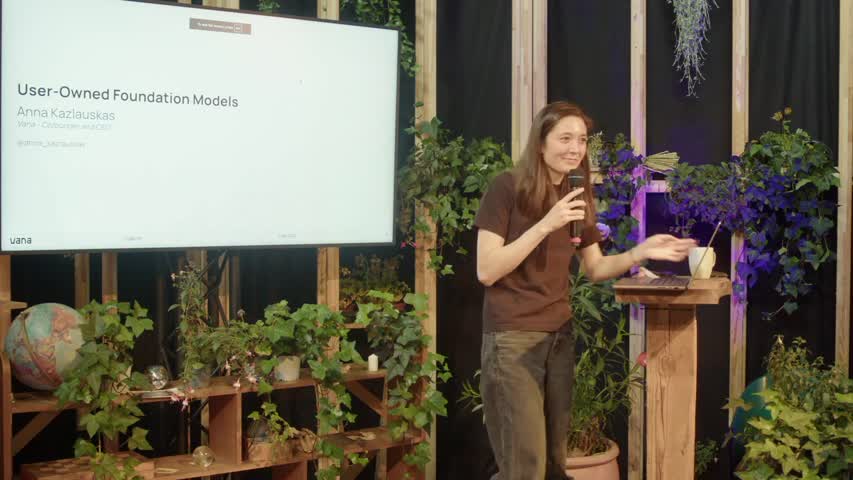
25:14User-owned Foundation Models
ZuBerlinJun 18, 2024
Clip The video focuses on the development of user-owned foundation models in AI, particularly in the context of the speaker's work at Vana. It begins with a discussion on why controlling AI is powerful, citing examples of AI-generated content that could shape perceptions of truth. The talk then delves into the creation of AI models using public data and highlights the challenges faced due to limited publicly available data. The speaker discusses how users legally own their data and proposes that if a large number of users pooled their data, it could be used to train competitive AI models. They provide calculations to show that user-generated data could surpass the amount used in current frontier models and suggest that decentralized compute resources, like those from cryptocurrency miners, could be mobilized for training these large-scale models. The video also touches on financial incentives for contributing high-quality data and covers various methods for ensuring data quality and authenticity. It explores governance issues around user-owned models, including how contributors might be compensated and how usage rules could be set collectively. Finally, the speaker encourages actions such as building data liquidity pools, integrating advanced privacy frameworks, running validators to check data quality, and supporting federated machine learning approaches. The overarching theme is empowering users to contribute to and control AI models as an alternative to relying on big tech companies' leftovers